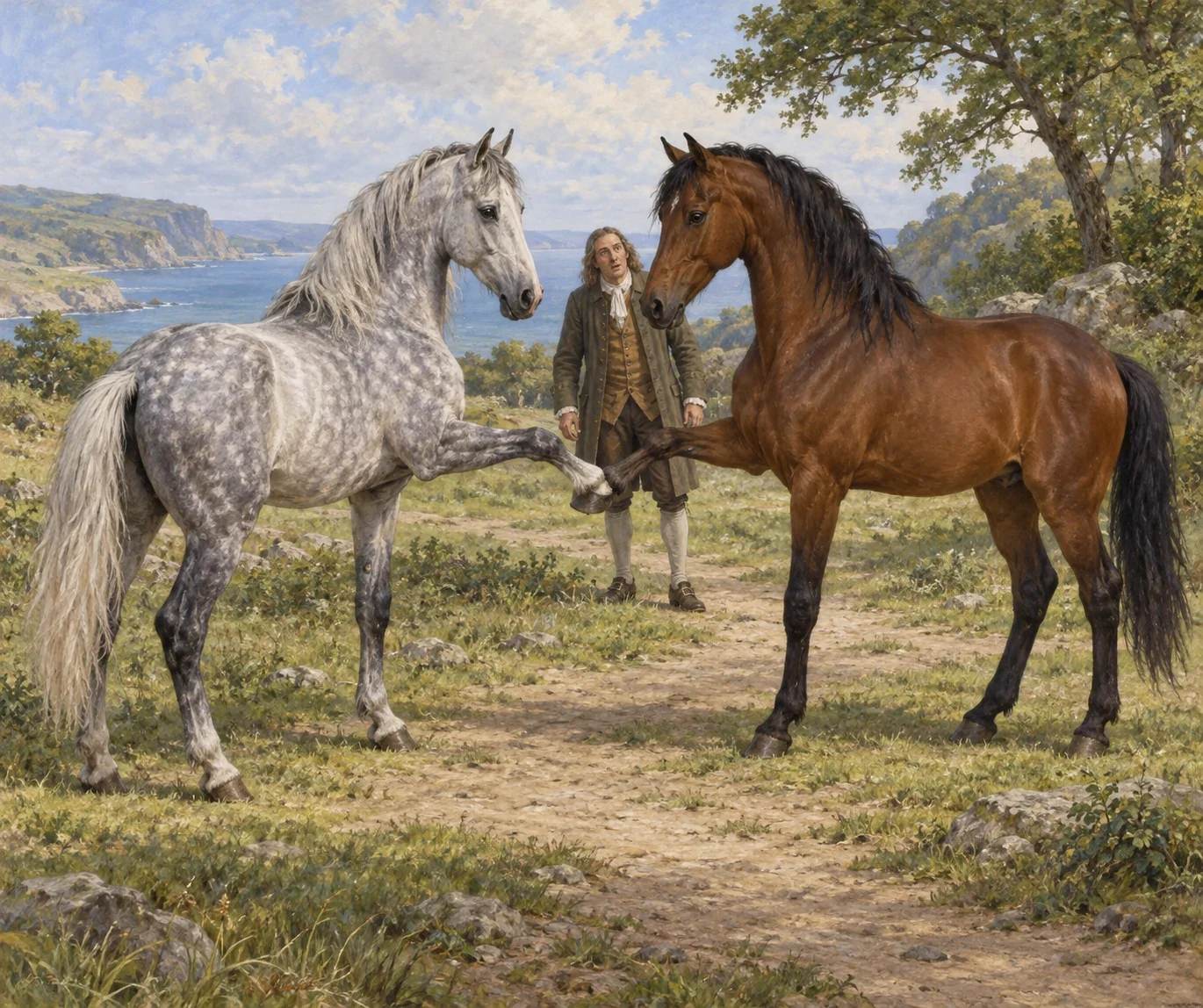
Modern AI interpretation of a dapple-gray and brown-bay Houyhnhnm touching right forehooves in greeting while Gulliver watches. Equine bodies and greeting follow the selected passage; composition and fine features are imagined.
Modern AI interpretation of a dapple-gray and brown-bay Houyhnhnm touching right forehooves in greeting while Gulliver watches. Equine bodies and greeting follow the selected passage; composition and fine features are imagined. Full-frame display derivative; no upscaling.
Overview
The Houyhnhnms are the rational, speaking horses encountered in Gulliver’s fourth voyage. His first hosts are a dapple-gray horse and a brown bay. They exchange an articulate sequence of neighs, touch their right forehooves in greeting and inspect the unfamiliar traveller’s hands, hat and clothing. Gulliver initially mistakes them for transformed magicians, because he expects people rather than horses to govern a country. Their conduct gradually overturns that expectation without turning their bodies into human-shaped beings.
Their domestic arrangements are also equine. Gulliver enters a low, straw-roofed timber-and-wattle house with a smooth clay floor, a rack and a manger. Horses answer one another and perform household business there. The selected passages therefore support a society with language, buildings and deliberation, while retaining horse bodies and hooves. A modern illustration of the first greeting can identify the gray and bay hosts through their attested colours and hoof gesture, without adding human hands, saddles or ceremonial clothing.
Gulliver reports that their central maxim is to cultivate reason and be governed by it. He describes friendship and benevolence as extended throughout their race, with strangers welcomed like neighbours. Young animals of both sexes receive lessons in temperance, industry, exercise and cleanliness. These are the narrator’s admiring judgments, not independently verified conclusions. The same account distinguishes noble families from an inferior servant class, gives them different breeding limits and treats partner selection as a means of preserving desired qualities.
Their representative council meets every fourth year to review resources and population needs across districts. Yet their orderly deliberation also includes whether the human-like Yahoos should be exterminated. Gulliver’s master proposes preventing the Yahoos from reproducing, drawing on the traveller’s explanation of castration. This episode prevents the reported benevolence from becoming an unqualified description of universal kindness. The selected society combines articulate reason, coordinated provision and exclusionary power; its literary presentation depends on Gulliver’s perspective and on the disturbing contrast between the horses’ self-image and their treatment of others.
First appearances & development
Jonathan Swift places this subject in Gulliver’s Travels. The retained primary edition identifies its original publication as 1726–7; the account is narrated by the fictional traveller Lemuel Gulliver.
Canon & continuity
Retained original narrative passages support the selected account. Gulliver’s descriptions and judgments remain attributed to the fictional narrator; they are not reports about an actual people or animal species.
Selected bibliography
Documented works and useful reading. This is not a list of every appearance.
- 01
Gulliver’s Travels into Several Remote Nations of the World
Selected primary passages: Part II chapter II for Glumdalclitch; Part IV chapters I, II, VIII and IX for the Houyhnhnms.
Family & connections
A source-supported family tree or inspiration record has not yet been compiled for this profile. Related reading below indicates a connection in subject matter, not a proven lineage or creative influence.
References
Sources supporting this profile. Linked pages have their own scope and editorial standards.
- PrimaryGulliver’s Travels — primary literary textResearch access: 2026-10-11
- CustodialProject Gutenberg ebook 829 — edition and rights recordResearch access: 2026-10-11
Image credits
Unofficial modern AI interpretationModern AI interpretation of a dapple-gray and brown-bay Houyhnhnm touching right forehooves in greeting while Gulliver watches. Equine bodies and greeting follow the selected passage; composition and fine features are imagined.
Modern AI interpretation of a dapple-gray and brown-bay Houyhnhnm touching right forehooves in greeting while Gulliver watches. Equine bodies and greeting follow the selected passage; composition and fine features are imagined. Full-frame display derivative; no upscaling.