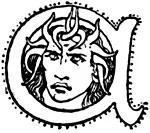
Batten: horned woman chapter initial
Named Horned Women chapter initial depicts a woman with upward horns; one artist representation of the company, not a universal anatomical claim. John Dickson Batten (1860–1932) credited by title page. 1892 first publication; selected impression undated.
Overview
The first visitor identifies herself as the Witch of One Horn and begins carding wool. Successive arrivals carry spinning equipment and bear increasing numbers of forehead horns, until twelve women with one through twelve horns work together beside the fire. Their speed and collective chanting accompany a spell that prevents the mistress from moving or calling for help. They then demand a cake and send her to collect water in an unsuitable vessel. The well’s voice offers assistance and a warning that draws the women away to their named home at Slievenamon.
The woman learns that the intruders have drawn blood from her sleeping family and incorporated it into their work. Following the well spirit’s help, she restores the sleepers and prevents the women’s return. When the witches call upon household materials to admit them, the door, water and cake answer that they cannot comply. The intruders flee through the air, cursing the spirit. The narrator also claims that a dropped mantle remained with the family for five centuries; this is part of the legend’s asserted memory, without independently inspected heirloom provenance. The group’s graduated horns are specific to Lady Wilde’s selected account: Jacobs notes a similar earlier version lacking that prominent feature.
Origins & earliest records
Jacobs explicitly selects the first story in Lady Wilde’s Ancient Legends and compares other printed variants, including one without horns. The inspected 1892 adaptation establishes the named Slievenamon association and distinctive group appearance; it does not date a continuous five-century family tradition from independent records.
Records & interpretation
The horns, immobilising spell and speaking materials are narrative evidence from a published legend. The claimed inherited mantle lacks an independently examined object history here. The account does not identify actual textile workers or establish a real population of horned women.
In the literature
“the first with one horn, the last with twelve horns”
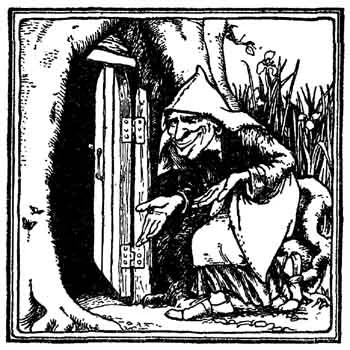
THE HORNED WOMEN; The assembled twelve visitors
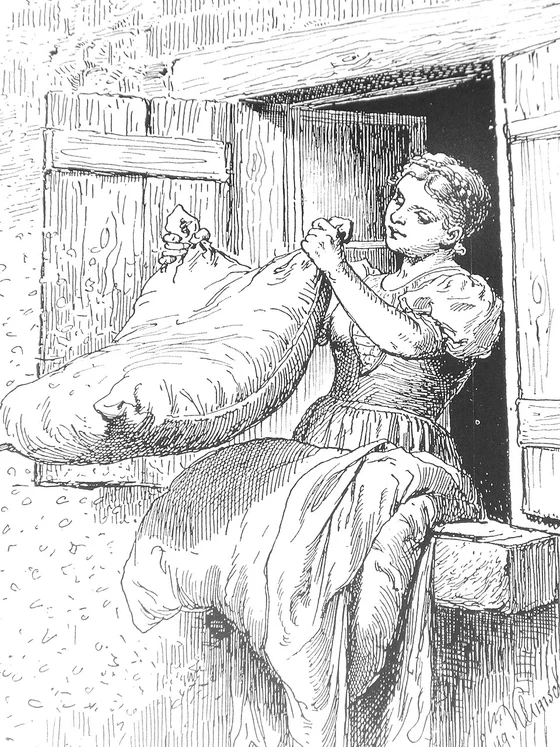
Successive women enter a household carrying textile tools, with horns increasing from one to twelve. They work with alarming speed and immobilise the mistress by a spell, then compel a cake and an impossible water-carrying task. No separate individual biographies are supplied.
Selected bibliography
Documented works and useful reading. This is not a list of every appearance.
- 01
Celtic Fairy Tales: The Horned Women
Complete selected episode and source note inspected; the preface explicitly admits altering and combining translated sources.
- 02
Celtic Fairy Tales — The Horned Women
Joseph Jacobs, Celtic Fairy Tales, PG7885 selected undated print/transcription; numbered tale and observed heading anchors used. Earlier collection publication and underlying witness dates do not establish this print’s date. Source notes openly record borrowing and adaptation; no guessed printed pages.
Family & connections
A source-supported family tree or inspiration record has not yet been compiled for this profile. Related reading below indicates a connection in subject matter, not a proven lineage or creative influence.
Located primary passages
Specific passages supporting details in this entry, grouped by their published witness.
Celtic Fairy Tales — The Horned Women
Joseph Jacobs, Celtic Fairy Tales, PG7885 selected undated print/transcription; numbered tale and observed heading anchors used. Earlier collection publication and underlying witness dates do not establish this print’s date. Source notes openly record borrowing and adaptation; no guessed printed pages.
- Successive women enter a household carrying textile tools, with horns increasing from one to twelve. They work with alarming speed and immobilise the mistress by a spell, then compel a cake and an impossible water-carrying task. No separate individual biographies are supplied.
THE HORNED WOMEN; Twelve working visitors and compelled mistress
- A well spirit helps the mistress deceive the women into fleeing to Slievenamon. Following further protective directions, the woman secures the house and restores her sleeping family. The returning visitors cannot gain admission, curse the helper and leave; a dropped mantle becomes the family’s claimed heirloom. No ritual formula is reproduced here.
Complete selected body and corresponding source note read. Underlying cited manuscripts, periodicals and local physical traces remain indirect. No verse, prayer or ritual formula excerpts; changeling injury is described solely as a historical narrative event.
Primary source witness
Joseph Jacobs, Celtic Fairy Tales, PG7885 selected undated print/transcription; numbered tale and observed heading anchors used. Earlier collection publication and underlying witness dates do not establish this print’s date. Source notes openly record borrowing and adaptation; no guessed printed pages.
- Jacobs names the first tale in Lady Wilde’s Ancient Legends as his source. He compares related fire-alarm and textile tales but expressly finds some proposed parallels weak. These comparisons do not establish a single universal horned-woman tradition.
Verifies the compiler’s stated transmission. Historical speculations and exact earliest-attestation claims are not adopted.
References
Sources supporting this profile. Linked pages have their own scope and editorial standards.
- Primary textJacobs, Celtic Fairy Tales: The Horned Women and source noteResearch access: 2026-10-05
Image credits
Historical illustrationBatten: horned woman chapter initial
Named Horned Women chapter initial depicts a woman with upward horns; one artist representation of the company, not a universal anatomical claim. John Dickson Batten (1860–1932) credited by title page. 1892 first publication; selected impression undated.