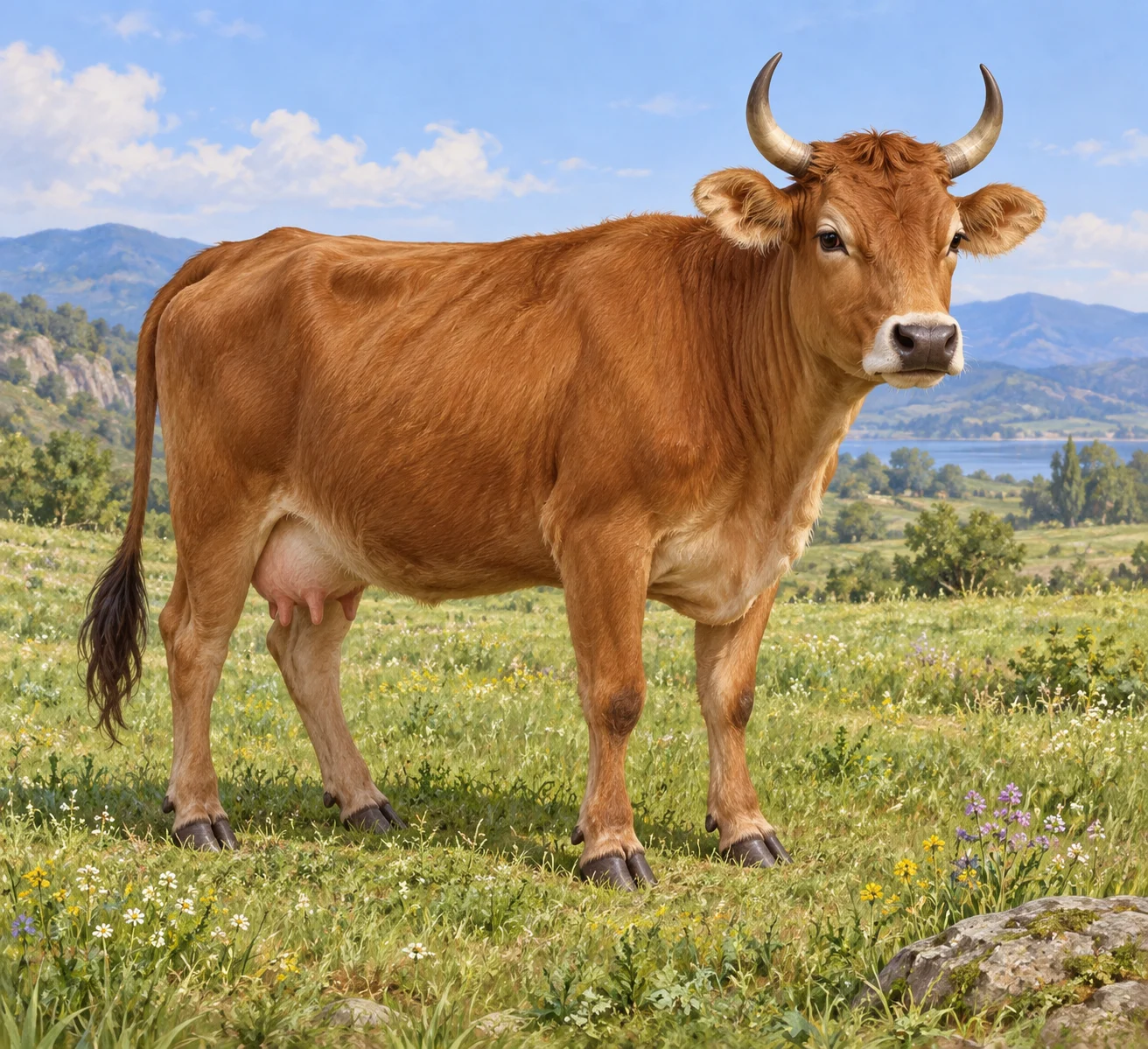
AI-generated reconstruction of Conkiajgharuna’s helpful cow before its death.
The cow’s speech, two provisioning horns and foreknowledge are textual. Exact coat, proportions, horn shape and field appearance are imagined; no biological breed or transparent horn anatomy is asserted.
Overview
Conkiajgharuna, whose name is glossed as the little girl in rags, loses her mother and is mistreated by her stepmother. Sent out to tend the cow, she must eat from a loaf, share it with travellers and still bring it home whole. The cow hears her crying and asks what troubles her. It reveals that one horn contains honey and the other butter, which she may take. The girl becomes well fed despite the impossible bread demand. The narrative therefore gives the animal speech and two provisioning horns, but does not identify a breed, coat colour or exact horn shape.
The cow later runs onto a roof, leading the girl to lose her spindle and enter the house of an old woman identified as a devi. Conkiajgharuna treats her kindly and receives directions to a spring that makes her hair and hands golden. When the stepsister follows the cow onto the roof and treats the same woman rudely, the visit ends in a different transformation. These rewards and punishments belong to the devi and the springs; the cow is not said to carry them out itself. A printed note explains that some houses in the Caucasus are built into the ground, making it possible to walk onto a roof. No flying-cow anatomy is required by the episode.
Blaming the cow for her daughter’s misfortune, the stepmother resolves to have it killed. The text explicitly says that the cow knows the future. It tells Conkiajgharuna to gather its bones, bury them and call at the grave when she is in trouble, asking for her steed and royal robes. The girl follows these instructions after its death. The tale does not describe the cow’s bodily resurrection, a surviving ghost in bovine form or a continuing herd of such animals. Its help continues through the grave and the preserved instruction.
When the family goes to church, a neighbour and her chickens help Conkiajgharuna with the stepmother’s new impossible tasks. Only then does the girl visit the cow’s grave and call for the promised aid. A horse and beautiful clothes appear, enabling her to go to church splendidly dressed. Later she loses a golden slipper in a stream; the king finds its owner after she pricks him from beneath the basket where her stepmother has hidden her. The marriage concludes the tale, with no further cow appearance. Wardrop’s note compares the story with Cinderella or Tattercoats, but the cow’s horn provisions, foreknowledge and grave instructions belong to this particular telling.
Origins & earliest records
Wardrop places this tale in the Georgian first part of Georgian Folk Tales, published by David Nutt in London in 1894. Her preface identifies the source of Part I as Khalkhuri Zghaprebi, edited by Aghniashvili and published in Tiflis by the Georgian Folklore Society in 1891. The Mingrelian and Gurian parts have separately identified sources and are not treated as interchangeable with this one. The selected English translation supplies no named oral teller for this tale. The earlier Georgian edition and later modern retellings have not been independently consulted.
Records & interpretation
Complete selected English narrative, ending, printed notes and full translator’s preface retained. This is Wardrop’s particular mediated version; source comparisons in her notes remain attributed references.
Selected bibliography
Documented works and useful reading. This is not a list of every appearance.
- 01
Georgian Folk Tales
Complete selected Georgian Part I tale, ending, printed notes and full translator’s preface. Earlier Georgian text and comparative works not independently consulted.
Family & connections
A source-supported family tree or inspiration record has not yet been compiled for this profile. Related reading below indicates a connection in subject matter, not a proven lineage or creative influence.
References
Sources supporting this profile. Linked pages have their own scope and editorial standards.
- Historical English translation of a collected traditional narrativeWardrop 1894 — complete selected narrative and source contextResearch access: 2026-10-18
Image credits
AI-generatedAI-generated reconstruction of Conkiajgharuna’s helpful cow before its death.
The cow’s speech, two provisioning horns and foreknowledge are textual. Exact coat, proportions, horn shape and field appearance are imagined; no biological breed or transparent horn anatomy is asserted.