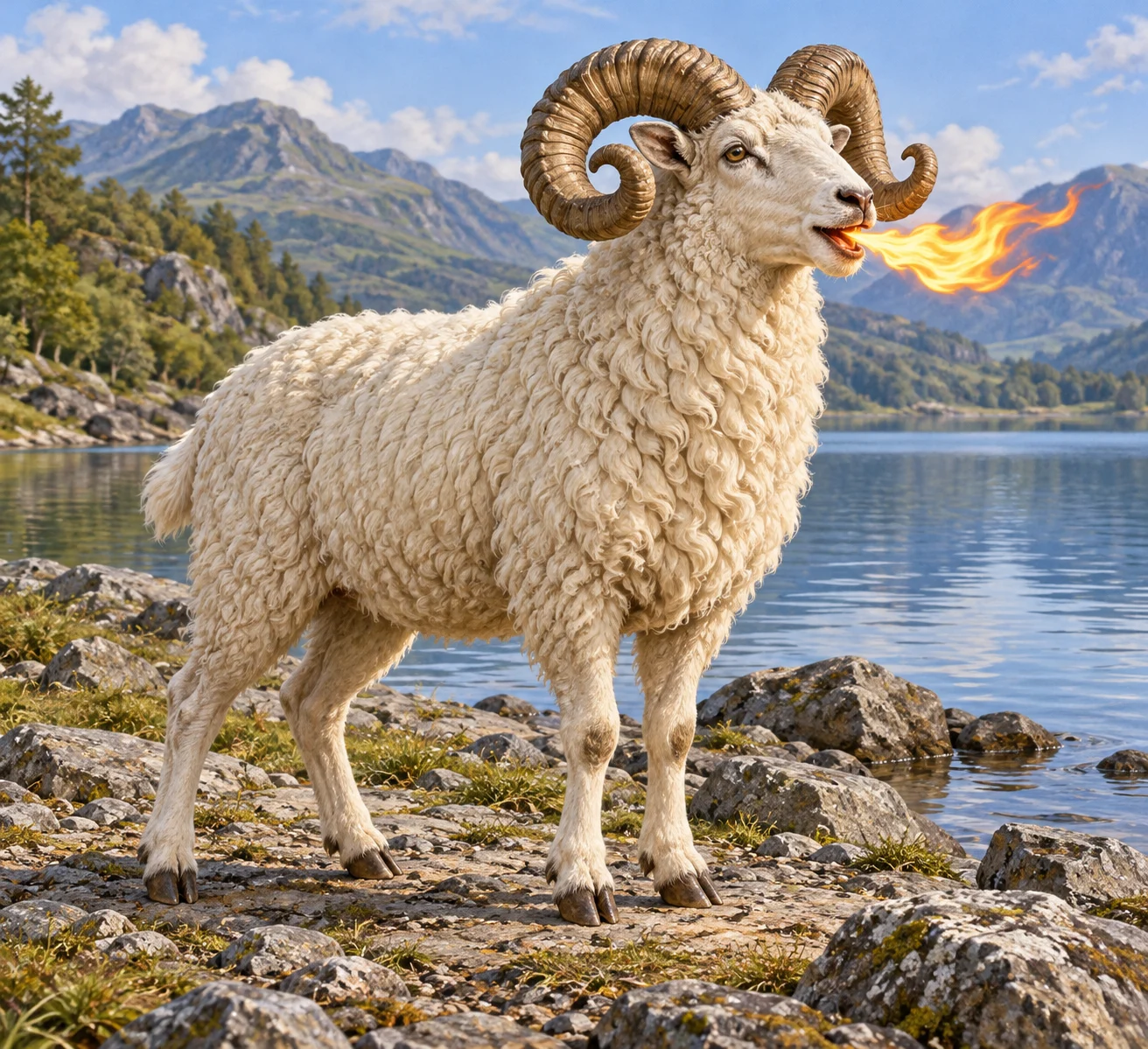
AI-generated reconstruction of the twisted-horn, flame-mouthed ram in The Frog’s Skin.
Twisted horns, mouth-flame and emergence from the lake are textual. Fleece colour, precise sheep anatomy, flame shape and shore pose are imagined; the final casket fire is a different event.
Overview
In The Frog’s Skin, the youngest of three brothers brings home a frog after an arrow falls into a lake. The animal later removes its skin and becomes the woman who secretly keeps his house. He burns the skin despite her warning, and a local lord then tries to take her by setting her husband impossible tasks. She directs him to her parents at the lake for help. Bullocks plough and sow the fields, and jackdaws gather the seed again. The ram appears only in the third task, when the lord demands a ring supposedly taken into the other world by his dead mother. The bullocks and birds are separate helpers, not transformations of the ram.
At his wife’s instruction the husband goes to the lake and asks Mother and Father to lend their ram. It emerges with twisted horns and a flame issuing from its mouth. It speaks, telling him to mount its back, then descends swiftly towards the lower regions and travels through the earth. Those are the explicit distinguishing features of the animal. The telling does not specify fleece colour, hoof design, wings or a fiery body, and it does not explain whether the parents created the ram or merely keep it.
During the journey the traveller sees pairs of people seated on supports that seem oddly suited to them, and a priest whose beard is being eaten by cattle. Each promises an explanation if he returns. At the place of boiling pitch and flame identified as hell, the ram tells him to sit firmly because they must pass through the fire. It leaps across with its rider, and both escape the flames unhurt. The mother of the oppressive lord gives the visitor a closed casket for her son, with instructions to hand it over and run. The narrative does not describe the ram attacking anyone with its mouth-flame.
On the return, the traveller hears the promised explanations: selfish treatment of neighbouring cattle accounts for the priest’s punishment, while the couples’ arrangements reflect their relationships in life. He eventually comes up to earth and dismounts from the ram. He delivers the casket and escapes before the lord opens it; fire from the casket consumes the lord. That final fire is distinct from the ram’s earlier mouth-flame. The husband and wife remain together, and the story ends without narrating another journey or a later fate for the ram.
Origins & earliest records
Wardrop places this tale in the Georgian first part of Georgian Folk Tales, published by David Nutt in London in 1894. Her preface identifies the source of Part I as Khalkhuri Zghaprebi, edited by Aghniashvili and published in Tiflis by the Georgian Folklore Society in 1891. The Mingrelian and Gurian parts have separately identified sources and are not treated as interchangeable with this one. The selected English translation supplies no named oral teller for this tale. The earlier Georgian edition and later modern retellings have not been independently consulted.
Records & interpretation
Complete selected English narrative, ending, printed notes and full translator’s preface retained. This is Wardrop’s particular mediated version; source comparisons in her notes remain attributed references.
Selected bibliography
Documented works and useful reading. This is not a list of every appearance.
- 01
Georgian Folk Tales
Complete selected Georgian Part I tale, ending, printed notes and full translator’s preface. Earlier Georgian text and comparative works not independently consulted.
Family & connections
A source-supported family tree or inspiration record has not yet been compiled for this profile. Related reading below indicates a connection in subject matter, not a proven lineage or creative influence.
References
Sources supporting this profile. Linked pages have their own scope and editorial standards.
- Historical English translation of a collected traditional narrativeWardrop 1894 — complete selected narrative and source contextResearch access: 2026-10-18
Image credits
AI-generatedAI-generated reconstruction of the twisted-horn, flame-mouthed ram in The Frog’s Skin.
Twisted horns, mouth-flame and emergence from the lake are textual. Fleece colour, precise sheep anatomy, flame shape and shore pose are imagined; the final casket fire is a different event.