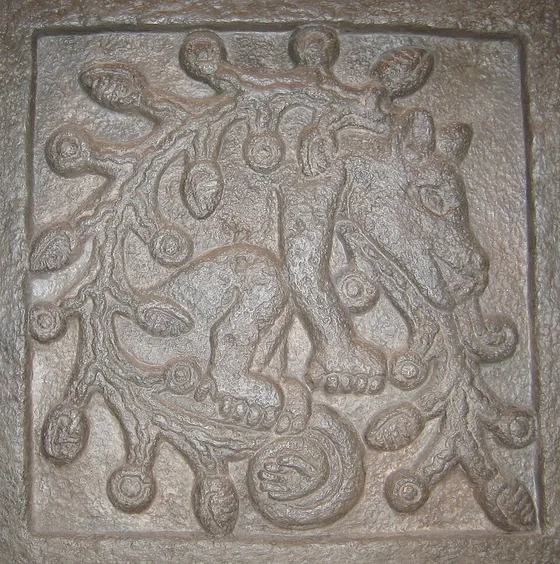
A sourced illustration has not yet been added. This gap is included in the coverage record.
Overview
Walter Roth used the historical spelling Warrau for the Warao people whose accounts he recorded along the Moruca River. His chapter distinguishes sea-associated Ho-inarau or Ho-aránni from river-associated Naba-rau or Naba-ranni, while its narratives also place Ho-aránni encounters in river travel. These beings may appear like people or fish. Roth records a Moruca piai's explanation that a macaw can call a Ho-aránni to overturn a canoe and kill its occupants, sometimes helping with the destruction itself. An account of former friendship between water and land people describes intermarriage followed by a breakdown in their relationship. Thus the hostile being in the swallowing story belongs to a larger range of relationships with water people. Another complete Warao account, How Sickness and Death Came into the World, begins with a fisherman asking for a wife from the water people. She takes him to her father's submerged house, securing the canoe with a live snake and offering a living alligator as a seat. Her father requests the man's sister in marriage to his son. The wife later warns that sending her to the community's separate menstrual house will kill her. Other women insist on that separation, and she dies. Her father blames the broken condition and declares that sickness, accidents and death will now afflict the land people. When the bereaved man later travels to sea with companions in two canoes, the underwater people see the vessels as birds overhead, shoot them down and release their kept sharks to tear the occupants' bodies. This marriage-and-reprisal account is separate from the piai's belly ordeal.
In the complete tale printed as the piai in the water spirit's belly, fishermen vanish from a particular stretch of river. A piai's son investigates and is taken too. The father approaches in a dugout carrying shelter posts, firewood and fire; the waiting spirit swallows boat and contents. Inside its dark belly, the piai lights the fire and drives six shelter poles into the flesh. The suffering Ho-aránni consults three other piais, but none can cure it. As it returns and gasps above water, the captive looks out: first he sees open sea, then distant vegetation, then recognizable trees. At the next surfacing he pushes his canoe through the jaws and escapes. The ending is costly. He reaches his wife with his hair falling out from the heat and dies soon afterward. The tale closes by crediting ancestors with destroying many dangerous water spirits.
Origins & earliest records
The directly inspected witness is Roth's 1915 publication, chapter XII, especially sections 177, 179 and 182, pages 241–245. Roth states that he obtained the swallowing tale from Moruca River Warao people. The story's oral history is not dated, and its publication year should not be presented as the tradition's beginning.
Records & interpretation
The macaw explanation, complete swallowing narrative and separate water-spouse account were inspected. Their different actions and endings remain visible: the swallowed piai escapes but dies, whereas broken marriage conditions precede collective retaliation in section 190. The latter describes a historical narrative about menstrual separation; it is not a statement of modern Warao practice or a medical explanation.
In the literature
“And he did die soon”
Section182, printed p.245
This refers to the escaping human piai, not an explicitly narrated final death of Ho-aránni.
Selected bibliography
Documented works and useful reading. This is not a list of every appearance.
- 01
An inquiry into the animism and folk-lore of the Guiana Indians
Chapter XII, sections 177, 179 and 182, pp. 241–245, and complete section 190, How Sickness and Death Came into the World, pp. 250–251. Distinct Moruca swallowing and Warao marriage/reprisal narratives.
Family, evolution & connections
The water-spirit family in Roth’s section 190
Roth’s historical English translation of the Warao tale How Sickness and Death Came into the World, section 190, pp. 250–251.
Scroll sideways to see all branches. With a keyboard, focus the tree and use the arrow keys.
- Unnamed water-spirit father
- Unnamed water-spirit daughter (the fisherman’s wife)
- Unnamed water-spirit son (proposed bridegroom)
The householder calls the fisherman’s wife his daughter and another individual his son. Only those stated parent–child relations form the branching tree. Unnamed story participants are not universal ancestors of Ho-aránni. No mother is stated. The human husband is an affinal relation, not a child, and the requested second marriage is not shown completed. The tale’s sickness explanation is preserved as narrative testimony, not medical causation or a statement about all contemporary Warao beliefs.
Unnamed water-spirit father and daughter in Roth section 190
The submerged householder expressly calls the water-spirit wife his daughter. This is the family of one Warao tale in Roth’s historical translation, not parentage assigned to every Ho-aránni.
Unnamed water-spirit father and son in Roth section 190
The same householder calls another individual his son while requesting a reciprocal marriage. The father–son relationship is explicit; fulfillment of the proposed marriage is not narrated.
Water-spirit daughter and son in Roth section 190
The wife and the proposed bridegroom share the expressly stated water-spirit father. Their mother is not named, so full versus half siblinghood is unresolved.
Water-spirit wife and human fisherman in Roth section 190
The tale identifies the water-spirit daughter as the fisherman’s wife and her father as his father-in-law. This is narrative kinship, not evidence for biological relations between humans and water spirits.
Located primary passages
Specific passages supporting details in this entry, grouped by their published witness.
An inquiry into the animism and folk-lore of the Guiana Indians
Washington, D.C.: U.S. Government Printing Office,1915; selected Cornell scan. Catalogue year independently checked; field preface dated Pomeroon,June1913.
- Roth describes distinct Warao water-spirit categories and records a Moruca contributor’s explanation that a macaw tells Ho-aránni to overturn boats and may assist. Sea and river distinctions and the attributed rupture of former human friendship remain source-specific.
- After the spirit takes his son, the piai deliberately lets it swallow his boat, shelter rods, fire and wood. His actions inside cause pain that three consulted healers cannot relieve. He escapes when the returning spirit surfaces, but dies after reaching his wife because of the internal heat. The son’s rescue is not stated.
Section182, printed pp.244–245, The Piai in the Water Spirit’s Belly; complete episode
Unnamed historical contributor; no present-day universal Warao doctrine implied. Actualsection182 visually checked despite OCR183. Spirit’s doom is announced by a healer, but its final death is not separately narrated; the human’s death is explicit.
References
Sources supporting this profile. Linked pages have their own scope and editorial standards.
- ResearchRoth 1915: Warao water-being names, Moruca swallowing tale and water-spouse reprisalResearch access: 2026-10-05
- ResearchGlottolog: im Thurn's Guiana bibliography and historical language namesResearch access: 2026-10-05
Image credits
A sourced illustration has not yet been added. This gap is included in the coverage record.