Warwick Goble’s Hiraman parrot perched beside the king on the flying Pakshiraj
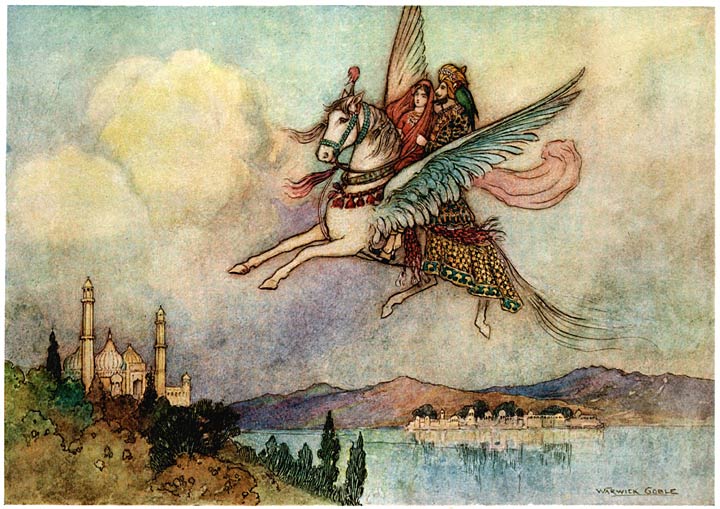
The small green parrot beside the king is Hiraman in Goble’s 1912 illustration of Day’s named return scene. The king, woman and bird travel home on the Pakshiraj. This narrative individual is not identified here as a modern zoological species.
Overview
A captured hiraman persuades the fowler to sell it to a king rather than kill it, and names its own high price. It converses intelligently and recites divine names, becoming the king’s constant companion. When his neglected queens threaten it, it escapes through a water-passage. Its report leads to their expulsion, an act of the king rather than an inherent effect of the bird’s voice.
The parrot identifies a neglected pakshiraj horse, supervises its recovery and helps the king cross distant seas. It lays a trail of silver grains to draw a woman from her palace, enabling her abduction. When the king later loses his sight and the woman is taken by another ruler, the bird feeds him and reconnects with her through the food she leaves for birds.
It obtains the droppings of bihangama and bihangami nestlings, which restore the king’s eyes in the story, and reunites the party for their return. That cure is a narrative event, not eye-care advice. Day’s note quotes Carey’s dictionary for a historical parrot name and scientific label; it does not establish the modern species identity of this extraordinary fictional individual.
Origins & earliest records
Bengali oral storytelling translated by Lal Behari Day
Records & interpretation
Complete relevant tale, attached notes,1883 preface and1912 edition credits directly read.
Selected bibliography
Documented works and useful reading. This is not a list of every appearance.
- 01
Folk-Tales of Bengal
XVI, The Story of a Hiraman, pp.200–210, notes1–3; first edition1883, illustrationsWarwickGoble
Family & connections
A source-supported family tree or inspiration record has not yet been compiled for this profile. Related reading below indicates a connection in subject matter, not a proven lineage or creative influence.
Primary records and illustrations
Lal Behari Day, Folk-Tales of Bengal (Macmillan,1912; first edition1883)
XVI. XVI, The Story of a Hiraman, pp.200–210, notes1–3
Complete tale and footnotes read, pluspreface andeditionhistory. Bengali oral informants described collectively, individual teller of this tale not identified. Original paraphrase; no source-image verification claimed.
References
Sources supporting this profile. Linked pages have their own scope and editorial standards.
- Historical translated oral narrative and collector notesLal Behari Day, Folk-Tales of Bengal (1912), XVI, The Story of a Hiraman, pp.200–210, notes1–3Research access: 2026-10-05
Image credits
Historical illustrationWarwick Goble’s Hiraman parrot perched beside the king on the flying Pakshiraj
The small green parrot beside the king is Hiraman in Goble’s 1912 illustration of Day’s named return scene. The king, woman and bird travel home on the Pakshiraj. This narrative individual is not identified here as a modern zoological species.