
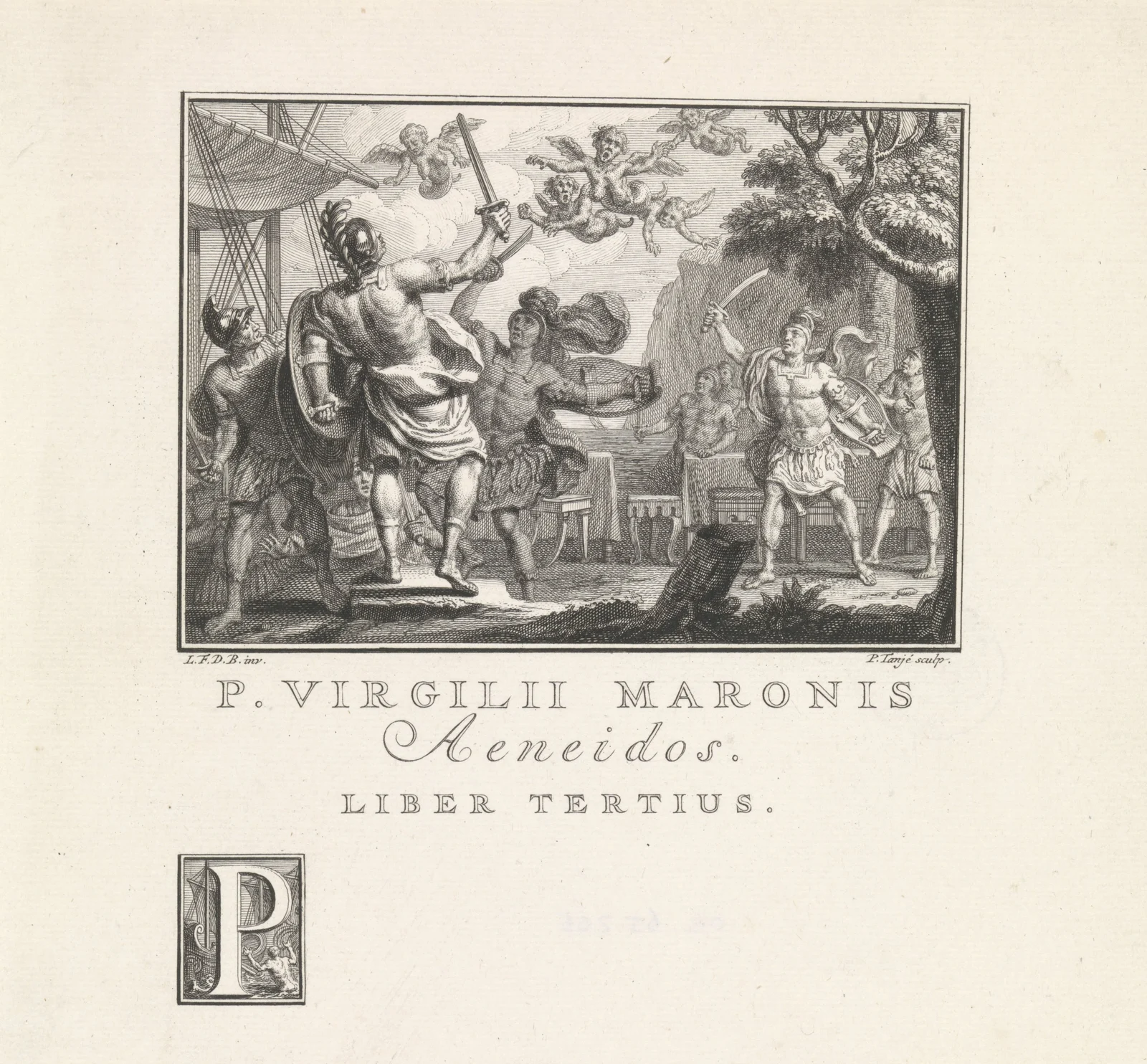
Aeneas and armed companions raise swords toward winged, human-faced Harpies above their meal beside a ship, in an eighteenth-century engraving.
Pieter Tanjé’s 1746 illustration for Book III of Virgil’s Aeneid shows the unsuccessful attempt to strike the Harpies on the Strophades.
Overview
Hesiod’s Theogony 265–269 places the Harpies in a divine genealogy: Thaumas and Ocean’s daughter Electra are parents of Iris and the long-haired Aello and Ocypetes. Their wings keep pace with winds and birds, and speed defines this brief notice. It does not supply Virgil’s later detailed grotesque anatomy or a Phineus episode. The Greek names and the English translation’s explanatory storm and flight glosses identify these figures without making every later name list identical.
In Apollonius’ Argonautica 2, Phineus loses food as punishment for revealing Zeus’s purposes too completely. The Harpies swoop with crooked beaks, seize provisions from his mouth and hands, and contaminate what little remains with intolerable smell. Zetes and Calais pursue them with strength imparted by Zeus, but Iris forbids their killing and promises that they will no longer approach Phineus. The pursuers turn back at islands thereafter called Strophades, while the Harpies retire to a Cretan den. The returning heroes report their success and Phineus can eat, although his blindness remains. Relief from the food torment is therefore not a general cure of all his afflictions.
Library 1.9.21 gives winged female creatures and the same food deprivation but explicitly records alternatives. It offers different causes of Phineus’s blindness, variant Harpy names, and a pursuit in which one falls into a Peloponnesian river while another reaches the Echinadian islands exhausted. The compiler then contrasts Apollonius’s unharmed retreat after an oath. These competing outcomes belong to the ancient account itself; they should not be flattened into either a universal slaughter or a single agreed escape route.
Virgil’s Aeneid 3 locates Celaeno and the others on the Strophades after their exclusion from Phineus’s house. Aeneas describes bird bodies with maiden faces, clawed hands, gaunt hunger and defiling excrement. They repeatedly raid the Trojans’ meals. Swords fail to wound their backs or feathers, and Celaeno warns that the travellers will reach Italy but face hunger sufficient to eat their tables before securing their city. She speaks as a prophetic authority and accuses the Trojans of attacking after slaughtering the island’s cattle. The frightened company seeks divine protection and leaves. This Roman encounter adds speech, invulnerability and a specific hostile prophecy; it does not turn the earlier speed-and-genealogy notice into an identical scene.
Origins & earliest records
The profile compares located literary passages rather than assigning one original account to the entire tradition. It uses Evelyn-White’s Hesiod, Seaton’s Apollonius, Frazer’s Library and Fairclough’s Virgil translations, each identified on its hosted primary-text page.
Records & interpretation
Theogony 265–269; Argonautica 2.178–300 and 426–465; Library 1.9.21; Aeneid 3.209–277. The sources differ in names, anatomy, destination and pursuit outcome.
Selected bibliography
Documented works and useful reading. This is not a list of every appearance.
- 01
Theogony 265–269
Genealogy and winged speed.
- 02
Argonautica 2.178–300; 426–465
Complete Phineus raid, pursuit, oath, Cretan withdrawal and returning report; blindness remains.
- 03
Library 1.9.21
Complete passage expressly compares variant names and outcomes with Apollonius.
- 04
Aeneid 3.209–277
Complete Strophades encounter and Celaeno’s prophecy through departure.
Family, evolution & connections
Hesiod’s Harpies and Iris — Theogony 265–269
The complete Thaumas–Electra household passage, Theogony 265–269, Evelyn-White translation.
Scroll sideways to see all branches. With a keyboard, focus the tree and use the arrow keys.
- Thaumas and Electra (joint parents)
- Iris, named sibling
Explicit named joint parentage and three individually named children. Aello and Ocypetes represent this text’s Harpy pair; no later added Harpy names or descendants are imported. Iris is a separate sibling. Birth order is unstated, and no natural bird genealogy is implied.
Electra, daughter of Ocean
Electra bears Thaumas the named Harpies Aello and Ocypetes, together with Iris. This is the parentage of the sisters in this passage, not a universal genealogy for every later creature called a harpy.
Thaumas
Hesiod names Thaumas as Electra’s husband and as the father to whom she bears Iris and the two Harpies. No additional Harpy daughter is supplied in this short genealogy.
Iris
Iris and the two named Harpies are listed as children of Thaumas and Electra. Iris remains a distinct named sibling, not an additional Harpy merely because she shares their parents.
Ocean, Electra’s father
The passage explicitly calls Electra the daughter of Ocean. The maternal-grandfather relation follows her stated parentage and her motherhood of the Harpies; no mother of Electra is added from outside these lines.
References
Sources supporting this profile. Linked pages have their own scope and editorial standards.
- Primary literary translationHesiod: Harpy genealogyResearch access: 2026-10-05
- Primary literary translationApollonius: Phineus encounterResearch access: 2026-10-05
- Primary literary translationLibrary: recorded Harpy variantsResearch access: 2026-10-05
- Primary literary translationVirgil: Strophades encounterResearch access: 2026-10-05
Image credits
Historical literary illustrationAeneas and armed companions raise swords toward winged, human-faced Harpies above their meal beside a ship, in an eighteenth-century engraving.
Pieter Tanjé’s 1746 illustration for Book III of Virgil’s Aeneid shows the unsuccessful attempt to strike the Harpies on the Strophades.