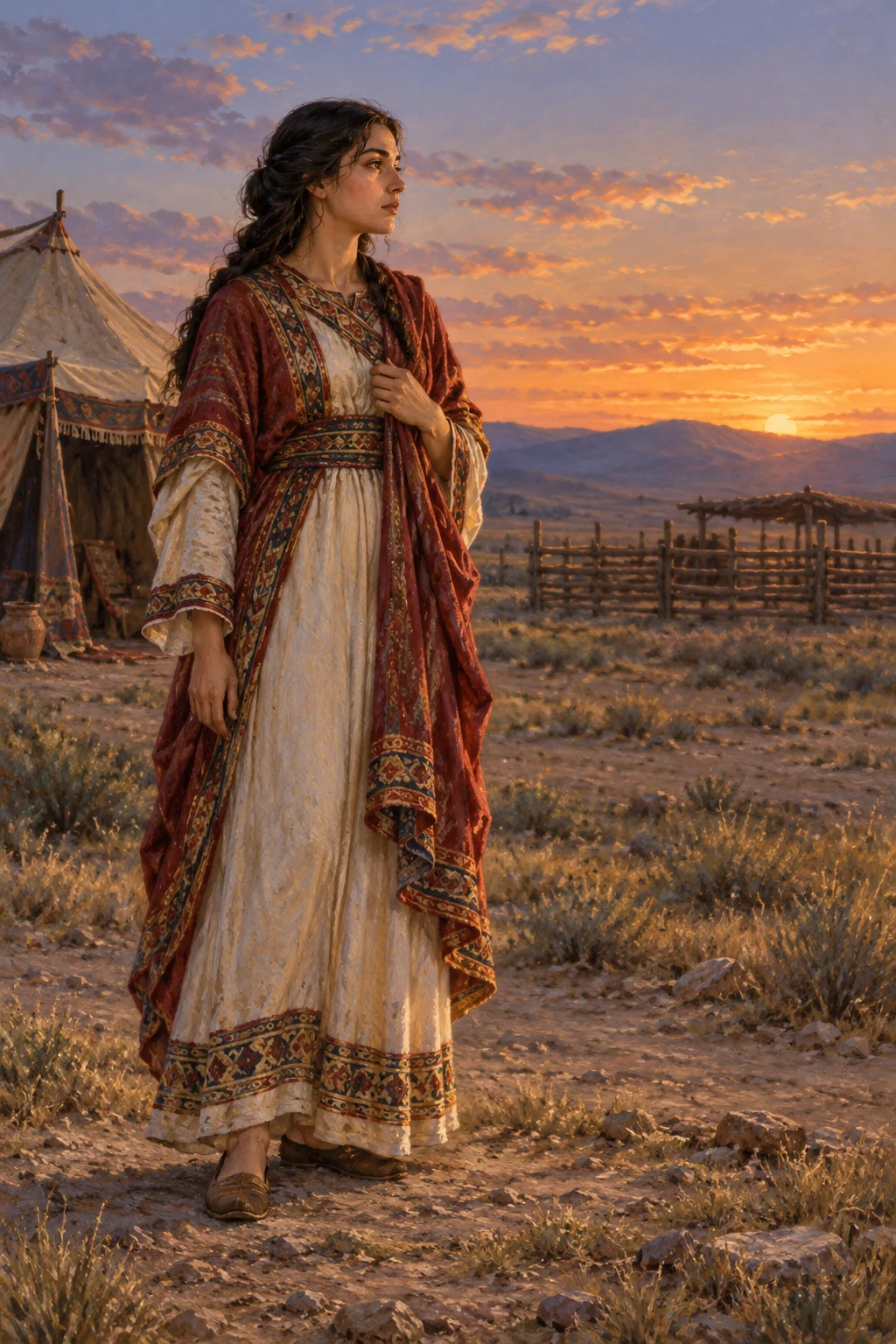
Hani in festive attire near an imagined camp enclosure; appearance, garment design and staging interpretive.
Original narrative illustration; appearance, clothing and staging imagined, not an authenticated portrait or cultural record.
Overview
Hani is named as Mando’s daughter and Murid son of Mubarak’s betrothed. In the editor’s account, Chakur persuades the intoxicated Murid to surrender the betrothal and then marries her. A separate prefatory version makes Chakur’s interest follow a hunting visit in which she gives him a cup of water containing straw. The main ballad begins after Hani and Murid have renewed their association. She has gone out to investigate disturbances among the horses, on the third occasion in festive attire. Chakur’s questions about supposed lightning draw Murid into acknowledging the encounters; Murid’s father then strikes him and demands that he stop. Murid vows to abandon his weapons and fine clothes for a pilgrim’s life.
The ballad later brings the traveller back to the Rind camp. His prowess with an iron bow reveals his identity, and the people place him and Hani together. This does not produce a gentle reunion: he bites her cheek and lips, accuses her of failing him and refuses to leave his companions for her. Hani follows, hoping either to turn him back or obtain a token from his hand. His final answer is a curse directed at Chakur and a declaration that consenting would burden him with sin. The poem ends with that refusal, without narrating a marriage to Murid or confirming a successful reconciliation. Hani’s experience is therefore part of a harsh, divided romance rather than evidence that women were literally transferable possessions or that every later retelling ends in the same way.
Origins & earliest records
Dames’s XXII combines a text from T. M. Mayer’s Baloch Classics with additions from Leech. Its prefatory note also retells an account in J. M’C. Douie’s English Biluchi-nama, which Dames says differs from Hetu Ram’s Urdu edition. These layers explain the ballad rather than supplying a single verbatim telling or a verified life of Hani.
Records & interpretation
Dames XXII, pp.54–57, including both introductory accounts and the complete translated ballad through Murid’s final response. The water-cup episode and the concluding refusal belong to different textual layers identified by the editor.
Selected bibliography
Documented works and useful reading. This is not a list of every appearance.
- 01
Popular Poetry of the Baloches, volume I
London: David Nutt for the Folk-Lore Society; original title dated 1906. English prose renderings with explanatory notes.
Family & connections
A source-supported family tree or inspiration record has not yet been compiled for this profile. Related reading below indicates a connection in subject matter, not a proven lineage or creative influence.
References
Sources supporting this profile. Linked pages have their own scope and editorial standards.
- Historical collected folklore and original English translationDames, Popular Poetry of the Baloches: original English narratives, poems and source notesResearch access: 2026-10-18
Image credits
AI-generatedHani in festive attire near an imagined camp enclosure; appearance, garment design and staging interpretive.
Original narrative illustration; appearance, clothing and staging imagined, not an authenticated portrait or cultural record.