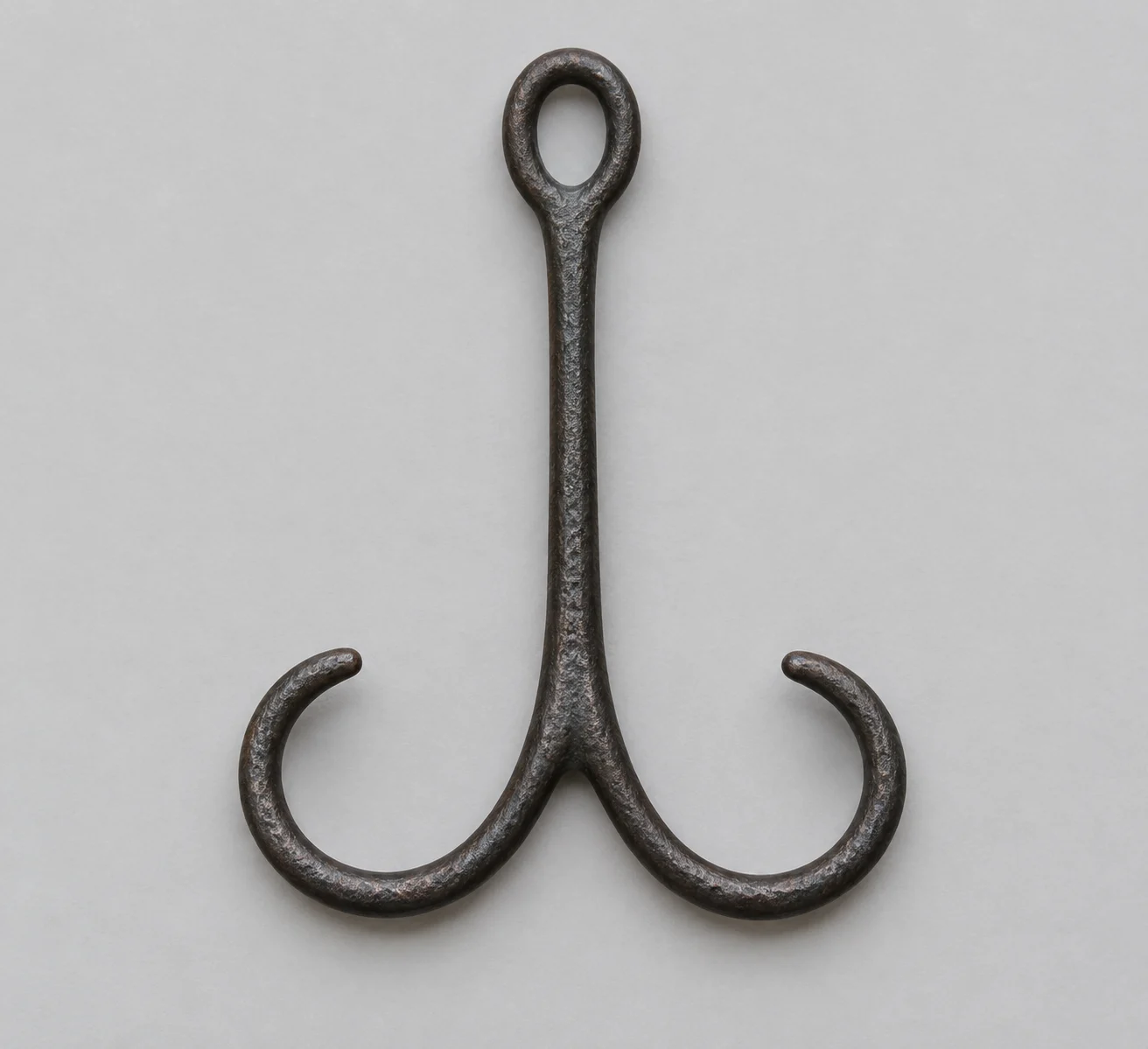
Generated interpretation of a published school-workshop form; not an authenticated specimen or exact replica. Stem proportions differ from the source drawing; this is an interpretation.
Overview
Todd’s hammock chapter offers a hook as an alternative aid for stringing the warp. In the first illustrated design, a closed upper eye narrows into a stem and then spreads into two opposed curls. Their free tips turn inward, leaving open gaps rather than two fully closed lower rings. The instruction nevertheless calls the two sides rings and assigns half of the warp strings to each. The drawing supports this distinctive three-part outline, but does not identify its material, an individual maker or the method of manufacture. It is a tool used during preparation on the loom, rather than a pictured attachment carrying the weight of a person.
The hook appears within a complete classroom hammock project. Todd first explains fastening rings behind the loom and passing the continuous warp back and forth, then describes weaving cords, adding stripes and securing the ends. She introduces the two hook designs as a quicker and easier way to arrange the warp. The second design opens by unpinning one side and is a separate alternative, not another view of the first. Her discussion also includes fringe and headings, and mentions a hammock for Miss Dolly. The selected profile therefore keeps the first hook distinct from the finished miniature textile and from suspension hardware, without turning a historical craft illustration into a load-bearing specification.
History & identity
The manual names Mattie Phipps Todd of the Motley School, Minneapolis, and carries a 1902 copyright. It includes an introduction by Alice W. Cooley, identified as a former supervisor of primary schools in Minneapolis. These are dated printed affiliations; the exact physical printing date is not separately established.
Sources & representation
Complete hammock chapter and its Hook No. 1 drawing, read with the title, full introduction and complete warp-stringing chapter. The whole native drawing was viewed. Exact material, dimensions, fastening to a loom and hidden construction are not established.
Selected bibliography
Documented works and useful reading. This is not a list of every appearance.
- 01
Hand-Loom Weaving: A Manual for School and Home
Rand, McNally & Company, Chicago, New York and London; transcribed copyright 1902. Introduction by Alice W. Cooley. Selected complete chapters on warp stringing, hammocks and classroom projects.
Language & cultural connections
Source-supported language and cultural connections have not yet been compiled for this profile.
References
Sources supporting this profile. Linked pages have their own scope and editorial standards.
- Historical instructional accountHand-Loom Weaving, original instructional manualResearch access: 2026-10-18
Image credits
AI-generatedGenerated interpretation of a published school-workshop form; not an authenticated specimen or exact replica. Stem proportions differ from the source drawing; this is an interpretation.