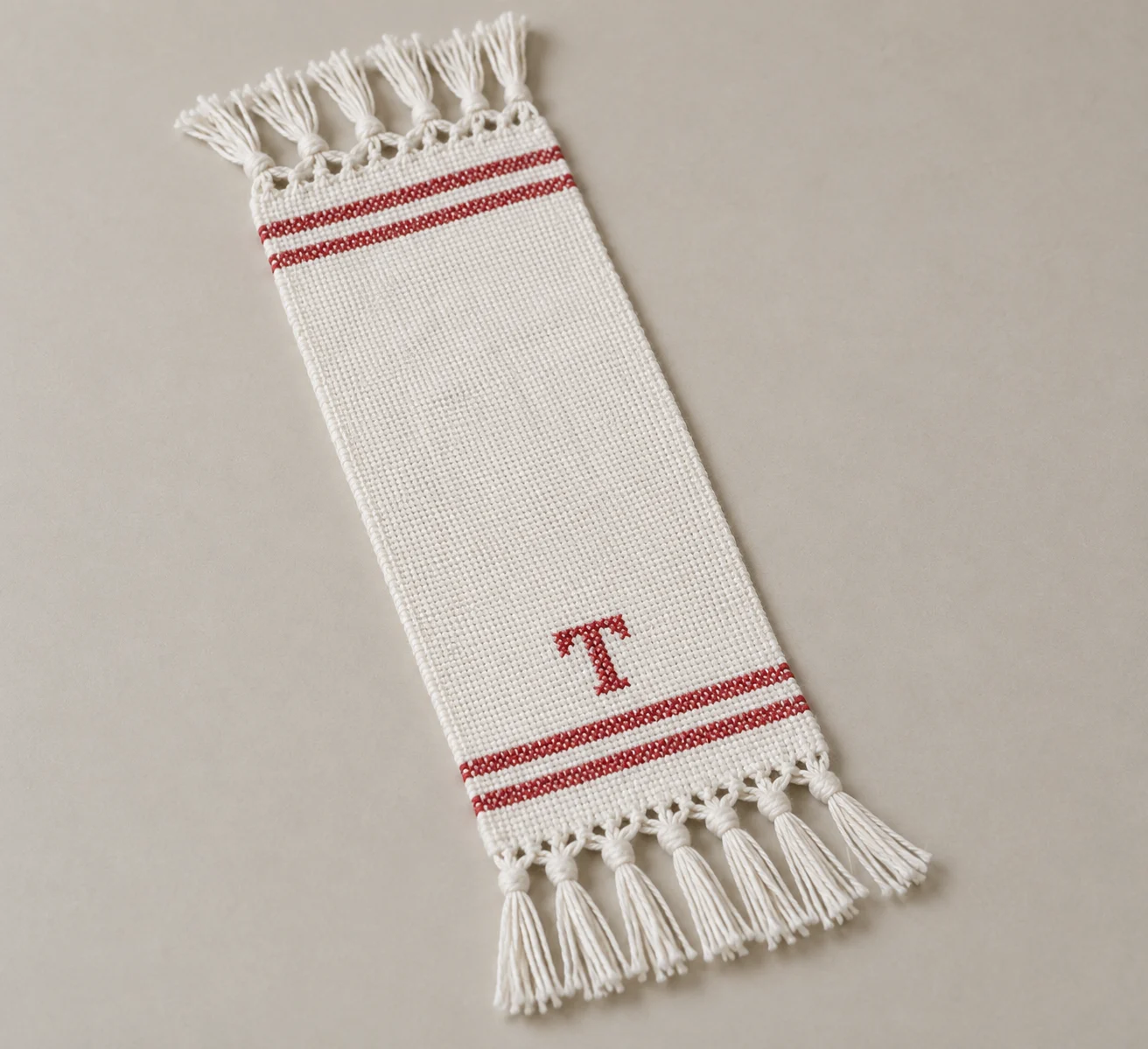
Generated interpretation of a published school-workshop form; not an authenticated specimen or exact replica. The source’s knotted fringe is simplified here.
Overview
Todd’s doll towel is made on the adjustable loom with fine darning cotton in both warp and woof. The warp strings are paired and extended beyond the woven body so that fringe can be knotted at each end. She calls for the woof to be pushed close and smooth, and takes the miniature towel’s proportions from a larger towel rather than prescribing one fixed size. The photographed example is explicitly described as white cotton with red stripes and a red initial. Its long rectangular body has narrow bands near both ends, open knotted fringe headings and loose tassels; the small initial visible above the lower border is a capital T.
The towel belongs to a sequence of projects through which a woven mat becomes a useful or playful household article. Todd proposes planning towel borders with classroom tablets and coloured paper before weaving them, and describes cross-stitching the initial. Nearby projects include blankets, clothing, bags and covers, showing how the manual reuses basic loom methods for different purposes. Its separate fringe discussion explains joining neighbouring strands into knots, rather than treating every fringe as unworked loose warp. This is evidence of Todd’s published school-and-home craft programme, not proof of a standard towel used throughout Minneapolis or of present-day classroom practice. The proposed study shows the complete miniature textile without inventing a doll, a room or a child maker.
History & identity
The manual names Mattie Phipps Todd of the Motley School, Minneapolis, and carries a 1902 copyright. It includes an introduction by Alice W. Cooley, identified as a former supervisor of primary schools in Minneapolis. These are dated printed affiliations; the exact physical printing date is not separately established.
Sources & representation
Complete project paragraph on doll towels, paired-warp instructions, related fringe paragraphs and the complete native towel photograph; read within the full surrounding project chapter. White cotton and red stripes/initial are stated in the prose rather than inferred from the monochrome photograph.
Selected bibliography
Documented works and useful reading. This is not a list of every appearance.
- 01
Hand-Loom Weaving: A Manual for School and Home
Rand, McNally & Company, Chicago, New York and London; transcribed copyright 1902. Introduction by Alice W. Cooley. Selected complete chapters on warp stringing, hammocks and classroom projects.
Language & cultural connections
Source-supported language and cultural connections have not yet been compiled for this profile.
References
Sources supporting this profile. Linked pages have their own scope and editorial standards.
- Historical instructional accountHand-Loom Weaving, original instructional manualResearch access: 2026-10-18
Image credits
AI-generatedGenerated interpretation of a published school-workshop form; not an authenticated specimen or exact replica. The source’s knotted fringe is simplified here.