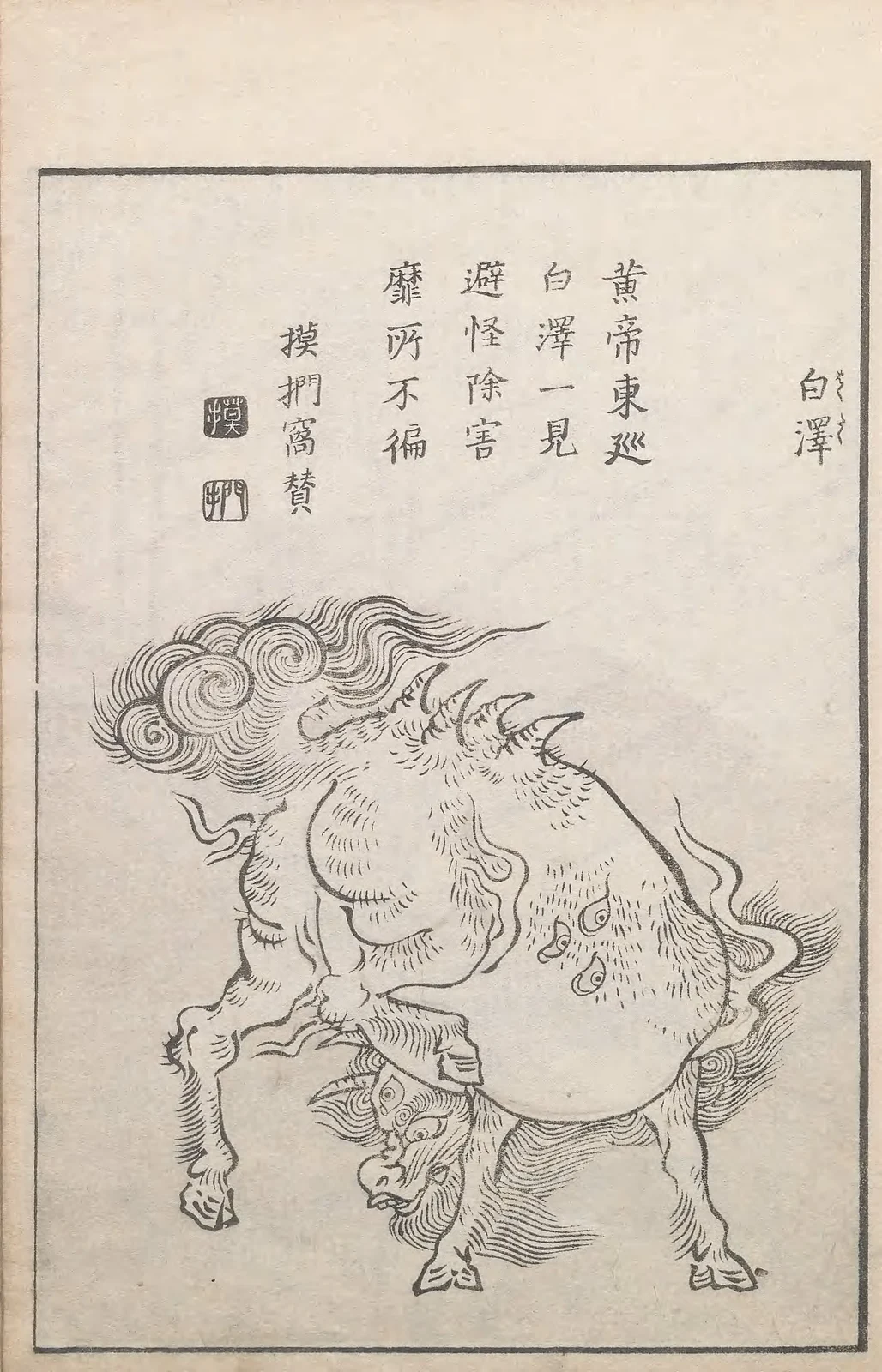
Hakutaku / Bai Ze, named plate by Toriyama Sekien
Printed label 白澤 directly inspected in the enlarged image. Sekien’s Hakutaku is a horned, many-eyed beast labelled with the Chinese name Bai Ze. Exact URL copied from returned IIIF manifest. Sekien's Japanese representation of Bai Ze, conventionally called Hakutaku; not a distinct biological species. Sekien's Japanese representation of Bai Ze, conventionally called Hakutaku; not a distinct biological species. Sekien's Japanese representation of Bai Ze, conventionally called Hakutaku; not a distinct biological species. Sekien's Japanese representation of Bai Ze, conventionally called Hakutaku; not a distinct biological species. Sekien's Japanese representation of Bai Ze, conventionally called Hakutaku; not a distinct biological species. Sekien's Japanese representation of Bai Ze, conventionally called Hakutaku; not a distinct biological species. Sekien's Japanese representation of Bai Ze, conventionally called Hakutaku; not a distinct biological species. Sekien's Japanese representation of Bai Ze, conventionally called Hakutaku; not a distinct biological species. Sekien's Japanese representation of Bai Ze, conventionally called Hakutaku; not a distinct biological species. Sekien's Japanese representation of Bai Ze, conventionally called Hakutaku; not a distinct biological species. Sekien's Japanese representation of Bai Ze, conventionally called Hakutaku; not a distinct biological species. Sekien's Japanese representation of Bai Ze, conventionally called Hakutaku; not a distinct biological species. Sekien's Japanese representation of Bai Ze, conventionally called Hakutaku; not a distinct biological species. Sekien's Japanese representation of Bai Ze, conventionally called Hakutaku; not a distinct biological species. Sekien's Japanese representation of Bai Ze, conventionally called Hakutaku; not a distinct biological species. Sekien's Japanese representation of Bai Ze, conventionally called Hakutaku; not a distinct biological species. Sekien's Japanese representation of Bai Ze, conventionally called Hakutaku; not a distinct biological species. Sekien's Japanese representation of Bai Ze, conventionally called Hakutaku; not a distinct biological species. Sekien's Japanese representation of Bai Ze, conventionally called Hakutaku; not a distinct biological species. Sekien's Japanese representation of Bai Ze, conventionally called Hakutaku; not a distinct biological species. Sekien's Japanese representation of Bai Ze, conventionally called Hakutaku; not a distinct biological species.
Overview
Hakutaku is illustrated as a stocky, four-legged beast with horns, a long beard and a shaggy curled mane. Extra eye-like features appear on its flank, separate from the face. One foreleg is raised, while the other three support the body. The drawing places the creature alone beneath a short Chinese-text inscription, allowing its unusual anatomy to dominate the page.
The printed title 白澤 supplies the Chinese name Bai Ze, here represented in a Japanese illustrated collection. This is a particular cross-cultural visual witness, not a separate natural species defined by the Japanese reading Hakutaku. The inscription invokes the Yellow Emperor and protection against harmful beings. The profile records that association and the visible features without claiming that this page provides the full earlier Chinese narrative or every historical version of its body.
Origins & earliest records
Toriyama Sekien, Konjaku Hyakki Shūi (1781), volume 3; selected named plate directly inspected in the institutional digitization. This is not a claim that an oral tradition began in that year.
Records & interpretation
Printed label 白澤, image composition and exact manifest URL directly checked. Explanatory cursive text is not completely transcribed; unverified narrative powers are omitted.
Selected bibliography
Documented works and useful reading. This is not a list of every appearance.
- 01
Konjaku Hyakki Shūi
Volume 3; IIIF canvas index 16 (zero-based); HyakkishuYiV3Tori_0017.jp2. Individually enlarged and inspected.
Family & connections
A source-supported family tree or inspiration record has not yet been compiled for this profile. Related reading below indicates a connection in subject matter, not a proven lineage or creative influence.
Primary records and illustrations
Konjaku Hyakki Shūi
Volume 3; Smithsonian Libraries digitization. IIIF canvas index 16 (zero-based); HyakkishuYiV3Tori_0017.jp2
Printed label 白澤 directly inspected in the enlarged image. Sekien’s Hakutaku is a horned, many-eyed beast labelled with the Chinese name Bai Ze. Exact URL copied from returned IIIF manifest.
References
Sources supporting this profile. Linked pages have their own scope and editorial standards.
- Institutional primary-book recordKonjaku Hyakki Shūi — institutional volume 3Research access: 2026-10-05
- Primary illustrated plate / institutional digitizationHakutaku / Bai Ze (白澤) — inspected primary plateResearch access: 2026-10-05
Image credits
Historical illustrationHakutaku / Bai Ze, named plate by Toriyama Sekien
Printed label 白澤 directly inspected in the enlarged image. Sekien’s Hakutaku is a horned, many-eyed beast labelled with the Chinese name Bai Ze. Exact URL copied from returned IIIF manifest. Sekien's Japanese representation of Bai Ze, conventionally called Hakutaku; not a distinct biological species. Sekien's Japanese representation of Bai Ze, conventionally called Hakutaku; not a distinct biological species. Sekien's Japanese representation of Bai Ze, conventionally called Hakutaku; not a distinct biological species. Sekien's Japanese representation of Bai Ze, conventionally called Hakutaku; not a distinct biological species. Sekien's Japanese representation of Bai Ze, conventionally called Hakutaku; not a distinct biological species. Sekien's Japanese representation of Bai Ze, conventionally called Hakutaku; not a distinct biological species. Sekien's Japanese representation of Bai Ze, conventionally called Hakutaku; not a distinct biological species. Sekien's Japanese representation of Bai Ze, conventionally called Hakutaku; not a distinct biological species. Sekien's Japanese representation of Bai Ze, conventionally called Hakutaku; not a distinct biological species. Sekien's Japanese representation of Bai Ze, conventionally called Hakutaku; not a distinct biological species. Sekien's Japanese representation of Bai Ze, conventionally called Hakutaku; not a distinct biological species. Sekien's Japanese representation of Bai Ze, conventionally called Hakutaku; not a distinct biological species. Sekien's Japanese representation of Bai Ze, conventionally called Hakutaku; not a distinct biological species. Sekien's Japanese representation of Bai Ze, conventionally called Hakutaku; not a distinct biological species. Sekien's Japanese representation of Bai Ze, conventionally called Hakutaku; not a distinct biological species. Sekien's Japanese representation of Bai Ze, conventionally called Hakutaku; not a distinct biological species. Sekien's Japanese representation of Bai Ze, conventionally called Hakutaku; not a distinct biological species. Sekien's Japanese representation of Bai Ze, conventionally called Hakutaku; not a distinct biological species. Sekien's Japanese representation of Bai Ze, conventionally called Hakutaku; not a distinct biological species. Sekien's Japanese representation of Bai Ze, conventionally called Hakutaku; not a distinct biological species. Sekien's Japanese representation of Bai Ze, conventionally called Hakutaku; not a distinct biological species.