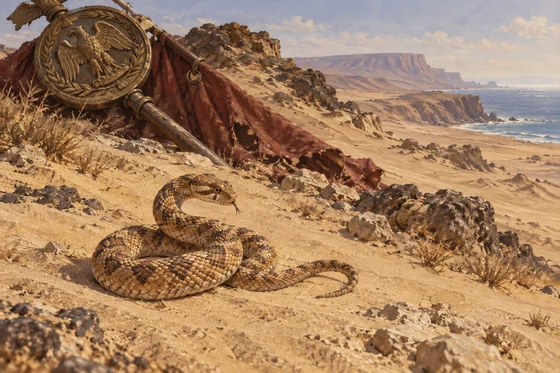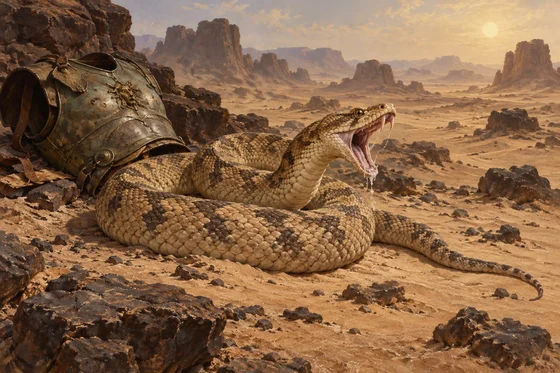
Haemorrhois - AI-generated imagined folklore illustration.
AI-generated imagined Haemorrhois spreading its coils in Lucan’s desert setting. The wine-colored scales and camp arrangement are invented; the legendary bleeding effect is not depicted.
Overview
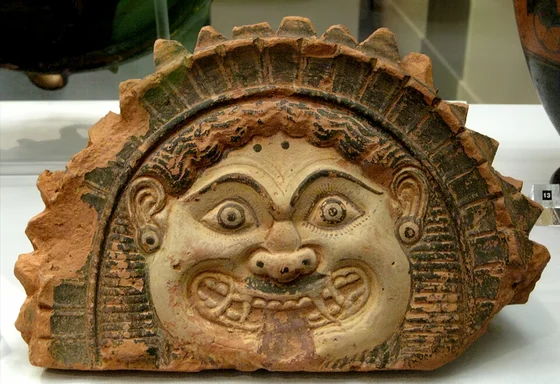
Lucan’s Book IX presents the Haemorrhois as a large coiling serpent that prevents its victim’s blood from remaining in the veins. It appears within the catalogue following the myth of Medusa’s blood generating the snakes of Libya. The origin belongs to that poetic setting and is not a biological explanation.
The subsequent episode singles out Tullus, a courageous follower attached to Cato. Once bitten, he suffers bleeding from the body’s ordinary outlets, including tears and sweat. The narrator compares the distribution with liquid sprayed from a statue. This elaborate poetic image makes the Haemorrhois distinct from the Dipsas’s drying thirst and Prester’s enlargement.
The catalogue and named encounter together supply stronger evidence than the name alone: they define a particular effect and locate it in the continuing ordeal of the army. They do not define horn count, skin color or a modern species. The profile treats the serpent as an ancient literary marvel. Modern red or dark coloration symbolizes the narrative association and must be labelled as invented rather than an attested physical feature.
Origins & earliest records
Selected ancient witness: Lucan’s first-century epic, inspected through Project Gutenberg English verse text; broader Greek zoological terminology not fully collated.
Records & interpretation
Complete BookIX origin/catalogue and Tullus episode; local text9690–9708.
Selected bibliography
Documented works and useful reading. This is not a list of every appearance.
- 01
Pharsalia, Book IX
Complete serpent-origin passage, named catalogue, Aulus/Sabellus/Nasidius/Tullus episodes and ensuing soldiers’ lament inspected; PG602 text cached. The cached electronic text does not establish an inspected print-edition year; no1905 edition claim is retained.
Family & connections
A source-supported family tree or inspiration record has not yet been compiled for this profile. Related reading below indicates a connection in subject matter, not a proven lineage or creative influence.
References
Sources supporting this profile. Linked pages have their own scope and editorial standards.
- Primary text or custodial scholarly editionPharsalia, Book IXResearch access: 2026-10-10
Image credits
AI-generated imagined folklore illustrationHaemorrhois - AI-generated imagined folklore illustration.
AI-generated imagined Haemorrhois spreading its coils in Lucan’s desert setting. The wine-colored scales and camp arrangement are invented; the legendary bleeding effect is not depicted.