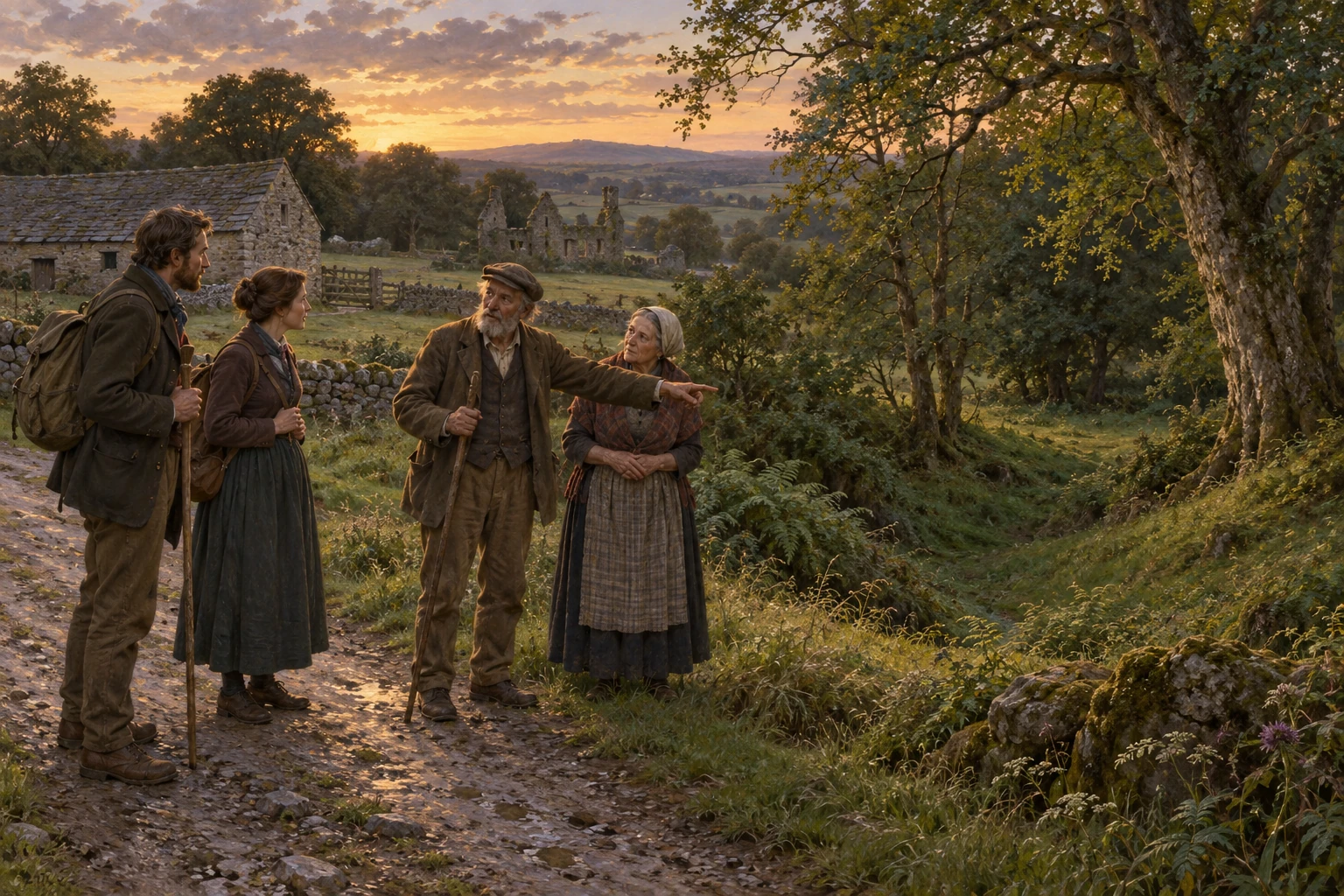
AI-generated contextual interpretation of Waugh’s Grislehurst Boggart conversation. The couple, hollow and ash-tree setting follow the account; people’s appearance, visitors, dress and site layout are artistic reconstructions. No physical appearance of the reported spirit is established.
An illustration of reported local testimony, not ethnographic or archaeological evidence.
Overview
In The Grave of Grislehurst Boggart, Edwin Waugh describes an evening walk from the Heywood area to the remains of Grislehurst Hall. His 1855 sketch combines landscape, local history and conversation. An unnamed elderly man points out a hollow near an ash tree where he says the Boggart is buried. His wife adds that a cock was buried with it and a wooden stake driven through it into the ground. The burial is their reported tradition, not an excavation or ceremony witnessed by Waugh.
The supposed laying has not ended their fear. When the visitor asks whether a buried spirit can still trouble them, the woman insists that the place remains haunted. The man says a neighbouring farmer’s wife heard something at night less than a fortnight earlier and was nearly thrown from bed. His wife reports discussing this with that neighbour, who now fears being alone as darkness approaches. The couple also attributes the unyoking of cattle, overturned carts and things moved about sleeping households to the Boggart. Some of the woman’s attempted recollections are interrupted by her husband rather than developed into complete separate encounters.
Waugh then asks whether they have considered digging into the alleged grave. Both refuse. The woman says that even Joseph Fenton, a locally bold landowner, dares not touch it. No digging follows, and the account establishes neither a recovered creature nor what is actually beneath the ground. The couple notices the visitors’ disbelief; the woman turns away, saying that they are fortunate if their own neighbourhood has nothing of that kind. Conversation returns to age, work and neighbours, and the visitors take leave and walk home through Simpson Clough.
The narrator’s closing reflection treats the conversation as evidence of continuing local superstition, while imagining the couple’s nightly fears. His sceptical and sometimes patronising language is part of the literary framing, not a judgement adopted here about Lancashire people. The story presents an unresolved local haunting report with a claimed burial and living dissent about its efficacy. It gives no fear-responsive transformations, fixed appearance or basis for deriving Harry Potter’s Boggart mechanics from this episode.
Origins & earliest records
Edwin Waugh, Sketches of Lancashire Life and Localities, London: Whittaker and Co.; Manchester: James Galt and Co., 1855. Complete The Grave of Grislehurst Boggart in retained original-volume OCR. Apparent printed chapter sequence 213–234; no page images collated. Harland 1867 cites p. 192, which does not match this retained pagination. Do not silently identify the citation’s edition or apply its page number to this witness.
Records & interpretation
Whole selected chapter, including introductory Robin/Clegg context, landscape and history, elderly couple dialogue, return journey, conclusion and inline historical/dialect footnotes, read from original-volume OCR. Title and complete preface read. Heavy OCR corruption limits exact quotation and page-number certainty; no fresh scan-pixel inspection.
Selected bibliography
Documented works and useful reading. This is not a list of every appearance.
- 01
Sketches of Lancashire Life and Localities: The Grave of Grislehurst Boggart
Identified original volume and complete chapter; Harland p. 192 citation not reconciled with this pagination.
Family, evolution & connections
Boggart
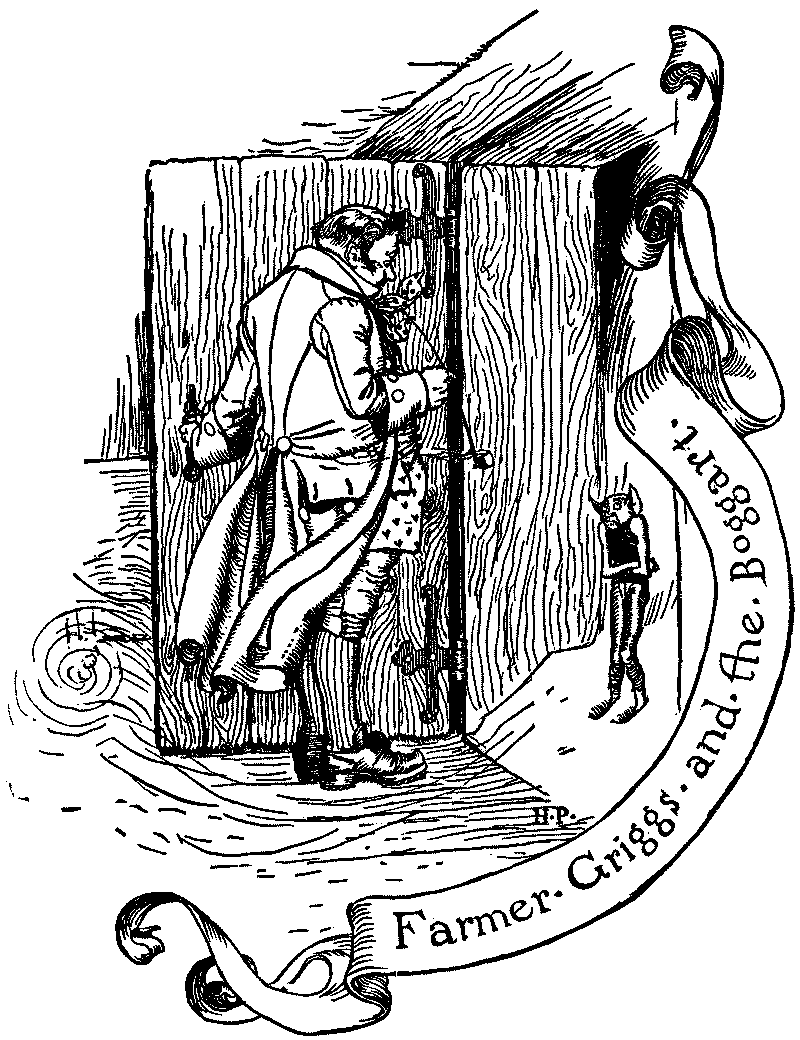
Waugh’s Grislehurst conversation is a distinct local Boggart account: an alleged grave, reported disturbances after laying, and refusal to dig. Keightley and Pyle instead preserve their separately attributed household stories. This comparison does not identify the beings, establish the reported events, or derive Harry Potter’s fear transformations from Waugh.
References
Sources supporting this profile. Linked pages have their own scope and editorial standards.
- Historical original English literary accountInternet Archive original 1855 volume, retained OCRResearch access: 2026-10-26
Image credits
Modern interpretation of a historical literary accountAI-generated contextual interpretation of Waugh’s Grislehurst Boggart conversation. The couple, hollow and ash-tree setting follow the account; people’s appearance, visitors, dress and site layout are artistic reconstructions. No physical appearance of the reported spirit is established.
An illustration of reported local testimony, not ethnographic or archaeological evidence.