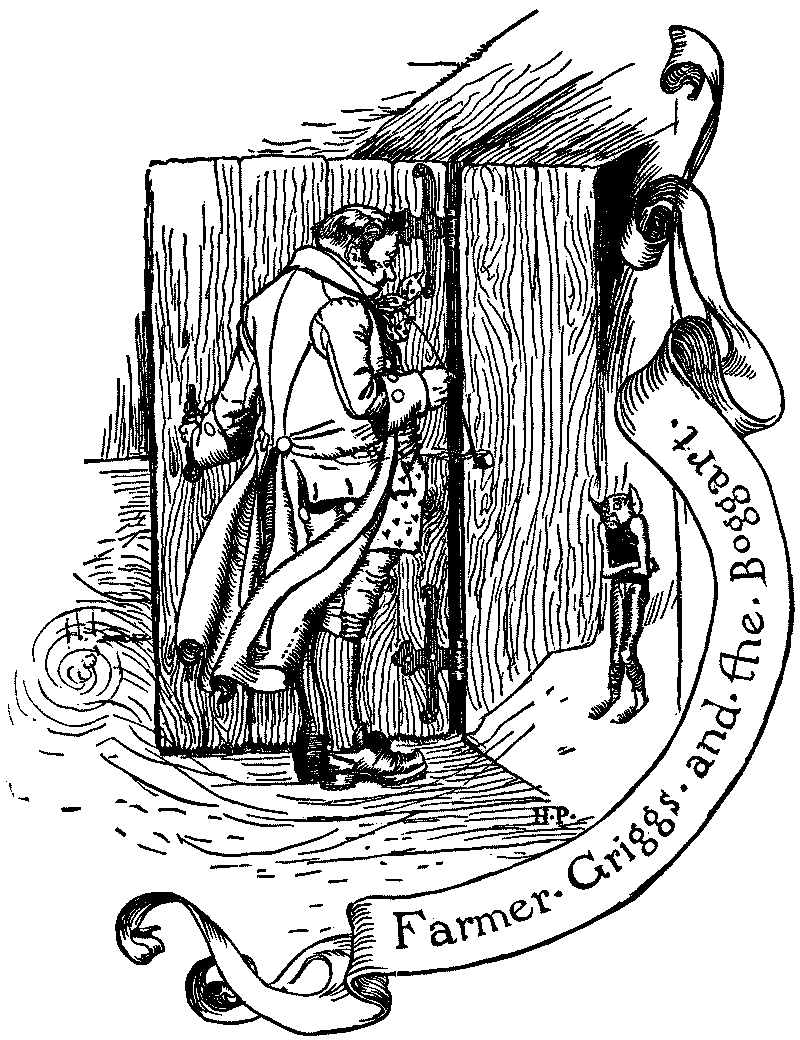
Howard Pyle’s Hardfist boggart standing before Farmer Griggs at the door
Pyle’s illustration depicts Hardfist, the named boggart in his literary telling. Its pointed ears, head projections and fitted legwear belong to this drawing; the tale describes the arrival as barefoot. This visible figure does not define Keightley’s unseen Yorkshire household spirit.
Overview
The boggart in Thomas Keightley’s Yorkshire story is an unseen inhabitant of George Gilbertson’s farmhouse. It steals the children’s food, overturns their bowls, disturbs bed curtains and presses on sleepers. A knothole in a wooden partition becomes the focus of a strange game: when a child pushes a shoehorn through it, the object flies back out. Keightley presents this as the family’s dealings with the house spirit, rather than describing a visible monster with a settled shape.
The family eventually loads its possessions onto carts and leaves. While Gilbertson explains the move to John Marshall, the boggart answers from an upright churn among the furniture: it is moving with them. Gilbertson concludes that returning to the familiar house is preferable to being tormented elsewhere. This version ends with the decision to turn back; it does not add a successful exorcism. Keightley’s note says he abridged a letter in the Literary Gazette, number 430 of 1825, whose writer knew the reputed house and recalled a tailor’s account. That is a chain of reported testimony, not Keightley’s own observation of the haunting.
Howard Pyle’s Farmer Griggs’s Boggart gives a substantially different literary treatment. Its boggart, Hardfist, first appears at the door as a knee-high, barefoot figure with a brown face and bright eyes. It promises to perform the household work without wages. Once warmed beside the fire it becomes invisible; Pyle compares this changing visibility with frost. Its efficient labour tempts Griggs to dismiss his servants, but the bargain brings cheating at market, hungry children, neglected animals and a dark, cold house. Pyle’s opening explicitly uses the spirit to personify ill temper, meanness and similar faults.
Pyle retains the attempted move and the voice from the churn, but changes the names to Georgie and Mally Griggs and their neighbour Jerry Jinks. He then continues beyond that episode: a wise man’s advice leads the farmer to leave a complete new outfit by the hearth. The boggart dresses, sings and departs permanently. Its cold-weather visibility, personal name and clothing ending belong to Pyle’s telling; they are not transferred backward into Keightley’s invisible Yorkshire visitor. Keightley compares the boggart with brownies and kobolds while distinguishing the outdoor barguest. Such a collector’s comparison provides context without establishing a single universal species or a biological family tree.
Origins & earliest records
Keightley’s inspected 1892 edition prints The Boggart on pp. 307–308 and cites an 1825 Literary Gazette letter in note 354. The earlier letter is identified through that citation, not independently read. Pyle’s work dates from 1885; the inspected E. M. Hale special-edition title page is undated.
Records & interpretation
Complete Keightley tale, introductory distinction and notes 352–354 read; complete Pyle tale, pp. 69–81, including its additional ending read. Both are textual witnesses, with no verified physical specimen or biological classification.
Additional images
 View larger
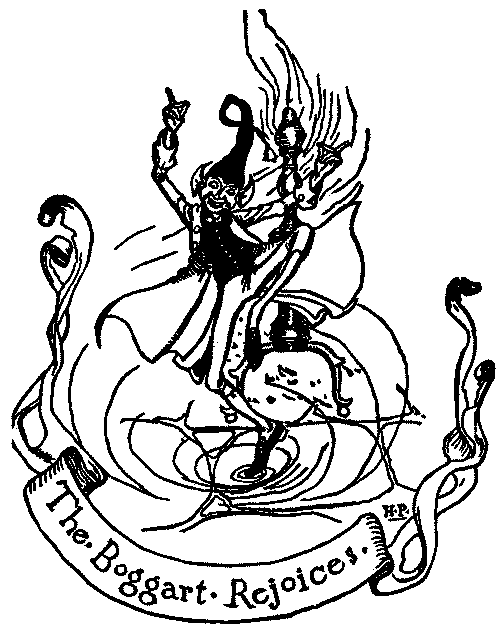
 Howard Pyle’s Hardfist boggart dancing in his new clothes
Hardfist dances in his new outfit before leaving Farmer Griggs’s house permanently. The clothes and successful departure belong to Pyle’s added ending, rather than Keightley’s account of the family returning home with the spirit.
In the literature
“Aye, aye, Georgey, we're flitting ye see.”
The Boggart, p.308, voice from the packed upright churn
The boggart accompanies the family’s attempted move; this telling ends in their decision to return.
Selected bibliography
Documented works and useful reading. This is not a list of every appearance.
- 01
The Fairy Mythology: The Boggart
Revised and enlarged edition, pp. 307–308 and notes 352–354; complete tale read. Note 354 locates a mediated earlier source in Literary Gazette no. 430 (1825).
- 02
Pepper & Salt; or, Seasoning for Young Folk: Farmer Griggs’s Boggart
Complete story, pp. 69–81. Gutenberg plain-text front matter also notes a 1913 reissue; that is not treated as a printed date on the Hale title page.
Family & connections
A source-supported family tree or inspiration record has not yet been compiled for this profile. Related reading below indicates a connection in subject matter, not a proven lineage or creative influence.
Located primary passages
Specific passages supporting details in this entry, grouped by their published witness.
The Fairy Mythology: The Boggart
London: George Bell & Sons, 1892, new revised and greatly enlarged edition; reprinted from stereotype plates. Hosted page markers not newly collated with original pixels.
- George Gilbertson’s unseen household visitor steals or overturns food, shakes bed curtains and presses on sleepers. A shoehorn pushed through a partition hole flies back, becoming a children’s game. The family attempts to move, but the boggart answers from their upright churn. Gilbertson resolves to return home. Note354 identifies Keightley’s abridgement of a Literary Gazette430 letter from1825, including that letter-writer’s knowledge of the reputed house and a tailor’s recollection.
Complete The Boggart, pp.307–308; preceding Boggart/Barguest comparison and notes352–354
The inspected witness establishes a reported or literary version, not supernatural physical fact. Complete selected passage does not mean complete source volume or earlier cited sources were read.
Pepper & Salt; or, Seasoning for Young Folk: Farmer Griggs’s Boggart
Original work1885; selected E.M.Hale special edition title undated. Plain-text front matter says “1885, reissued1913”, which is not a printed date established on that special title.
- Pyle introduces the boggart as a personification of ill temper and meanness. Hardfist arrives knee-high and barefoot, becomes invisible when warmed, and performs household work before cheating at market and depriving children and animals of food. Griggs dismisses servants, then attempts escape by moving. The boggart rides in the churn, so the family returns. Father Grimes subsequently advises an outfit left by the hearth; the boggart dresses and leaves permanently.
The inspected witness establishes a reported or literary version, not supernatural physical fact. Complete selected passage does not mean complete source volume or earlier cited sources were read.
References
Sources supporting this profile. Linked pages have their own scope and editorial standards.
- Primary textKeightley, complete Yorkshire Boggart narrative and source noteResearch access: 2026-10-05
- Primary textPyle, complete Farmer Griggs narrative with illustrationsResearch access: 2026-10-05
Image credits
Historical illustrationHoward Pyle’s Hardfist boggart standing before Farmer Griggs at the door
Pyle’s illustration depicts Hardfist, the named boggart in his literary telling. Its pointed ears, head projections and fitted legwear belong to this drawing; the tale describes the arrival as barefoot. This visible figure does not define Keightley’s unseen Yorkshire household spirit.
Further credits appear with each additional image.