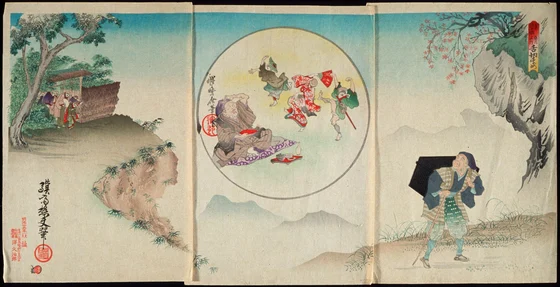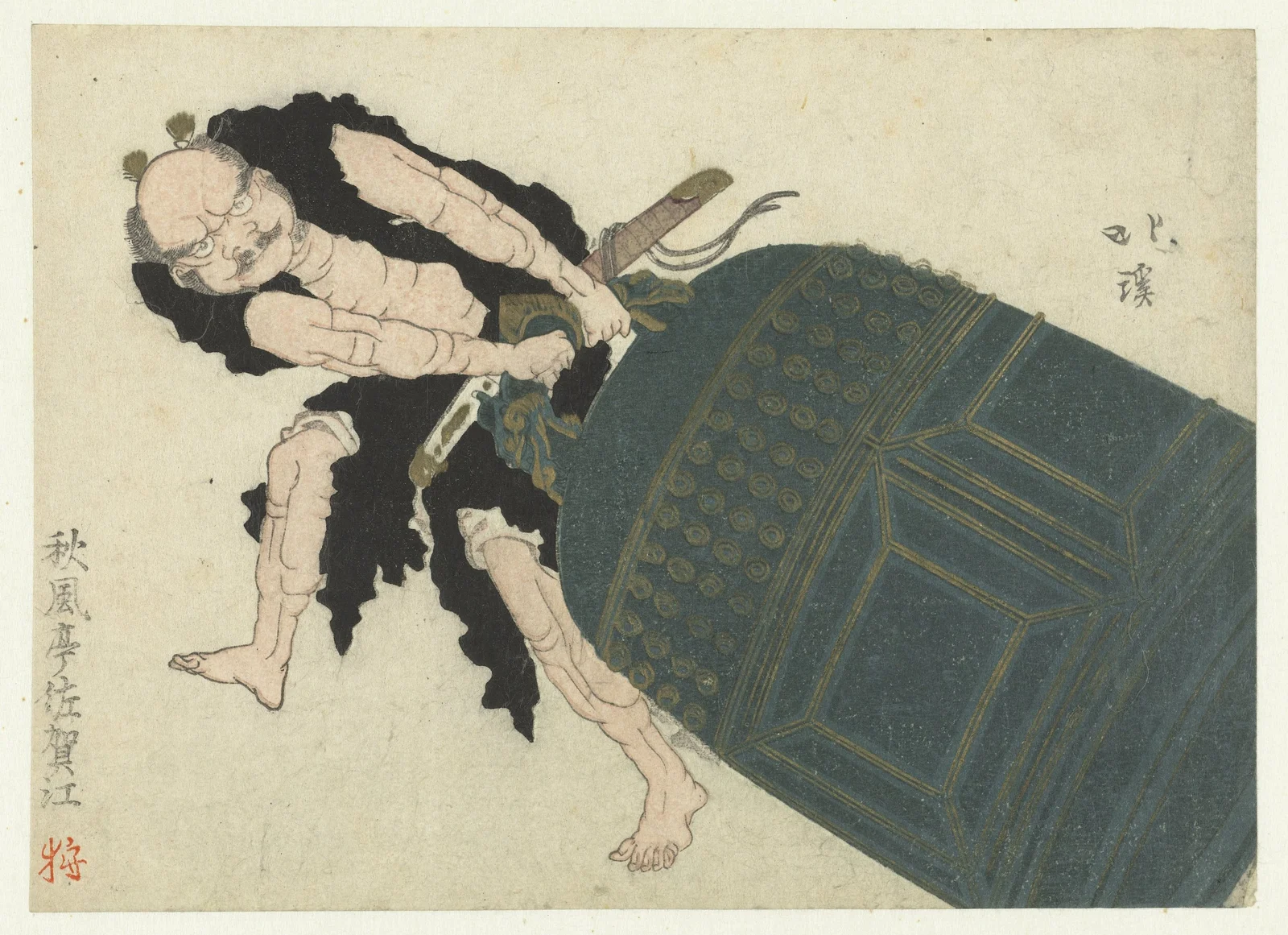
Benkei drags a large decorated temple bell in a colour woodblock print.
Hokkei's surimono, circa 1810–1820, which the Rijksmuseum identifies as Benkei dragging the Miidera bell toward Mount Hiei. An earlier, related depiction, not an illustration made for Griffis's later retelling; the bell is not shown speaking. Whole museum-supplied sheet-cropped rendition, including edge wear; not the full-resolution master. Compressed for display.
Overview
Griffis tells of a bronze bell at Miidera whose legendary history leads through an Indian Buddhist temple and the Dragon King’s realm before Toda the Archer gives it to the monks. Its first act of agency occurs when a woman admires her reflection and touches it: the metal shrinks away and loses its perfect surface. The narrator links this incident to a restriction on women entering the monastery; the story’s exclusionary judgment is not adopted as a fact about women or a universal Buddhist rule.
Benkei later steals the bell for Hiyeisan. Whenever struck there, its fading tone becomes a complaint that it wants to return to Miidera. Consecrated water, repeated blows and different ringers all fail to change its demand. Enraged, Benkei carries it back toward its old home and rolls it downhill; the Miidera monks rehang it, after which it sounds and behaves like an ordinary bell. The account gives the object feeling and speech, but names no indwelling spirit and supplies no humanoid transformation. Its legendary provenance is distinguished from independently verified artifact history.
Origins & earliest records
Japanese narrative in an English literary collection
Records & interpretation
Complete relevant chapters, endings and collection preface read.
Selected bibliography
Documented works and useful reading. This is not a list of every appearance.
- 01
Japanese Fairy World: Stories from the Wonder-Lore of Japan
XII, Benkei and the Bell, pp.93–101
Family & connections
A source-supported family tree or inspiration record has not yet been compiled for this profile. Related reading below indicates a connection in subject matter, not a proven lineage or creative influence.
Primary records and illustrations
William Elliot Griffis, Japanese Fairy World (1887 edition)
English literary collection. XII, Benkei and the Bell, pp.93–101
Complete relevant chapters read. Benkei later steals the bell for Hiyeisan. Whenever struck there, its fading tone becomes a complaint that it wants to return to Miidera. Consecrated water, repeated blows and different ringers all fail to change its demand. Enraged, Benkei carries it back toward its old home and rolls it downhill; the Miidera monks rehang it, after which it sounds and behaves like an ordinary bell. The account gives the object feeling and speech, but names no indwelling spirit and supplies no humanoid transformation. Its legendary provenance is distinguished from independently verified artifact history.
References
Sources supporting this profile. Linked pages have their own scope and editorial standards.
- Historical English literary retellingGriffis, Japanese Fairy World, XII, Benkei and the Bell, pp.93–101Research access: 2026-10-05
Image credits
Historical illustrationBenkei drags a large decorated temple bell in a colour woodblock print.
Hokkei's surimono, circa 1810–1820, which the Rijksmuseum identifies as Benkei dragging the Miidera bell toward Mount Hiei. An earlier, related depiction, not an illustration made for Griffis's later retelling; the bell is not shown speaking. Whole museum-supplied sheet-cropped rendition, including edge wear; not the full-resolution master. Compressed for display.