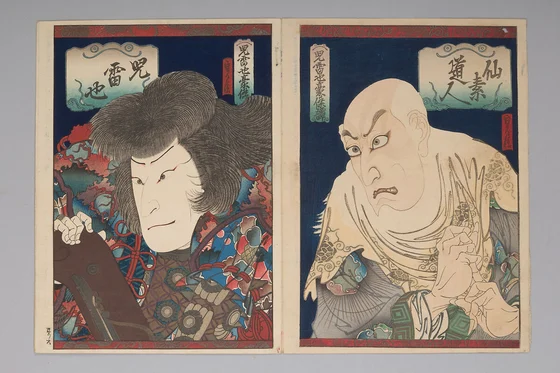
A sourced illustration has not yet been added. This gap is included in the coverage record.
Overview
When Empress Jingu calls the kami to assist her proposed expedition, Isora alone fails to arrive promptly. After she continues her invocation through the night, he rises from the seabed covered with mud, shells and seaweed. Griffis’s narrator calls him slovenly and gruff; those judgments are the retelling’s characterization, not a general description of the worship of this sea kami.
Jingu sends him to Riu Gu to request the two tide jewels from Kai Riu O. He descends, presents her request and receives the jewels on a large shell. He returns them to the empress, who later uses them to make the sea withdraw and return. In the following chapter he is recalled as the intermediary who appeared to Jingu, contrasted with the Sea King’s personal appearance to her son.
Isora’s encrusted emergence is directly described, but the story does not turn the attached shells or seaweed into separate limbs or assign him a fish species. The expedition belongs to Griffis’s legendary imperial narrative and does not verify its military events. This public historical literary presentation is kept distinct from contemporary devotional practice and from other accounts of Isora.
Origins & earliest records
Japanese narrative in an English literary collection
Records & interpretation
Complete relevant chapters, endings and collection preface read.
Selected bibliography
Documented works and useful reading. This is not a list of every appearance.
- 01
Japanese Fairy World: Stories from the Wonder-Lore of Japan
XXXI, The Jewels of the Ebbing and the Flowing Tide, pp.273–281; XXXII, pp.282–288
Family & connections
A source-supported family tree or inspiration record has not yet been compiled for this profile. Related reading below indicates a connection in subject matter, not a proven lineage or creative influence.
Primary records and illustrations
William Elliot Griffis, Japanese Fairy World (1887 edition)
English literary collection. XXXI, The Jewels of the Ebbing and the Flowing Tide, pp.273–281; XXXII, pp.282–288
Full relevant chapters and preface read. Isora’s encrusted emergence is directly described, but the story does not turn the attached shells or seaweed into separate limbs or assign him a fish species. The expedition belongs to Griffis’s legendary imperial narrative and does not verify its military events. This public historical literary presentation is kept distinct from contemporary devotional practice and from other accounts of Isora.
References
Sources supporting this profile. Linked pages have their own scope and editorial standards.
- Historical English literary retellingGriffis, Japanese Fairy World (1887), XXXI, The Jewels of the Ebbing and the Flowing Tide, pp.273–281; XXXII, pp.282–288Research access: 2026-10-05
Image credits
A sourced illustration has not yet been added. This gap is included in the coverage record.