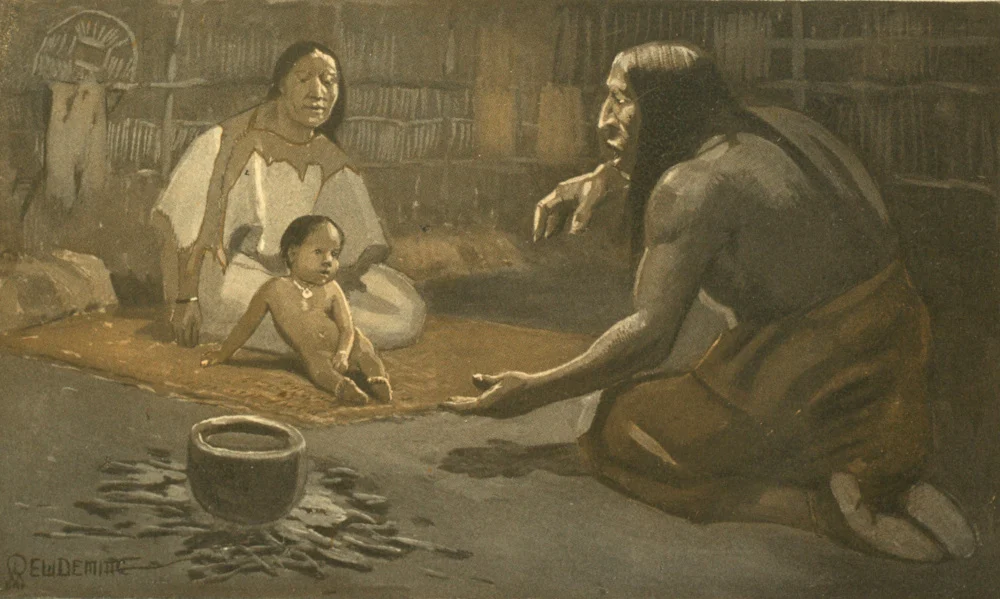
Edwin Willard Deming’s illustration of Kulóskap kneeling and reaching toward a seated baby, with a woman behind the child and a pot over a small fire.
Kulóskap and the Babe, Edwin Willard Deming’s 1902 frontispiece. It illustrates Leland and Prince’s Penobscot-labelled episode in which the baby resists the hero’s commands. This is a separate literary adaptation, not an illustration commissioned for Rand’s collected accounts.
Overview
Rand’s collection presents Glooscap through several distinct episodes rather than a single continuous biography. In the unnamed teller’s Adventures of Kaktoogwasees, he receives Little Thunder and the specialist companions travelling to obtain a bride. A small scraping of bone becomes abundant food, Badger receives powerful clothing, and a rock-like canoe carries the party. Music supplied for the journey charms the giant skunk and beaver, allowing safe passage. Glooscap hosts another feast on their return and joins the dancing. Ben Brooks’s Beautiful Bride, dated 31 August1869, separately makes him the provider of a self-moving island-like canoe in a marriage expedition aided by Megumoowesoo; the similar journeys retain their different incidents and outcomes.
Benjamin Brooks told Glooscap and His Four Visitors on 14 October1869, and Rand says he wrote it down that day. Four men search from spring through winter to the following midsummer. At a lakeside lodge they encounter a hospitable middle-aged man, an elderly woman and a young hunter. At the elder man’s direction, the hunter washes the woman’s face, restores her youthful appearance and dresses her beautifully. The visitors infer family relationships from the household’s forms of address; the episode does not establish a genealogy applicable to every Glooscap tale. Their host eventually identifies himself as the figure they seek.
Each visitor asks for a different gift: a better character, material abundance, affection and respect, or long life. Glooscap transforms the last man into a gnarled cedar on a barren hill, explaining that its useless timber and inaccessible position should protect it from being cut down. He does not promise immortality or claim to know its exact lifespan. The other men initially fear a similar fate, but receive fine clothing and boxes of ointment. Glooscap then guides them home in a single day. Applied only after arrival, the ointments grant the three requested changes. Rand follows this narrative with his own Christian moral exposition, which is distinguished from Brooks’s attributed tale.
A short account headed Glooscap’s Origin is credited to Gabriel Thomas of Fredericton. It describes twins choosing different modes of birth: one is born normally, while the younger kills their mother by emerging through her side. Glooscap deceives his brother about his vulnerability to a cattail, survives the attempted killing, and then kills the younger with bird-down. Wolves described as his dogs and the loon lament his subsequent departure. Rand expressly questions whether this account actually concerns another legendary person. That uncertainty is retained: the twin narrative is neither treated as an uncontested origin nor used to import a name for the unnamed younger brother.
Origins & earliest records
Silas Tertius Rand’s Legends of the Micmacs, edited by Helen L. Webster and published posthumously in1894. Selected accounts name Benjamin Brooks and Gabriel Thomas; XIII does not name its teller. Webster explains Rand’s English retelling and checking procedure and Leland’s earlier use of Rand’s manuscripts, so the two printed collections are not automatically independent witnesses.
Records & interpretation
Complete selected narratives: XIII110–119; XXIV185–189; XLIII253–258, including Rand’s separate moral interpretation; LX339–340, including his doubt about identity. Named tellers and dates remain specific to their own chapters. No whole-book or single pan-regional tradition claim.
Selected bibliography
Documented works and useful reading. This is not a list of every appearance.
- 01
Legends of the Micmacs
XIII110–119 unnamed teller; XXIV185–189 Ben Brooks31Aug1869; XLIII253–258 Benjamin Brooks14Oct1869, written same day; LX339–340 Gabriel Thomas of Fredericton, identity questioned by Rand; prefacev–ix.
Family, evolution & connections
Twins in Rand LX — Glooscap attribution questioned
Complete LX, pp. 339–340, attributed to Gabriel Thomas.
Scroll sideways to see all branches. With a keyboard, focus the tree and use the arrow keys.
- Unnamed mother in the questioned LX account
- Elder twin called Glooscap in LX (identification questioned by Rand)
- Unnamed younger twin (kills mother during birth)
One unnamed maternal branch records the two expressly narrated twins. Rand explicitly doubts that this account concerns Glooscap. The diagram retains its printed attribution without resolving that doubt. No father or name for the younger twin is provided. Other Glooscap accounts and differently named twin narratives are not merged.
The unnamed younger twin in the questioned LX account
LX calls the elder twin Glooscap and gives him an unnamed younger twin. Rand expressly questions whether this account instead concerns another person. The name of the younger twin is not supplied; this record preserves that doubt rather than harmonizing other versions.
The unnamed mother of the twins in LX
The two twins share an unnamed mother in LX; the younger kills her during birth. Because Rand questions the elder’s identification as Glooscap, this parentage stays confined to that attributed account. No father, later household or independently named mother is reconstructed.
Located primary passages
Specific passages supporting details in this entry, grouped by their published witness.
Legends of the Micmacs
New York and London: Longmans, Green & Co., 1894, Wellesley Philological Publications; Silas Tertius Rand’s English translations edited by Helen L. Webster. Preface dated November 1893 read completely; selected episodes independently read from retained original-volume OCR.
- Glooscap provides hospitality, empowering equipment, guidance and a second wedding celebration in this unnamed teller’s episode.
- Glooscap assists the bride quest but is distinct from the unnamed Mégiimoowésoo guide.
XXIV, The Beautiful Bride, pp.185–189, complete story and ending credit
- Four wishes receive different outcomes, including a long-lived cedar transformation, in Benjamin Brooks’s dated telling.
XLIII, Glooscap and His Four Visitors, pp.253–258, complete story and interpretive ending
- Gabriel Thomas’s twin-origin notice is preserved with Rand’s explicit doubt about its subject.
LX, Glooscap’s Origin, pp.339–340, complete notice and opening qualification
This complete episode has no independently identified named teller; the fairy interpretation of Marten in a note remains Rand’s deduction. No performance words or instructions reproduced. Translation process and editor’s intervention retained; no original-language transcription claimed. Named guide category is not silently merged with Glooscap or promoted into a new personal identity. Brooks’s confidence about antiquity is his reported opinion, not proof of earliest origin. Translation process and editor’s intervention retained; no original-language transcription claimed. Household kinship is partly the visitors’ own conclusion; no named mother or brother supplied. Rand’s Christian parable is commentary, not universal Mi’kmaq theology. No ritual procedure reproduced. Translation process and editor’s intervention retained; no original-language transcription claimed. A distinct qualified account, not harmonised with every Glooscap tradition; younger brother and mother unnamed. No imported name such as Malsum inferred from other collections. Translation process and editor’s intervention retained; no original-language transcription claimed.
References
Sources supporting this profile. Linked pages have their own scope and editorial standards.
- Primary textRand1894 original collectionResearch access: 2026-10-05
Image credits
Historical literary illustration of Kulóskap in a separately identified Penobscot metrical adaptationEdwin Willard Deming’s illustration of Kulóskap kneeling and reaching toward a seated baby, with a woman behind the child and a pot over a small fire.
Kulóskap and the Babe, Edwin Willard Deming’s 1902 frontispiece. It illustrates Leland and Prince’s Penobscot-labelled episode in which the baby resists the hero’s commands. This is a separate literary adaptation, not an illustration commissioned for Rand’s collected accounts.