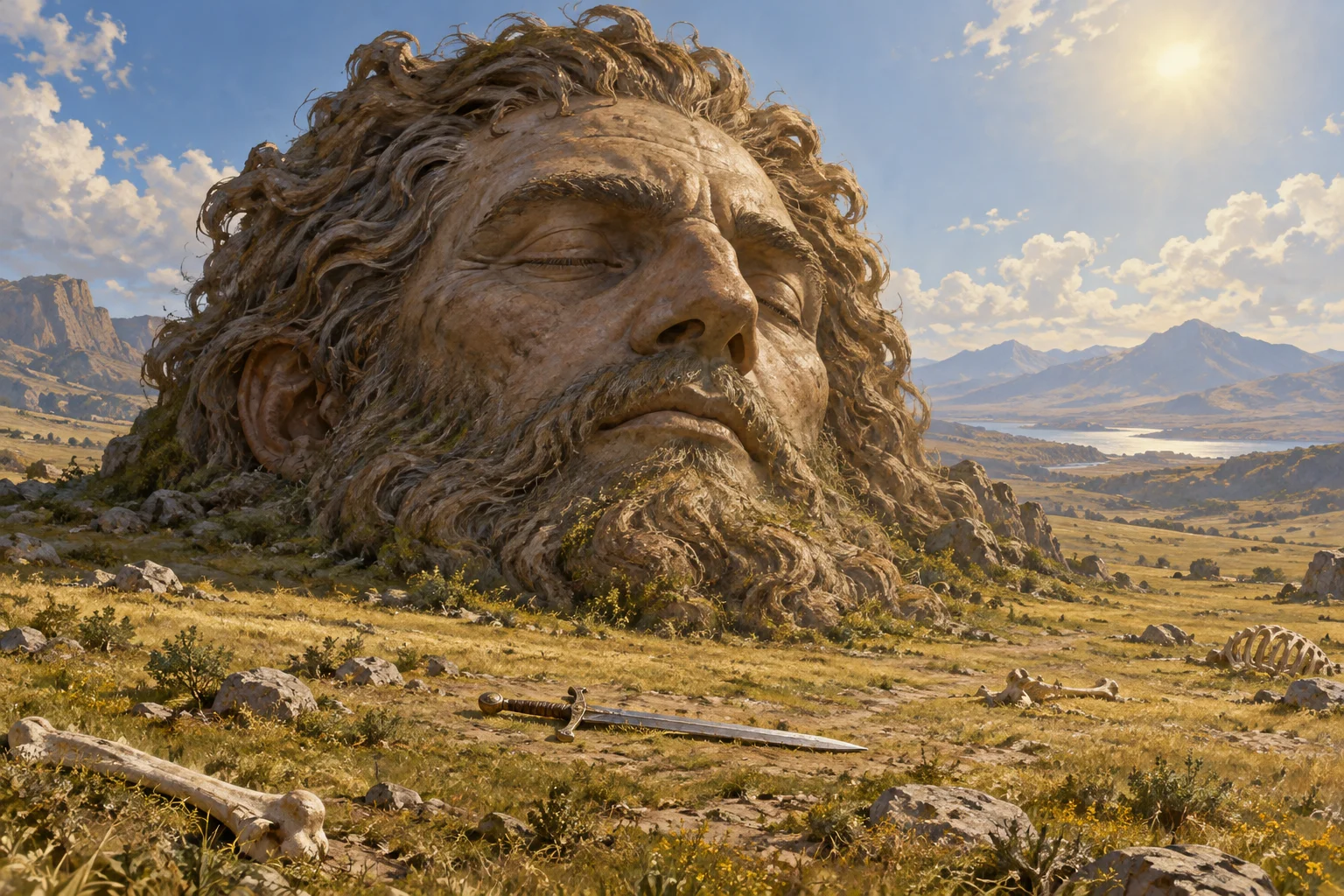
An enormous sleeping human head rests on a plain, with a sword and weathered bones before it.
AI-generated interpretation of the living giant head sleeping in the sun in The Whirlwind (Biggs, 1920). Mountain-like size, sleep, sword before him and bone-strewn plain are textual. Face, scale, weathered texture, terrain and sword design are choices; the head has not turned to stone. Its own trunk has long rotted away; none is shown. Original composition from Glinski's tales in Biggs's English translation; no existing illustration copied. Not a historical image. Compressed for display.
Overview
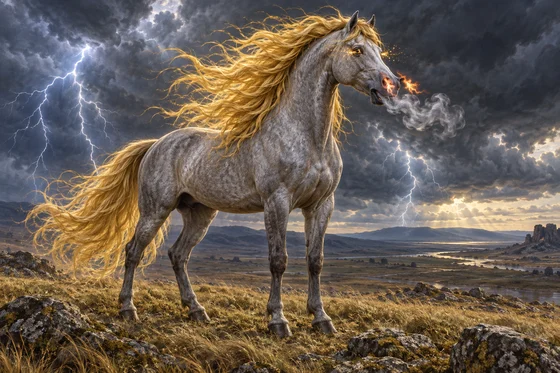
Dobrotek encounters this moving, mountain-sized head on a plain covered with bones. Its bloodshot eyes kill by looking, and the enchanted sword lies nearby. The Grey Seer-Horse protects the prince behind its neck and mane while he takes the weapon. Possessing the sword makes the prince safe from the gaze; the awakened head then tells its history rather than immediately attacking him.
It was formerly a knight of the race of giants and the whirlwind dwarf’s brother. Its physical strength once let it carry an uprooted century-old pine on one arm and its brother on the other. After they excavated the prophesied sword, the dwarf used a false listening contest to behead it. The abandoned trunk rotted, but magic kept the head alive for centuries as a murderous sword-guardian. It asks Dobrotek to avenge it by cutting the dwarf’s beard. When the prince returns, its jaws pulverize the captured dwarf. Dobrotek subsequently cuts the head itself into pieces and scatters them, so revenge does not restore the giant’s body or preserve its life.
Origins & earliest records
Polish Fairy Tales, translated from A. J. Gliński by Maude Ashurst Biggs (1920), The Whirlwind, pp. 37–52.
Records & interpretation
The selected English tale supplies the transformation, actions and ending. Biggs’s preface explicitly acknowledges considerable shortening of her source.
3D model
An original procedural model made for the Mythscribe World Builder. It is an interpretation based on this entry, not a historical source or a depiction from the records cited here.
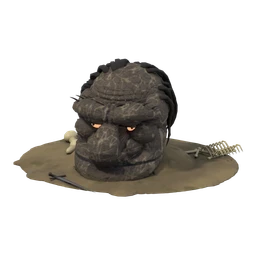
Procedural folklore creature kit · 29,141 triangles · 2.1 MB
Opens mythscribe.cloud in a new tab. Sign-in is required.
Selected bibliography
Documented works and useful reading. This is not a list of every appearance.
- 01
Polish Fairy Tales: The Whirlwind, pp. 37–52
Complete selected English narrative and translator’s preface. No individually named oral contributor provided; original Polish text not collated.
Family, evolution & connections
The dwarf and Giant-Head — Biggs’s Whirlwind
Complete The Whirlwind, pp. 37–52.
Scroll sideways to see all branches. With a keyboard, focus the tree and use the arrow keys.
- Two brothers, parents unspecified
Horse’s brother identification and the Giant-Head’s confirming account, pp. 43–46. Sibling grouping, not a parent node. Parents and birth order unnamed. Different giant/dwarf bodies do not imply different families or a natural taxonomy. Ladna rejects the dwarf; her completed marriage is to Dobrotek, not her captor. Both brothers are destroyed before the final wedding.
The Seven-Inch Whirlwind Magician
The horse identifies the Giant-Head as the dwarf’s brother, and the head’s own account confirms it. He describes his former giant body and his brother’s dwarf birth; neither parent is named.
References
Sources supporting this profile. Linked pages have their own scope and editorial standards.
- Primary historical shortened literary translationGliński/Biggs 1920: The WhirlwindResearch access: 2026-10-05
Image credits
AI-generated interpretationAn enormous sleeping human head rests on a plain, with a sword and weathered bones before it.
AI-generated interpretation of the living giant head sleeping in the sun in The Whirlwind (Biggs, 1920). Mountain-like size, sleep, sword before him and bone-strewn plain are textual. Face, scale, weathered texture, terrain and sword design are choices; the head has not turned to stone. Its own trunk has long rotted away; none is shown. Original composition from Glinski's tales in Biggs's English translation; no existing illustration copied. Not a historical image. Compressed for display.