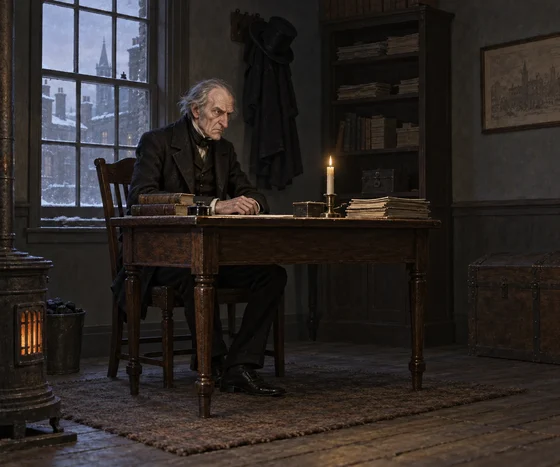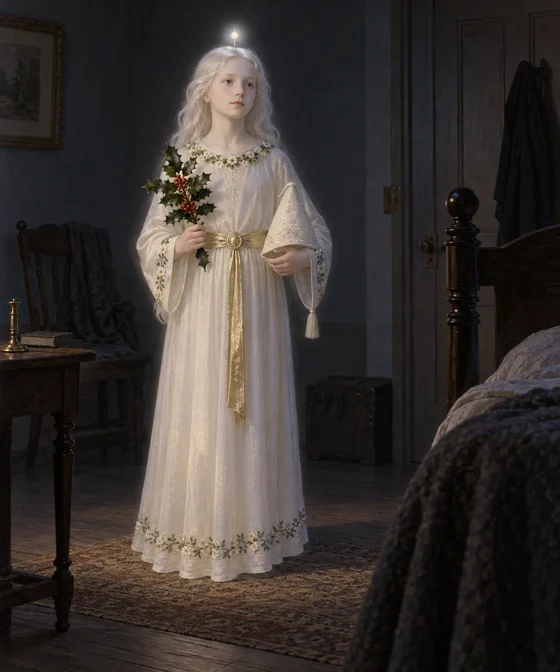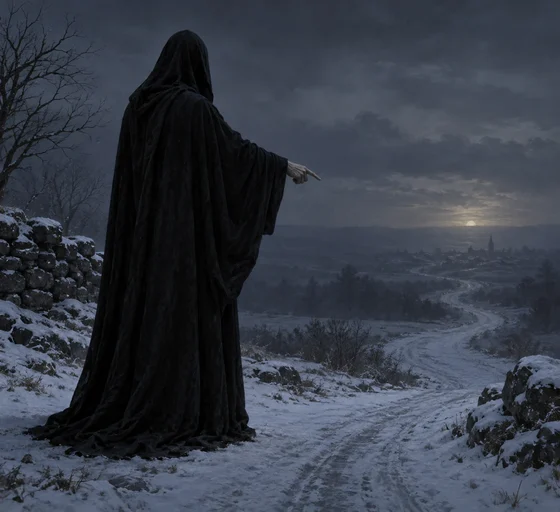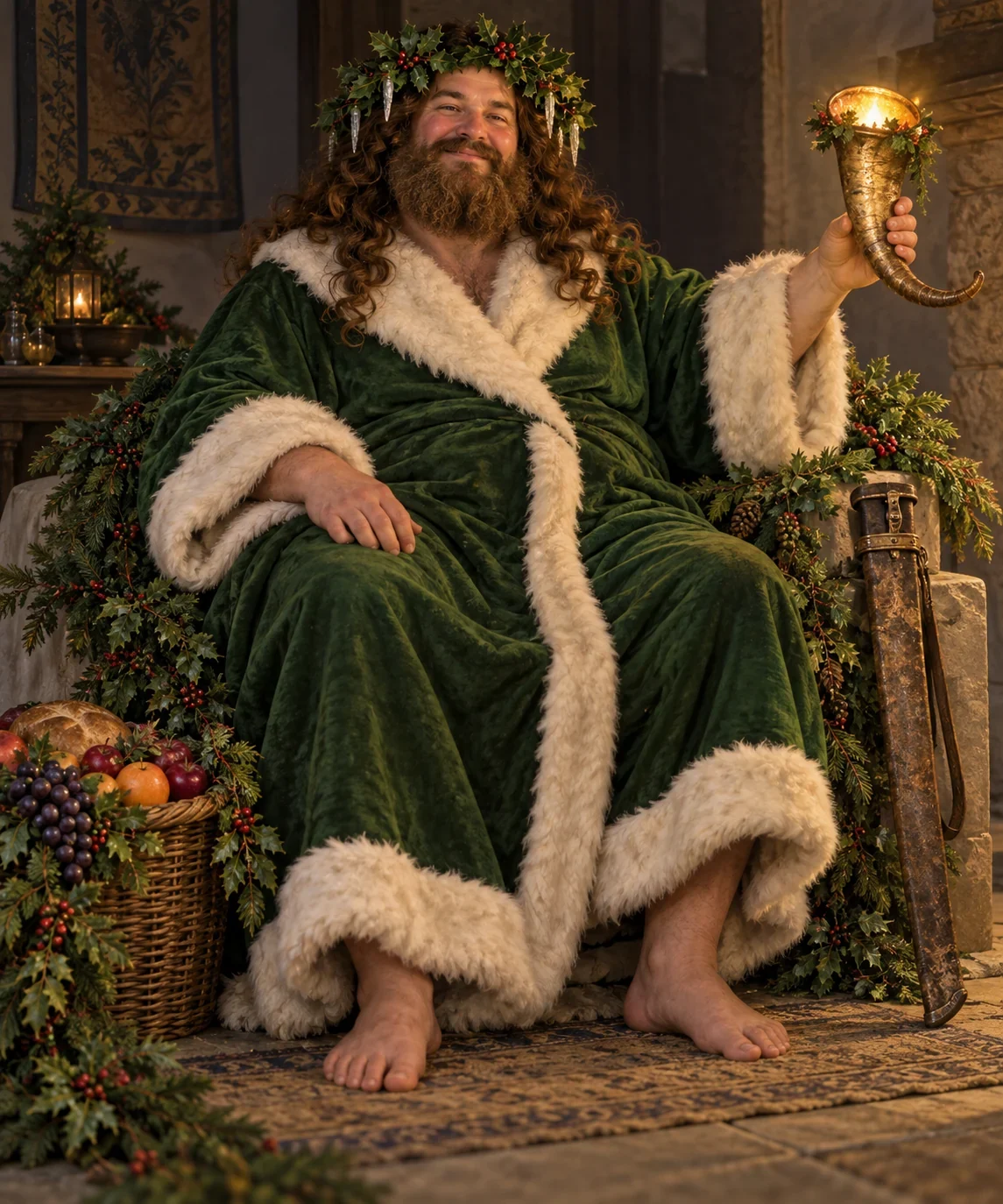
Imagined Ghost of Christmas Present in a quiet original-novel portrait.
Unofficial AI interpretation. Christmas Present pauses with its horn-shaped torch. Selected object or posture follows the original novel; exact portrait, unmentioned clothing and scene arrangement are imagined, without an adaptation likeness claim. Full-frame display derivative; no upscaling.
Overview
The Ghost of Christmas Present is the second guiding visitor in A Christmas Carol. Scrooge finds his room transformed by living greenery and abundant food, with a cheerful giant seated among the provisions. The spirit carries a glowing torch shaped like a horn of plenty. Its green robe is edged with white fur, and a holly wreath with icicles rests above long brown curls. The original description also gives bare feet, an open hand and an antique scabbard containing no sword. Its warmth and freedom contrast with Scrooge’s habitual coldness. Exact facial features, a numerical body size and later festive costume conventions are not fixed by those details.
The spirit asks Scrooge to touch its robe and takes him into the city’s Christmas activity. Its torch supplies a blessing to food carried to the bakers and restores good humour when people quarrel. The narrative describes a preference for helping poor households because their need is greatest. This is a particular action of the story’s visitor, not a comprehensive account of an annual gift-bringer with a workshop or a system of judging every child. The abundance surrounding its arrival is likewise an emblem of generosity and celebration rather than proof that every person in the city has adequate food or shelter.
At the Cratchits’ modest home, Scrooge observes family affection, effort and joy amid limited resources. The spirit directs his attention to Tiny Tim and warns what may happen if the relevant future shadows remain unchanged. When Scrooge expresses concern, it returns his own earlier words about surplus population, forcing him to hear their cruelty in a concrete setting. Visits to miners, a lighthouse and a ship extend the celebration beyond comfortable domestic rooms. Fred’s gathering reveals laughter at Scrooge’s expense alongside continued good wishes. These scenes show shared human feeling without erasing poverty, danger, illness or differences between the people being visited.
As the journey continues the spirit visibly ages, and it tells Scrooge that its brief life will end that night. Near the close it exposes two children hidden beneath its robe, naming them Ignorance and Want and attributing them to humanity. They are separate figures shown by the spirit, not its ordinary offspring or alternative bodies. Its warning returns responsibility to people rather than offering abundance as a cure that needs no action. At midnight this visitor disappears and the final phantom arrives. This profile follows the original story’s present-time guide, retaining its blessing, rebuke and limited duration without merging it with Father Christmas, Santa Claus or an adaptation’s independent magical biography.
First appearances & development
Charles Dickens’s A Christmas Carol establishes this character through Scrooge’s encounters with the three guiding spirits. This profile follows the selected original narrative and does not combine adaptation continuity with it.
Canon & continuity
Original narrative.
Selected bibliography
Documented works and useful reading. This is not a list of every appearance.
- 01
A Christmas Carol
Original.
Family & connections
A source-supported family tree or inspiration record has not yet been compiled for this profile. Related reading below indicates a connection in subject matter, not a proven lineage or creative influence.
References
Sources supporting this profile. Linked pages have their own scope and editorial standards.
- PrimaryA Christmas CarolResearch access: 2026-10-12
Image credits
Unofficial modern AI interpretationImagined Ghost of Christmas Present in a quiet original-novel portrait.
Unofficial AI interpretation. Christmas Present pauses with its horn-shaped torch. Selected object or posture follows the original novel; exact portrait, unmentioned clothing and scene arrangement are imagined, without an adaptation likeness claim. Full-frame display derivative; no upscaling.