A sourced illustration has not yet been added. This gap is included in the coverage record.
Overview
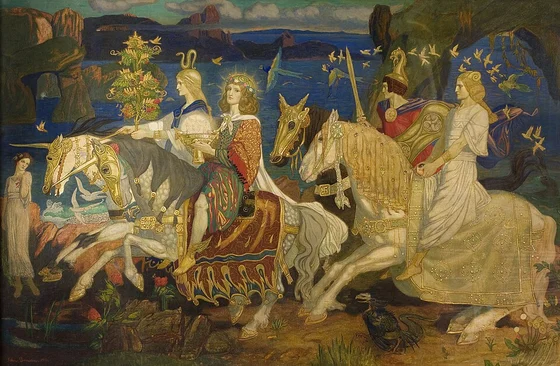
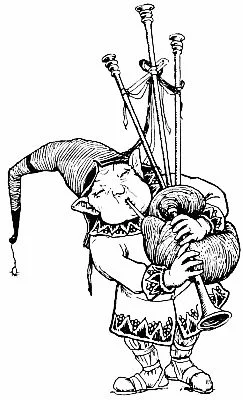
At Cnoc Matha, Donal and Paddy meet the rulers whom Jacobs spells Finvara and Nuala, surrounded by a great gathering of little people. Finvara announces a hurling match against Munster at Moytura and treats defeat as a threat to the host’s reputation. The musicians lead the procession, while the story says the fairy teams require living men beside them. Paddy’s role therefore bridges ordinary society and the hill court through participation, rather than implying that every human player is secretly a fairy.
The match becomes a fight and Connacht wins with Paddy’s help. The defeated Munster host transforms into beetles that devour the landscape before doves intercept them near Cong; this is a reported action of that host, not a personal shapeshift ascribed to Finvarra or Nuala. On the victors’ return Finvara rewards Paddy with gold. Nuala is explicitly named as queen but receives no separately detailed action in this episode, so the paired profile avoids constructing an unsupported independent biography. Other folklore about these rulers, their homes or relationships requires additional specifically attributed witnesses. The rich regional gathering does not define a uniform fairy population throughout Ireland.
Origins & earliest records
Jacobs’s 1895 selected volume cites Hyde’s Beside the Fire for the complete episode. Its Finvara spelling and named Nuala attest this pair within a Connacht tale. The source does not furnish historical reign dates or establish the oral beginning of their wider traditions.
Records & interpretation
The hill gathering, game and rewarded human participation are folklore narrative evidence. No royal archives or physical fairy court are verified here. Group transformations belong to the named host that performs them and are not redistributed as each sovereign’s personal powers.
In the literature
“Finvara and Nuala were there, the arch-king and queen of the fairy host of Connacht”
Paddy O'Kelly and the Weasel; p.54, the fairy company reaches the rulers
The fairy company reaches Cnoc Matha, where Finvara and Nuala are named arch-king and queen of Connacht’s fairy host. Finvara mobilises them against Munster at Moytura; Paddy helps the Connacht side win and receives gold. The defeated Munster host becomes destructive beetles, consumed by doves at Cong. Their paired rulership does not itself supply a marriage or parentage statement.
Selected bibliography
Documented works and useful reading. This is not a list of every appearance.
- 01
More Celtic Fairy Tales: Paddy O’Kelly and the Weasel
Full selected episode and relevant editorial source note inspected; cited earlier collections remain attributed, not falsely claimed as newly read.
- 02
More Celtic Fairy Tales — Paddy O'Kelly and the Weasel
Joseph Jacobs, More Celtic Fairy Tales, New York: G.P.Putnam’s Sons; London:D.Nutt,1895, selected title page verified. Compiler acknowledges simplification and insertion of parallel incidents; each relevant source note supplies transmission claims. Historical English text, modern transcription; original illustration rights separate.
Family & connections
A source-supported family tree or inspiration record has not yet been compiled for this profile. Related reading below indicates a connection in subject matter, not a proven lineage or creative influence.
Located primary passages
Specific passages supporting details in this entry, grouped by their published witness.
More Celtic Fairy Tales — Paddy O'Kelly and the Weasel
Joseph Jacobs, More Celtic Fairy Tales, New York: G.P.Putnam’s Sons; London:D.Nutt,1895, selected title page verified. Compiler acknowledges simplification and insertion of parallel incidents; each relevant source note supplies transmission claims. Historical English text, modern transcription; original illustration rights separate.
- The fairy company reaches Cnoc Matha, where Finvara and Nuala are named arch-king and queen of Connacht’s fairy host. Finvara mobilises them against Munster at Moytura; Paddy helps the Connacht side win and receives gold. The defeated Munster host becomes destructive beetles, consumed by doves at Cong. Their paired rulership does not itself supply a marriage or parentage statement.
Paddy O'Kelly and the Weasel; pp.53–56, Connacht rulers and hurling conflict
Complete named tale independently read. Named source paragraphs and preface checked; extensive comparative Lir commentary was only partly read and its conclusions are not adopted. No verse, prayers or ritual formulas reproduced. Earlier editions and manuscripts remain indirect.
Primary source witness
Joseph Jacobs, More Celtic Fairy Tales, New York: G.P.Putnam’s Sons; London:D.Nutt,1895, selected title page verified. Compiler acknowledges simplification and insertion of parallel incidents; each relevant source note supplies transmission claims. Historical English text, modern transcription; original illustration rights separate.
- Jacobs credits Douglas Hyde’s Beside the Fire pp73–91. This verifies the compiler’s stated source; Hyde’s underlying edition and the unnamed grandmother at the tale’s conclusion have not been independently verified in this pass.
Verifies the compiler’s stated source, not the uninspected cited edition or asserted earliest manuscript.
References
Sources supporting this profile. Linked pages have their own scope and editorial standards.
- Primary textJacobs, More Celtic Fairy Tales: Paddy O’Kelly and the Weasel and source noteResearch access: 2026-10-05
Image credits
A sourced illustration has not yet been added. This gap is included in the coverage record.