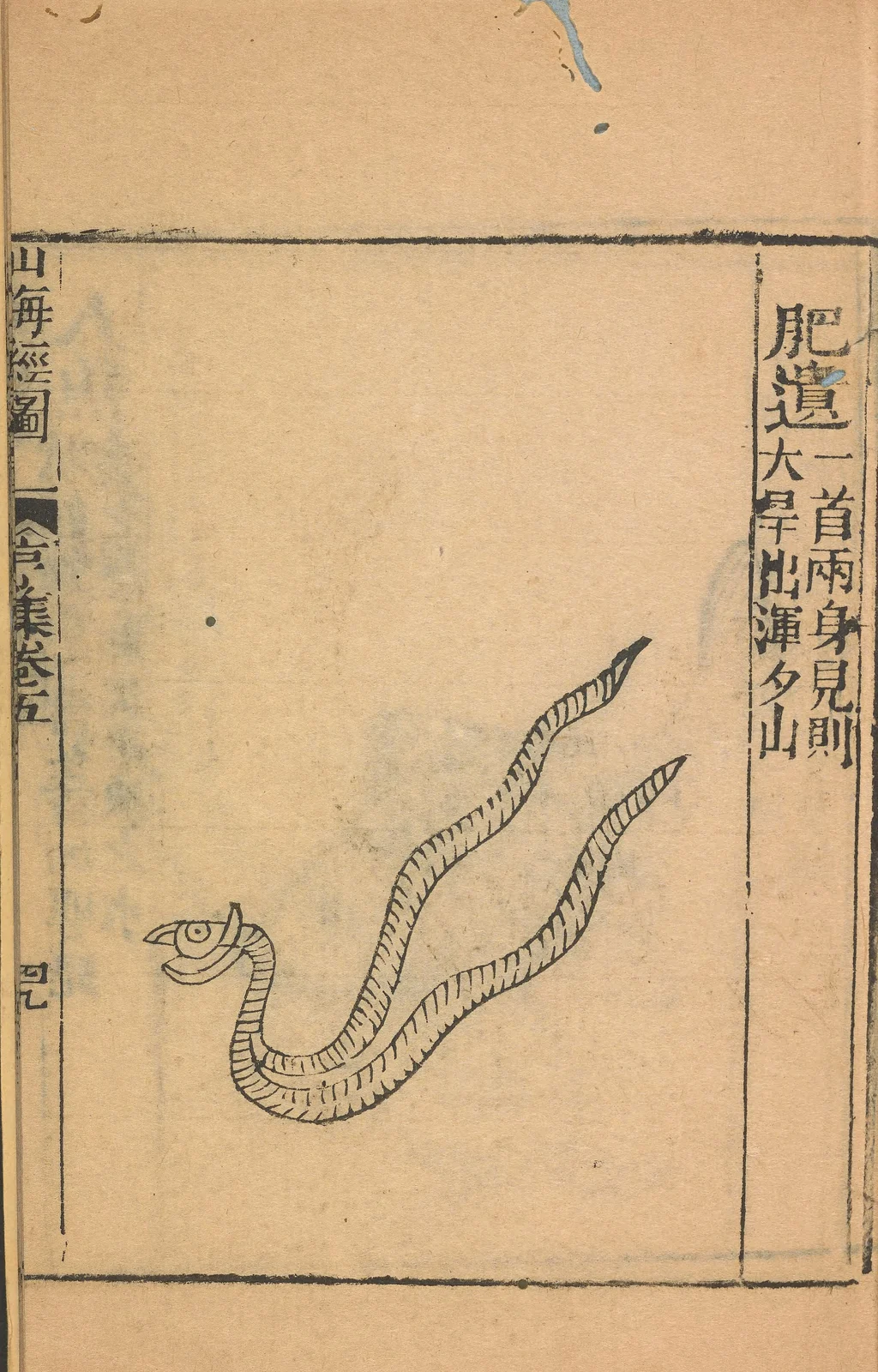
Feiyi of Mount Hunxi: one head and two bodies, Northern Mountains witness
Exact labelled1667 illustration of Northern Mountains Feiyi from Mount Hunxi: one head and two serpent bodies. This is the same-name Northern witness discussed separately in the profile, not the Western Taihua six-legged/four-winged form or the quail-like bird. Historical printed interpretation, not biological anatomy.
Overview
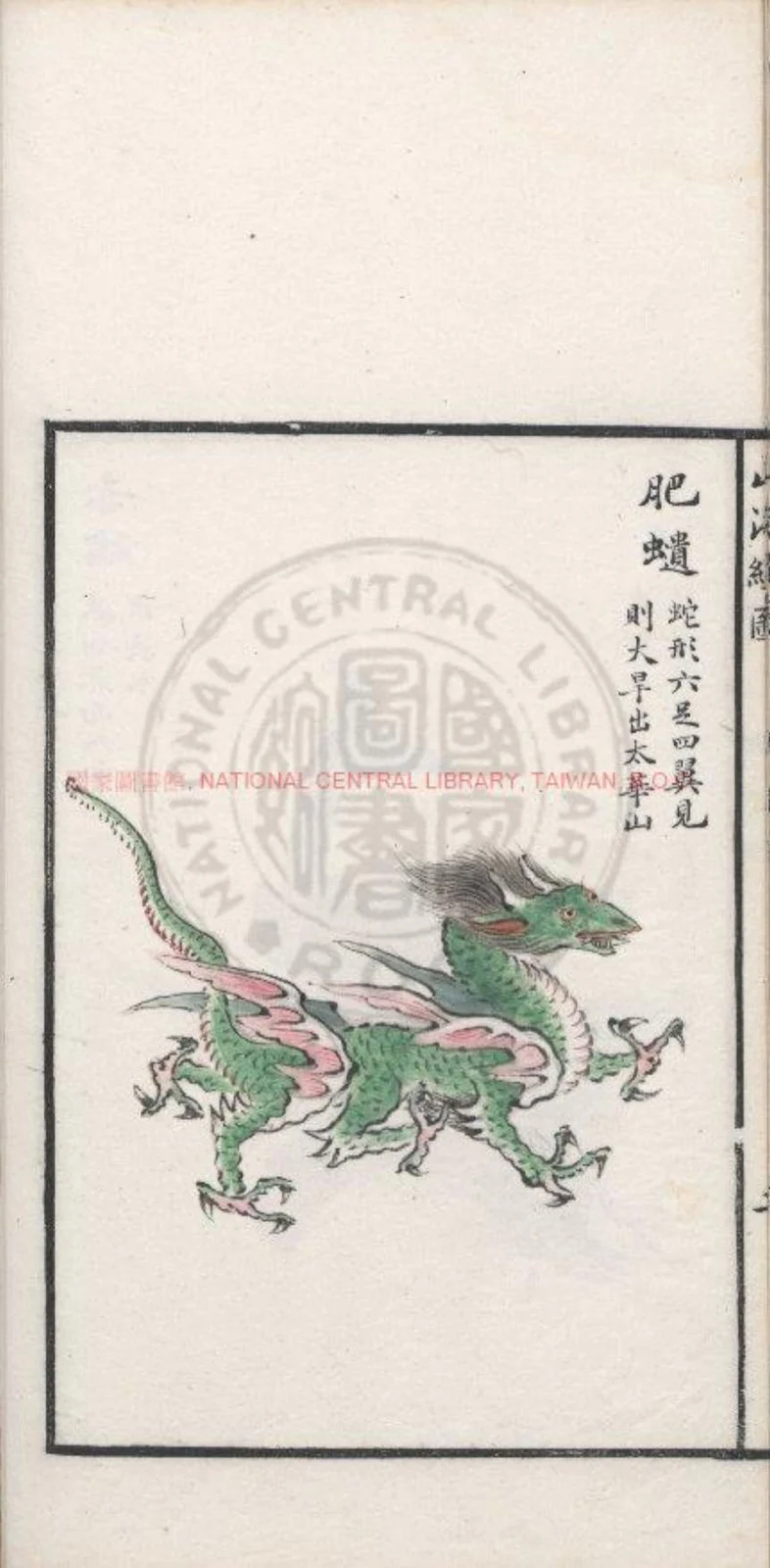
The Feiyi serpent is directly described in more than one mountain passage of the Shanhaijing, and their differences matter. In the first Western Mountains sequence, Mount Taihua contains a serpent with six feet and four wings. Its appearance is linked with great drought. The surrounding mountain description emphasizes a steep and lofty place where ordinary birds and beasts do not live, providing the setting for this extraordinary body.
The first Northern Mountains sequence places another serpent called Feiyi at Mount Hunxi. This one has a single head and two bodies. Its appearance is again associated with great drought in the country. The Northern passage does not add the six feet or four wings from Taihua. Keeping those counts source-specific avoids manufacturing a single serpent with every feature gathered from all entries.
Later in the third Northern sequence, the Fei River contains many Feiyi serpents. That brief mention supplies another locality but no detailed anatomy. It therefore strengthens the textual distribution of the name while doing little to resolve the relationship between the two fuller descriptions. Neither passage narrates a named traveller meeting or defeating the serpent.
The Western Mountains also describe a bird called Feiyi at Mount Ying. It resembles a quail, with a yellow body and a red beak, and has claimed dietary effects. That is a separately classified creature: the name alone does not establish that the bird becomes the serpent or shares its drought omen. The distinction is especially important when selecting images, because a historical plate labelled only with the romanized name could show the wrong body.
This profile gathers the serpent witnesses for comparison while preserving their anatomical alternatives and localities. The drought association is a statement of the received text, not evidence that a biological animal controls rainfall. The base text and its bracketed commentary remain separate, and the matched historical illustration below represents only the Northern Hunxi witness. Future illustration matching should identify both the printed name and the particular passage represented, including whether the artist chose the six-footed winged or double-bodied form.
In the Smithsonian digitized illustrated edition, catalogued as 1667, a one-headed serpent divides into two long bodies; the caption links its appearance to great drought at Hunxi Mountain. The engraving is a later visual interpretation of the textual creature. Its labelled page helps establish the pictured subject without treating the illustrator’s choices as evidence of an ancient animal sighting.
Origins & earliest records
China; Shanhaijing, Western Mountains
Records & interpretation
Directly read Chinese primary-text transcription; exact section and geographical passage retained. No matched scan or illustration verified.
Additional images
 View larger
 Feiyi serpent of Mount Taihua, with six feet and four wings, Qing Shanhaijing manuscript
This manuscript illustrates the Taihua Mountain witness: a serpent with six feet and four wings whose appearance is associated with great drought. Its horned head and colours are the artist’s choices. It differs from the one-headed, double-bodied Hunxi serpent shown in the other illustration.
Selected bibliography
Documented works and useful reading. This is not a list of every appearance.
- 01
Shanhaijing: Western Mountains
First western sequence; Mount Taihua 太華山; bracketed commentary distinguished from base text.
- 02
Shanhaijing, Western Mountains: Taihua serpent and Ying bird
Directly read named passage; commentary distinguished.
- 03
Shanhaijing, Northern Mountains: Hunxi serpent and Fei River
Directly read named passage; commentary distinguished.
Family & connections
A source-supported family tree or inspiration record has not yet been compiled for this profile. Related reading below indicates a connection in subject matter, not a proven lineage or creative influence.
Primary records and illustrations
Shan hai jing: er shi san juan (Smithsonian digitized edition)
Physical volume 2; Shan hai jing tu illustration sequence. IIIF canvas index 100 (zero based), labelled 肥遺; no printed page number asserted
Actual 1000-pixel page image directly inspected. A one-headed serpent divides into two long bodies; the caption links its appearance to great drought at Hunxi Mountain. Smithsonian-supplied Internet Archive catalog dates this physical volume 1667 and labels it public domain. This is the later printed illustration witness, not an image made in the ancient text’s composition period. Printed volume identification and canvas index are kept separate. Earlier directly read textual witness retained in additionalNarrativeSources.
References
Sources supporting this profile. Linked pages have their own scope and editorial standards.
- Primary-text transcriptionShanhaijing, Western Mountains: First western sequence; Mount Taihua 太華山Research access: 2026-10-05
- Primary-text transcriptionShanhaijing, Northern Mountains: Hunxi serpent and Fei RiverResearch access: 2026-10-05
- Primary illustrated bookSmithsonian Libraries digitized Shan hai jing, v.2, canvas 100: 肥遺Research access: 2026-10-05
Image credits
Historical illustrationFeiyi of Mount Hunxi: one head and two bodies, Northern Mountains witness
Exact labelled1667 illustration of Northern Mountains Feiyi from Mount Hunxi: one head and two serpent bodies. This is the same-name Northern witness discussed separately in the profile, not the Western Taihua six-legged/four-winged form or the quail-like bird. Historical printed interpretation, not biological anatomy.
Further credits appear with each additional image.