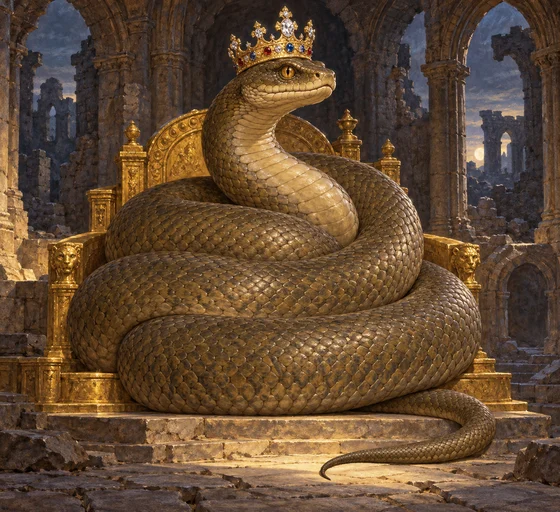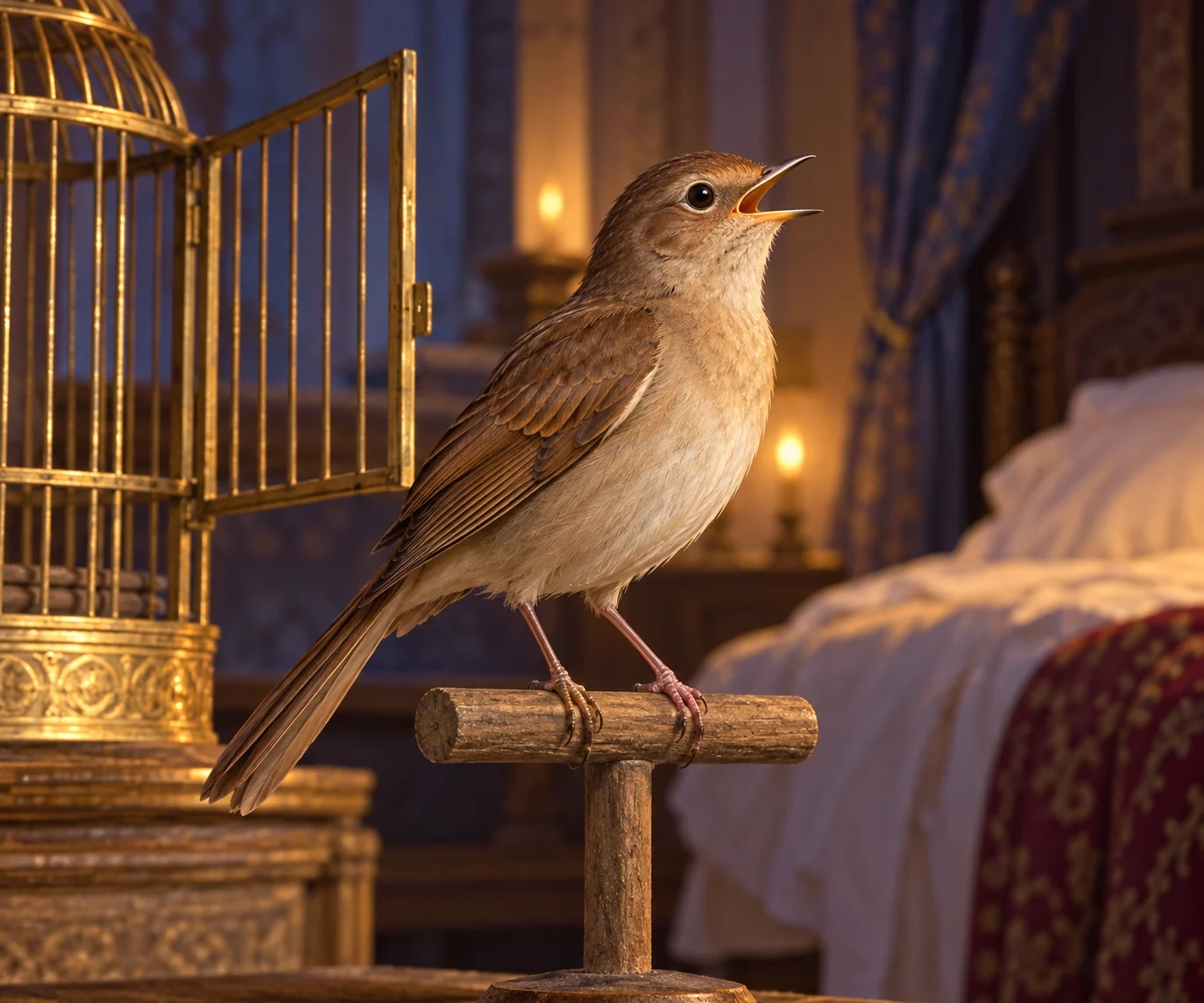
AI-generated textual reconstruction of Seklemian’s Fairy Nightingale.
Original interpretation of the narrated singing bird. Brown plumage, precise anatomy, perch, cage design and room are imagined; no metallic plumage or human form is supplied by the tale.
Overview
The Fairy Nightingale is the missing element in a king’s new church. Three successive buildings each take seven years, but at every dedication a monk appears in suffocating fog and says that something is lacking. Only when the king holds him back does he name the bird. The king’s three sons then take different roads in search of it. This opening makes the Nightingale the object of a particular quest; it does not describe an entire species of Armenian supernatural birds or give the creature another traditional name.
The youngest son receives the monk’s instructions for reaching the Fairy Queen, who owns the bird. He must respond favourably to her poisoned river and thorny grove, correct the food set before a wolf and lamb, and reverse the positions of the palace doors. Within the bedchamber, he watches the Nightingale leave its cage, stand beside the queen’s bed and sing her into sound sleep. When it returns to the cage, he steals cage and bird. The tale establishes enchanting song and a cage, but no exceptional size, metallic feathers, human head or precise plumage colour. Any detailed bird portrait therefore requires an expressly labelled reconstruction.
The queen orders the doors, animals, grove and river to stop the thief, but each refuses because of the treatment the young man has given it. He reaches the monk, entrusts him with the cage and then rescues his brothers from their own failures. On the homeward journey, those brothers leave him at the bottom of a well and carry the bird to their father, claiming that their youngest brother died during the quest. The cage is hung in the church. Its presence alone is insufficient: the Nightingale is sad and does not sing. That silence follows the brothers’ deception, while the story does not explicitly say that the bird explains their crime or speaks as a witness.
The Fairy Queen pursues the theft and challenges the brothers to describe the journey; their inability exposes their false claim. Meanwhile, women gathering barley rescue the youngest son, and one adopts him. He eventually returns, releases his imprisoned brothers and identifies himself to the queen. His account of the journey and the mark left by his earlier kiss lead her to accept him as her partner. After a forty-day wedding festival, they enter the church to marry, and the Nightingale sings a thousand and one songs. The narrator closes by saying it is still singing. This restored song completes the printed tale rather than proving that a physical bird or an actual church survived from its events.
Origins & earliest records
Seklemian’s 1898 English collection combines his personal notes with Sirwantzdiants’s Manana 1876 and Hamov-Hodov 1884, selecting between differing versions. His storyteller-address also acknowledges English editorial assistance. This is the selected printed telling, not a verbatim transcript assigned to a named oral teller.
Records & interpretation
Complete selected tale and ending, complete author’s storyteller-address and Blackwell introduction retained. The printed retelling and its editorial framing are distinguished from community-wide beliefs or natural history.
Selected bibliography
Documented works and useful reading. This is not a list of every appearance.
- 01
The Golden Maiden and Other Folk Tales and Fairy Stories Told in Armenia
Selected original historical English collection. Earlier Armenian source books are reported through Seklemian’s address, not directly consulted.
Family & connections
A source-supported family tree or inspiration record has not yet been compiled for this profile. Related reading below indicates a connection in subject matter, not a proven lineage or creative influence.
References
Sources supporting this profile. Linked pages have their own scope and editorial standards.
- Primary historical collected folklore tellingSeklemian 1898 — complete selected narrative and source contextResearch access: 2026-10-18
Image credits
AI-generatedAI-generated textual reconstruction of Seklemian’s Fairy Nightingale.
Original interpretation of the narrated singing bird. Brown plumage, precise anatomy, perch, cage design and room are imagined; no metallic plumage or human form is supplied by the tale.