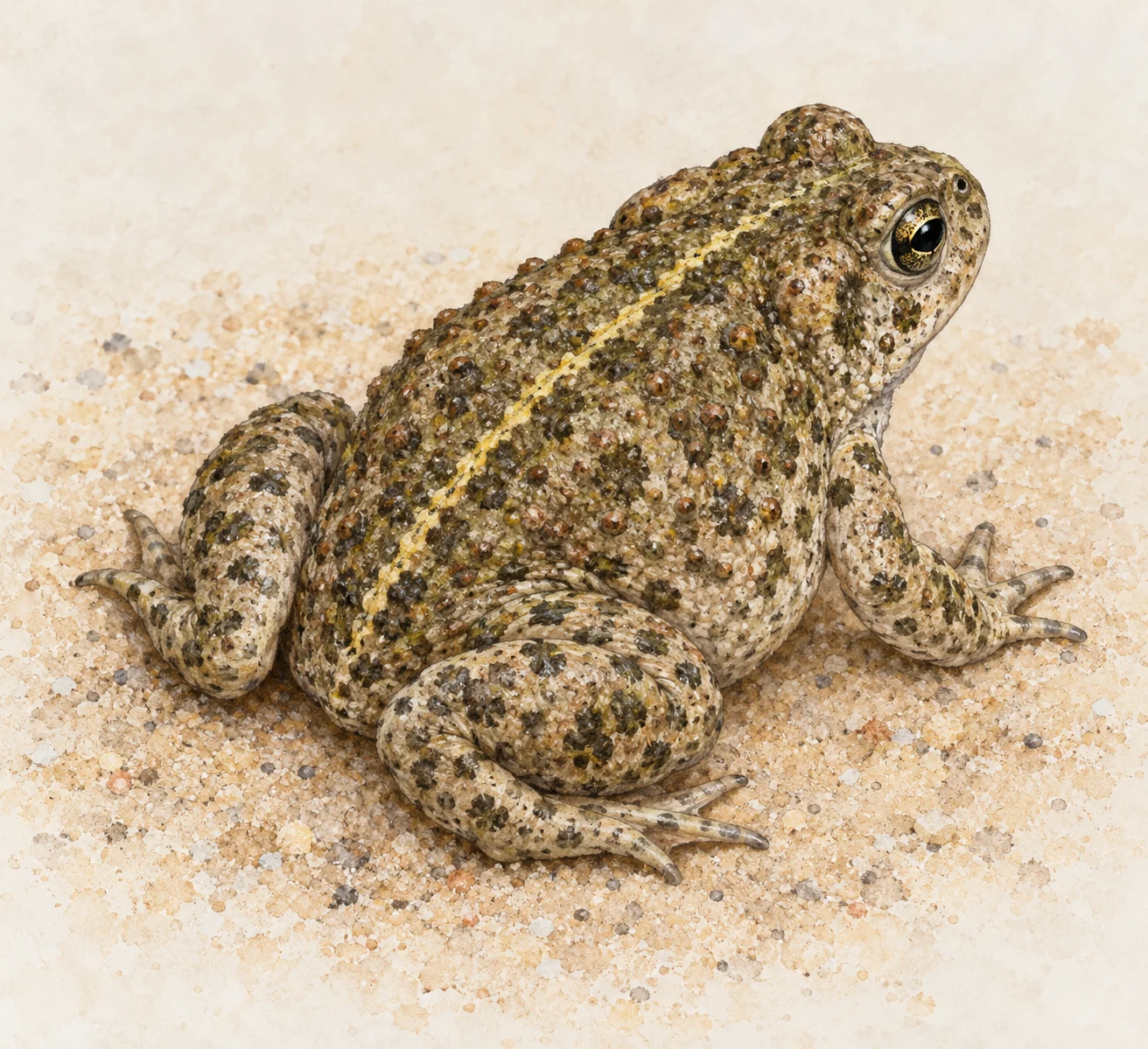
AI-generated natural-history illustration.
Independent interpretation; visible form only.
Overview
Natterjack toads have a narrow yellow stripe along the back and relatively short legs, used for walking rather than the familiar frog-like hop. Males give rasping calls beside breeding pools. Females lay two strings of eggs, usually with a single row in each; the young acquire their dorsal stripe early.
In Scotland, natterjacks occupy a few Solway coastal sites. NatureScot describes them hunting actively at night on open sandy heaths and coastal grasslands. They can dig into sand to escape daytime heat, and tolerate more saline conditions than common frogs and toads. These specialised habitats frame their regional conservation needs.
Origins & earliest records
British conservation accounts
Evidence & interpretation
Published accounts.
Selected bibliography
Documented works and useful reading. This is not a list of every appearance.
- 01
- 02
Family & connections
A source-supported family tree or inspiration record has not yet been compiled for this profile. Related reading below indicates a connection in subject matter, not a proven lineage or creative influence.
Look for a taxonomic record and classified relativesReferences
Sources supporting this profile. Linked pages have their own scope and editorial standards.
- Conservation charity accountNatterjack toadResearch access: 2026-10-18
- Conservation agency accountFrogs and ToadsResearch access: 2026-10-18
Image credits
AI-generated illustrationAI-generated natural-history illustration.
Independent interpretation; visible form only.