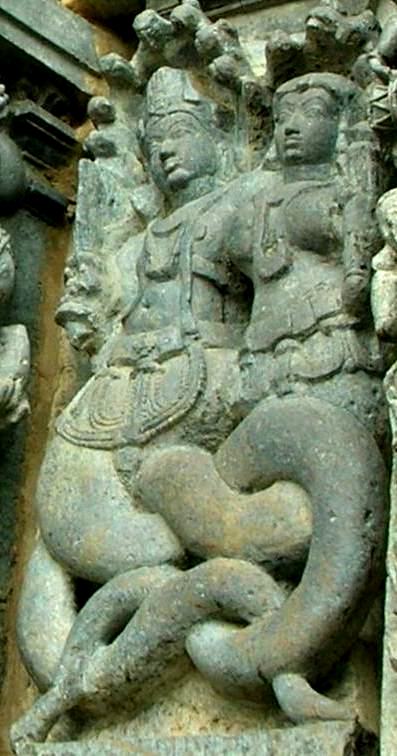
The Embopéan genie in its serpent form before the attack; appearance and chamber imagined.
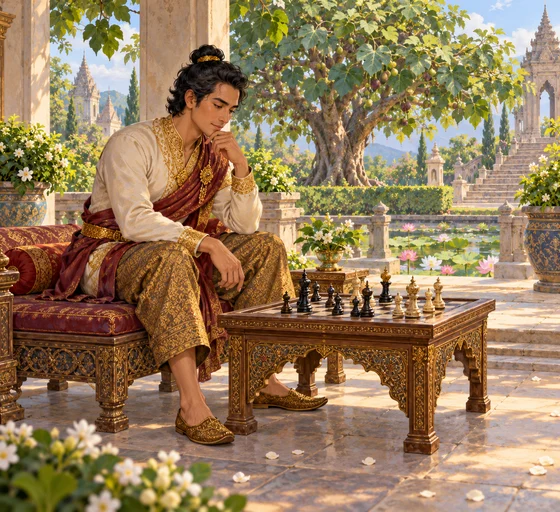
Original narrative illustration; appearance and material setting imagined, not an authenticated cultural specimen.
Overview
In the Méa Yeung narrative reported by Pavie, King Promtot hunts in the forest of Embopéan and becomes separated from his court. Only a poor man newly in royal service keeps up with him. The man serves the provisions prepared by his resourceful wife, and the satisfied king falls asleep beneath a fig tree. That tree is the favoured retreat of the forest’s most formidable genie. Offended because the king has settled there without greeting or praying to him, the spirit summons neighbouring genies. He proposes three successive attacks: breaking the fig tree’s branches over the king, bringing down his palace if he escapes, and approaching his bed at night in the form of a terrible naga if he survives again.
Méa Yeung hears the plan and wakes the king before the branches fall. Back at the palace, the king warns his household and escapes just before the walls collapse. Méa Yeung then keeps watch at another residence while the other guards fall asleep. A formidable serpent rises and approaches; the watcher kills it with his sabre. Blood splashes onto the sleeping queen, and his attempt to remove it is mistaken for an assault. The king orders his execution, but the city’s gatekeepers refuse an unlawful night departure and tell cautionary stories about innocent helpers killed in haste. By morning the king recalls the order, hears Méa Yeung’s account and has the serpent’s remains found beneath the royal bed. He acknowledges his error and rewards the rescuer and the gatekeepers. The serpent is the attacking spirit’s announced final form in this narrative, not evidence for a zoological species or a universal naga anatomy.
Origins & earliest records
Pavie attributes the telling of Méa Yeung to the Khmer companion Takiâte during a gathering with young Khmer musicians. Takiâte asks for an illustrated manuscript that Pavie says had been copied at Teuchtio, north of Battambang, so that he can show its pictures and consult its text. The story is therefore mediated by oral performance, a manuscript and Pavie’s French presentation.
Records & interpretation
Complete Méa Yeung chapter with its performance prelude and final attribution, printed pp. 78–94; full collection introduction, pp. 1–24.
Selected bibliography
Documented works and useful reading. This is not a list of every appearance.
- 01
Contes populaires du Cambodge, du Laos et du Siam
IV, Méa Yeung, pp. 78–94; introduction pp. 1–24.
Family & connections
A source-supported family tree or inspiration record has not yet been compiled for this profile. Related reading below indicates a connection in subject matter, not a proven lineage or creative influence.
References
Sources supporting this profile. Linked pages have their own scope and editorial standards.
- Historical collector’s attributed narrative accountPavie: Méa Yeung, complete original French accountResearch access: 2026-10-18
Image credits
AI-generatedThe Embopéan genie in its serpent form before the attack; appearance and chamber imagined.
Original narrative illustration; appearance and material setting imagined, not an authenticated cultural specimen.