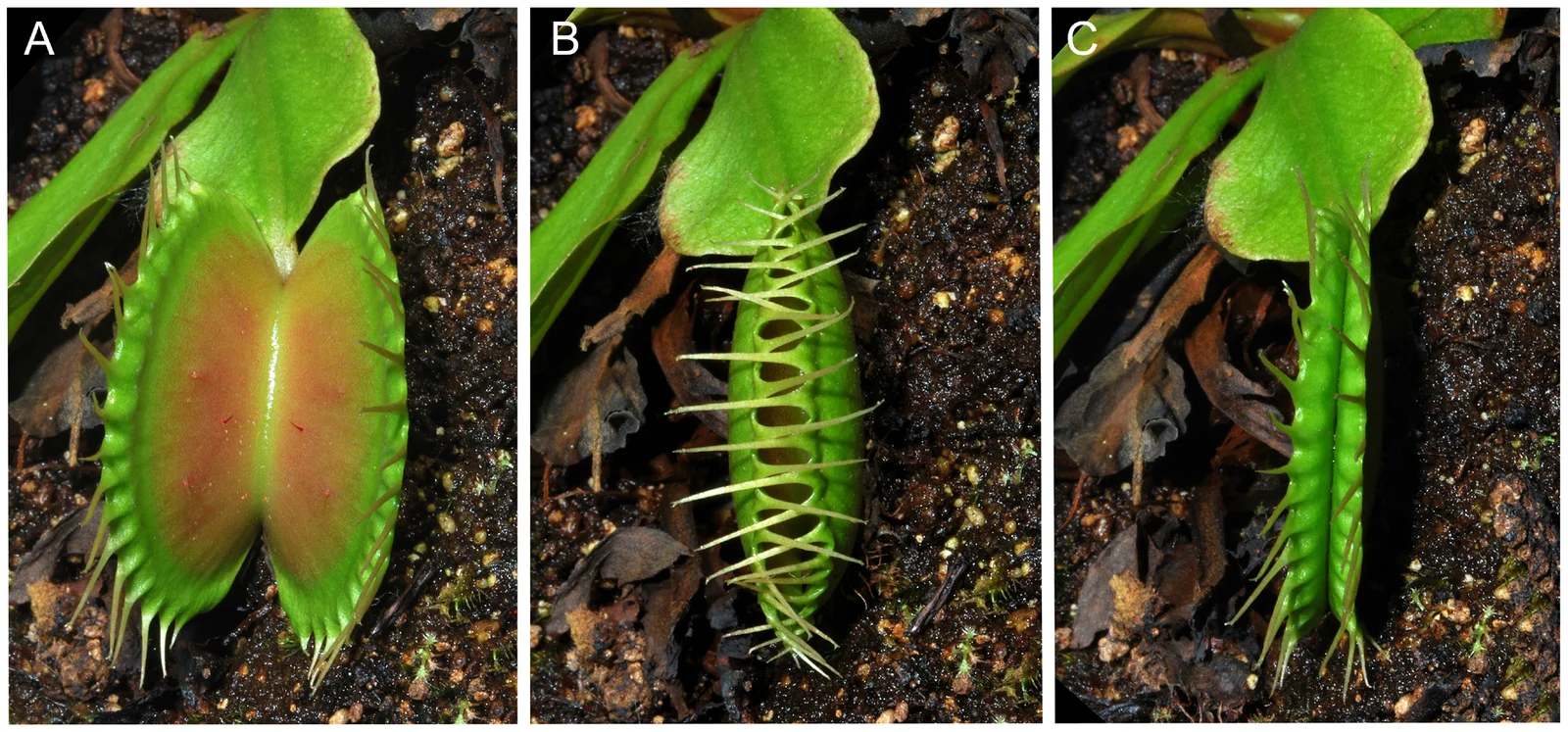
Three photographs of the same green Venus flytrap leaf: open reddish inner lobes, recently closed teeth, and a tightly narrowed trap, labelled A–C.
The same Venus flytrap trap before stimulation, one minute after its trigger hairs were stimulated twice, and three hours after repeated stimulation. The photographs show the open, closed and narrowed phases in this 2014 experiment.
Overview
The Venus flytrap, Dionaea muscipula, is a carnivorous member of Droseraceae with modified leaves that form paired snapping lobes. Its rapid closure is only one stage of a hunting cycle. A trap that shuts without retaining prey must reopen before it can capture anything again. Durak and colleagues studied this slower recovery process in two cultivated clones in 2022, separating observations of living traps from mechanical explanations of their movement.
The normal-sized clone, designated N, and a larger-trapped clone, L, were represented by herbarium vouchers FB15011 and FB15012 at Freiburg. Fifty traps per clone supplied measurements of shape. Normal traps had a median length of about 23 millimetres; the larger clone had a median near 33 millimetres and could exceed 40 millimetres. The study mechanically triggered empty traps, so its results concern reopening after unsuccessful capture rather than reopening after digestion. Cultivated clone differences should not be treated as a complete survey of wild variation.
Normal traps reopened through smooth outward bending. Larger traps could follow the same route or begin smoothly and later undergo reverse snap-buckling. That transition took minutes rather than the fractions of a second associated with fast closure. Occasional movements at the rim also occurred in both clones. The researchers suggested that interlocking marginal teeth and sticky nectar could contribute to these small movements; this was an explanation of the observations, not a separately demonstrated universal mechanism.
Digital image correlation mapped expansion and contraction on the trap surfaces. Reopening did not simply reverse the distribution of deformation during closure. Larger, more slender traps were more likely to display the unusual reopening behaviour, and some tore near the midrib as they reopened. Sections through damaged traps showed tears extending into the mesophyll while the inner lining appeared intact. Geometry therefore affects both movement and mechanical vulnerability, but slenderness alone did not explain why only a minority of large traps snapped back.
A simplified shallow-frame model illustrated how changing slenderness can alter mechanical instability. Its equilibrium paths supported a possible role for stored elastic energy during reopening; they were not direct measurements of all forces inside a living leaf. The authors retained possible contributions from physiological condition, water relations and other mechanical factors. This study demonstrates that recovery after an empty closure is a distinct, varied process, rather than merely a slow playback of capture in reverse.
Origins & earliest records
The primary account identifies a living North American wetland plant and compares two cultivated clones. It does not date the origin of the species or establish a direct ancestral organism.
Evidence & interpretation
Empty-trap time-lapse observations, morphometric measurements, surface deformation analysis and sections of broken traps support the reopening account. A simplified mechanical model and explanations involving nectar, hydration and prestress are distinguished from directly observed motion.
Selected bibliography
Documented works and useful reading. This is not a list of every appearance.
- 01
Smooth or with a Snap! Biomechanics of Trap Reopening in the Venus Flytrap (Dionaea muscipula)
Advanced Science 9:2201362, first published 1 June 2022. Complete main Introduction, Results and Discussion, Conclusion and Experimental Section with textual captions read. Supporting files, videos, figure pixels and mechanical/statistical reruns not inspected. Original explicit CC BY 4.0; attributed original summary. Main text and Table 1 give differing normal-trap median reopening times, so that precise value is omitted.
- 02
Genomes of the Venus Flytrap and Close Relatives Unveil the Roots of Plant Carnivory
Current Biology 30, 2312–2320.e5; online 14 May/issue 22 June 2020, DOI 10.1016/j.cub.2020.04.051.
Family, evolution & connections
Taxonomic classification
A hierarchy of classified groups, not a chain of direct ancestors.
- genusDionaea
- speciesDionaea muscipula
Located primary passages
Specific passages supporting details in this entry, grouped by their published witness.
Genomes of the Venus Flytrap and Close Relatives Unveil the Roots of Plant Carnivory
2020
- Draft genomes and tissue-expression comparisons support recruitment of ancestral nutrient-uptake functions into carnivorous traps. The authors infer shared duplication and later lineage-specific changes. Venus flytrap’s large genome includes extensive repetitive DNA; its draft assembly is substantially smaller than the measured genome.
Complete Introduction, Results and Discussion, STAR Methods; main captions 1–4/Table1.
An inferred evolutionary scenario, not observed historical steps. Candidate regulators lack independent functional proof here. Supplements, data, code and figure pixels unreviewed.
References
Sources supporting this profile. Linked pages have their own scope and editorial standards.
- ResearchSmooth or with a Snap! Biomechanics of Trap Reopening in the Venus Flytrap (Dionaea muscipula)Research access: 2026-10-06
Image credits
Scientific plant experimental photograph compositeThree photographs of the same green Venus flytrap leaf: open reddish inner lobes, recently closed teeth, and a tightly narrowed trap, labelled A–C.
The same Venus flytrap trap before stimulation, one minute after its trigger hairs were stimulated twice, and three hours after repeated stimulation. The photographs show the open, closed and narrowed phases in this 2014 experiment.