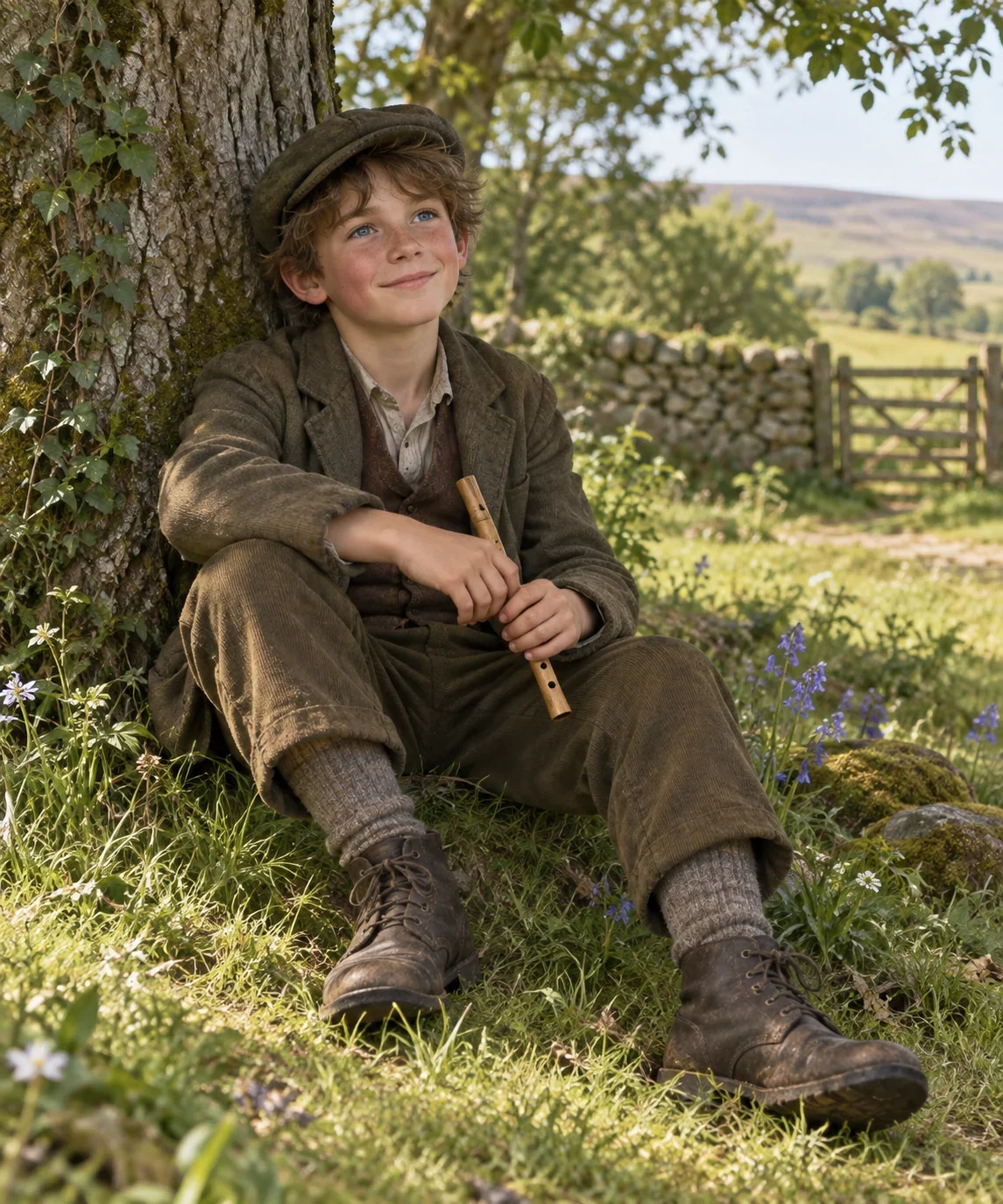
Imagined Dickon Sowerby in a quiet original-novel portrait.
Unofficial AI interpretation. Dickon rests beside a tree with his wooden pipe. Selected object or posture follows the original novel; exact portrait, unmentioned clothing and scene arrangement are imagined, without an adaptation likeness claim. Full-frame display derivative; no upscaling.
Overview
Dickon Sowerby is Martha’s twelve-year-old brother, a moorland boy whose knowledge of plants and animals makes him an important companion to Mary Lennox and Colin Craven. Before Mary meets him, Martha tells stories of his pony and of small creatures he has rescued. The family’s crowded cottage and limited food contrast with the resources of Misselthwaite Manor. These circumstances place Dickon’s competence in a working family and an outdoor childhood. He is not a manor servant assigned to obey the cousins, and the novel does not give him a formal magical office or hereditary title.
Mary first sees him sitting against a tree and playing a rough wooden pipe. His upturned nose, red cheeks and round blue eyes are part of the narrator’s portrait. A squirrel, pheasant and rabbits appear to listen nearby. His calm movements and attention to the robin help Mary trust him, and she soon asks whether he can keep her garden secret. Dickon shows her how to distinguish living wood from dead growth and how to tend the roses and emerging plants. Seeds, simple tools and shared labour make his assistance concrete. His apparent kinship with wild creatures is presented with wonder, while the practical observations supporting his gardening remain visible.
His rescued crow Soot and fox Captain recur in his company, and other animals join later scenes. They are distinct companions rather than alternate forms of the boy. Dickon understands how to move quietly, protect nests and avoid frightening animals. Mary and Colin sometimes speak as though he can charm living things, but their admiration should not be converted into a literal ability to command every species. His participation in the garden grows out of the confidence Mary places in him. He respects the enclosure’s privacy and helps preserve its growth rather than treating the discovery as an opportunity to claim ownership.
When Colin joins the secret, Dickon helps manage the chair, reassure him and support his first outdoor experiences. He takes part in the exercise and garden work through which Colin becomes stronger. He also notices the practical difficulty of feeding two children whose appetites have increased while their improvement is being concealed. His mother Susan provides food and advice, and the children’s meals make the work easier to sustain. Dickon’s steadiness contrasts with the cousins’ jealousy and outbursts, yet he remains a boy with a family and ordinary resources. This profile follows the original narrative, retaining the distinction between observed care and the children’s language of enchantment; later adaptation clothing, supernatural effects and an invented adult career remain outside its scope.
First appearances & development
Frances Hodgson Burnett’s The Secret Garden establishes this character through the children’s discovery, care and household relationships. This profile follows the selected original narrative and does not combine adaptation continuity with it.
Canon & continuity
Original narrative.
Selected bibliography
Documented works and useful reading. This is not a list of every appearance.
- 01
The Secret Garden
Original.
Family & connections
A source-supported family tree or inspiration record has not yet been compiled for this profile. Related reading below indicates a connection in subject matter, not a proven lineage or creative influence.
References
Sources supporting this profile. Linked pages have their own scope and editorial standards.
- PrimaryThe Secret GardenResearch access: 2026-10-12
Image credits
Unofficial modern AI interpretationImagined Dickon Sowerby in a quiet original-novel portrait.
Unofficial AI interpretation. Dickon rests beside a tree with his wooden pipe. Selected object or posture follows the original novel; exact portrait, unmentioned clothing and scene arrangement are imagined, without an adaptation likeness claim. Full-frame display derivative; no upscaling.