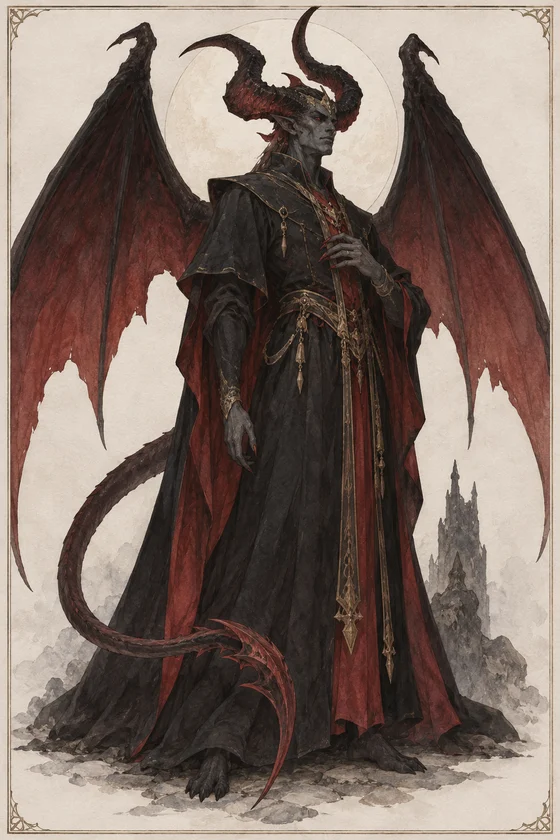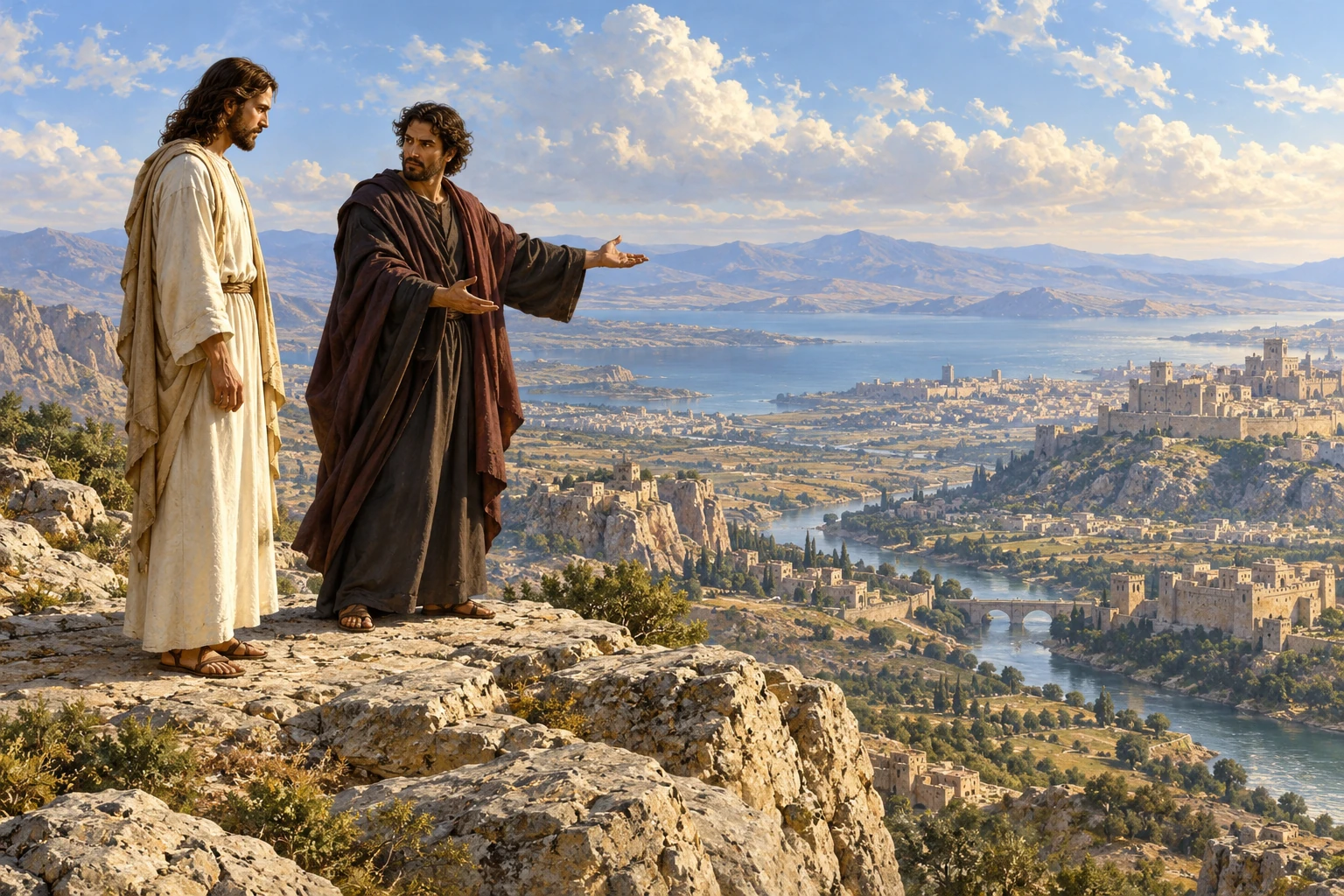
AI-generated interpretation of Matthew’s mountain temptation scene: Jesus at left and the tempter at right. The source gives no physical description of the Devil. Both faces, visible forms, clothes, gestures, landscape, settlements and architecture are imagined; no historical likeness, archaeological reconstruction or Final Fantasy design is claimed.
The humanlike tempter is an illustrative invention. The account and its religious language are attributed to the selected historical translation.
Overview
Matthew’s temptation narrative presents the Devil as the adversary who tests Jesus after a period of fasting. In Weymouth’s historical translation, the Spirit leads Jesus into the Desert, where he fasts for forty days and nights and becomes hungry. The Tempter approaches with a challenge framed around his identity as the Son of God: he should command stones to become loaves. Jesus answers with a scriptural statement that human life depends on what God appoints, rather than on bread alone. The encounter therefore begins with bodily need and a proposed demonstration of power, followed by an answer grounded in religious authority.
The Devil next takes Jesus to the Holy City and places him on the roof of the Temple. He proposes another test of divine sonship, urging Jesus to throw himself down. This time the challenge includes a scriptural quotation: angels will protect him and keep his foot from striking a stone. Jesus replies with another written instruction, rejecting the demand to put God to the proof. The Devil’s use of scripture distinguishes this exchange from a simple physical attack. The narrative records opposed uses of religious language without describing the tempter’s face, skin, wings or other bodily features.
Finally, the Devil takes Jesus to an exceedingly lofty mountain and shows him the world’s kingdoms and their splendour. He offers these in return for Jesus kneeling and paying him homage. Jesus dismisses him as Satan and insists that worship belongs to God alone. The Devil leaves, and angels come to minister to Jesus, closing the episode. The Greek wording of Matthew 4:5 in the historical Westcott–Hort text uses the term diabolos for this adversary; Weymouth renders the figure as the Devil. This selected account supplies a specific scriptural context for that word. It does not establish that a similarly named game character represents the same being or that its designers consulted this passage.
Origins & earliest records
Matthew 4:1–11; selected historical Weymouth translation, with the Greek term identified from Westcott–Hort 1881, Matthew 4:5.
Records & interpretation
Complete episode directly read; English translation and Greek lexical witness distinguished.
Selected bibliography
Documented works and useful reading. This is not a list of every appearance.
- 01
Weymouth New Testament in Modern Speech, Matthew
Retained e-text labels the third edition, 1913; Matthew 4:1–11. The original translation of 1903 is not conflated with the selected edition.
- 02
The New Testament in the Original Greek
Matthew 4:5, historical Greek reproduction at BibleHub; lexical identification only, no facsimile inspection.
Family, evolution & connections
Diabolos (Final Fantasy)
The name Diabolos permits a lexical comparison with the Greek term used for the Devil in Matthew 4:5. In the selected complete temptation account, the adversary tests Jesus through food, angelic protection and dominion over kingdoms. The wording does not establish shared identity or a documented creator source.
References
Sources supporting this profile. Linked pages have their own scope and editorial standards.
- Historical primary translationWeymouth, Matthew 4:1–11 — historical translationResearch access: 2026-10-25
- Historical primary text reproductionMatthew 4:5 — Westcott–Hort 1881 Greek text reproductionResearch access: 2026-10-25
Image credits
Modern interpretation of a scriptural narrativeAI-generated interpretation of Matthew’s mountain temptation scene: Jesus at left and the tempter at right. The source gives no physical description of the Devil. Both faces, visible forms, clothes, gestures, landscape, settlements and architecture are imagined; no historical likeness, archaeological reconstruction or Final Fantasy design is claimed.
The humanlike tempter is an illustrative invention. The account and its religious language are attributed to the selected historical translation.