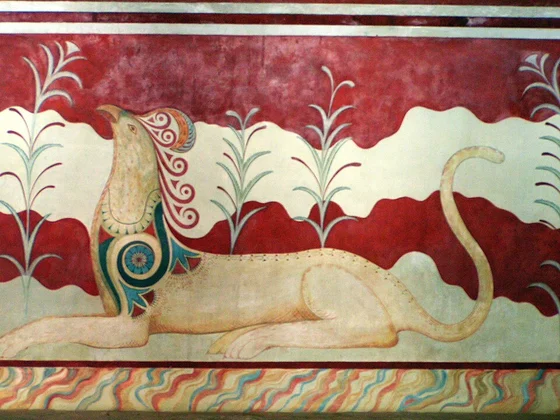
A sourced illustration has not yet been added. This gap is included in the coverage record.
Overview
Solomon tells the spirits that a girl born in Djabersa and a boy born in Djaberka will meet. A griffon declares that it will prevent their union despite divine intention. The prince visits Solomon but falls ill upon arrival; meanwhile the griffon abducts the other king’s daughter and places her on a fig tree beside the sea. Wind carries the prince’s ship toward this shore. He asks his companions to put him ashore and lies beneath the tree, where the princess throws down leaves to wake him. She says she is there with her mother and the griffon, then asks why God created no humans besides herself, her mother and Solomon. The prince explains that other people and countries exist.
The princess devises an escape that turns her captor’s transport strength against its own plan. She tells the prince to obtain a slaughtered horse and camphre to dry its hide, which is to be hung high on the mast. When the griffon returns, she weeps and asks it to take her to Solomon; it agrees to do so the following day. She instructs the prince to hide within the horse. The griffon then lifts the horse carcass containing him, and the girl also goes to Solomon. On their arrival, Solomon reminds the creature of his prediction that the pair would be reunited. Ashamed, the griffon immediately flees to an island, the printed ending rather than a narrated death or punishment by the reunited pair.
Basset’s adjacent notes discuss a separately reported Maghreb anqa legend in which an abducted bride prompts a prophet’s appeal and divine removal of the creature to an inaccessible ocean island. In the Aïn Sfisifa story, however, the griffon itself retreats in shame after the horse concealment succeeds. The notes also compare this transport stratagem with Sindbad and other bird-and-carcass narratives. These are the editor’s comparative accounts and proposed relationships, not additional actions by this griffon or evidence that the princess lived with the other legends’ elephants and rhinoceroses. The original source note specifically names Ahmed ben Mohammed’s Tlemcen dictation in 1883.
Origins & earliest records
René Basset, Contes populaires berbères (Paris, 1887), no. 13, Salomon et le griffon, complete pp. 27–28. Source note 22, p. 149, names Ahmed ben Mohammed of Aïn Sfisifa as the contributor who dictated the Berber text at Tlemcen in 1883. The preface separately describes the two-tailor collection context.
Records & interpretation
Complete original narrative inspected in DjVu pages 65–66; original note 22 inspected in page 187, printed p. 149. It explicitly names Ahmed ben Mohammed and the 1883 Tlemcen dictation. Its reference to an earlier 1885 transcription, pp. 413–416, is a bibliographic lead, not an independently inspected second witness. Generic griffin is a comparison, not an asserted morphology match. Original comparative notes 23–24, printed pp. 150–151, inspected on pages 188–189; their mediated anqa exile and bird-transport comparisons are separately attributed, without claiming the cited works were independently read.
Selected bibliography
Documented works and useful reading. This is not a list of every appearance.
- 01
Contes populaires berbères
No. 13, complete pp. 27–28; source note 22, p. 149; preface xiii–xiv. Comparative notes 23–24, pp. 150–151, distinguished from main episode.
Family & connections
A source-supported family tree or inspiration record has not yet been compiled for this profile. Related reading below indicates a connection in subject matter, not a proven lineage or creative influence.
References
Sources supporting this profile. Linked pages have their own scope and editorial standards.
- Primary collected narrative; original facsimile inspectedOriginal edition, Solomon and the griffonResearch access: 2026-10-05
Image credits
A sourced illustration has not yet been added. This gap is included in the coverage record.