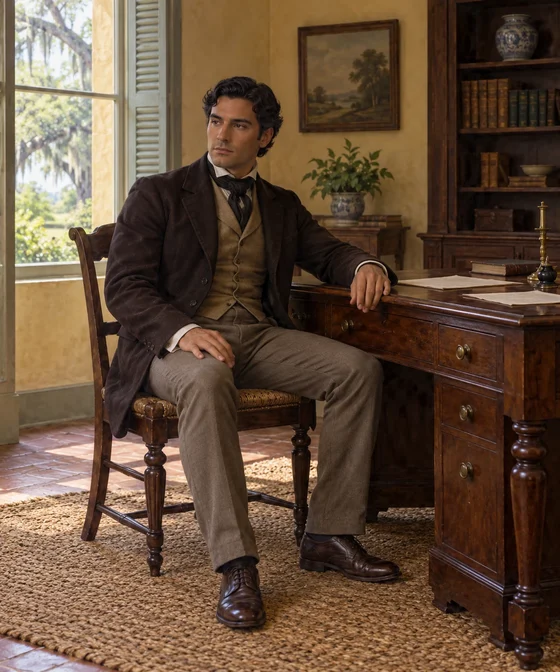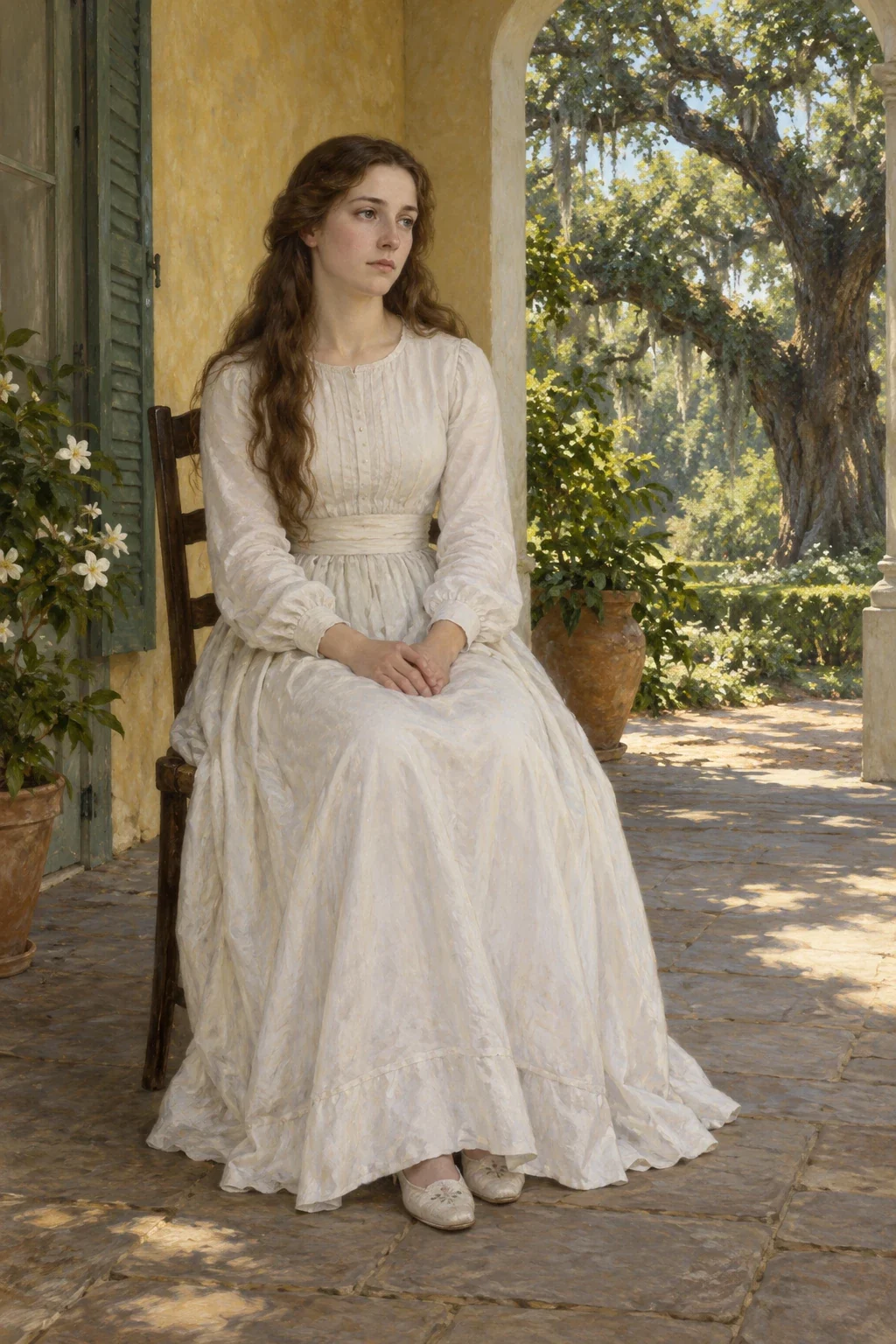
Original AI literary interpretation.
Overview
Désirée is found as a toddler asleep beside the stone gateway of Valmondé and adopted by its childless owners. Her original parentage is unknown: rumours about travellers do not establish it. She grows into a beautiful, gentle, affectionate and sincere young woman. Eighteen years after her discovery, Armand Aubigny falls passionately in love with her. Her adoptive father raises the uncertainty of her origin, but Armand initially dismisses it, believing that his own prestigious Louisiana name is sufficient. After their marriage and the birth of a son, Désirée delights in his pride and in the temporary easing of his harsh treatment of enslaved people.
Her happiness depends painfully upon his approval. When the child is about three months old, Armand withdraws from both mother and baby and becomes cruel again toward the people he enslaves. Désirée perceives a resemblance between her baby and a child attending him, then asks her husband what it means. He asserts that neither the child nor she is white. She denies this by pointing to her brown hair, gray eyes and fair skin, but those comparisons express the racist categories governing her situation; they are not a reliable means of determining anyone's ancestry. Armand's accusation is not established as a fact about her parentage.
Madame Valmondé answers Désirée's desperate appeal with an invitation to return home with her child. Armand instead tells her to leave and makes no answer to her farewell. Still wearing a thin white garment and slippers, with her brown hair uncovered, she carries the baby away. She avoids the road to Valmondé and disappears among the reeds and willows beside the bayou, never returning. The text does not show a death or establish a precise manner of death. Its final letter reveals that Armand's own mother belonged to the population marked by slavery, overturning his confidence in his family identity without resolving Désirée's origins or depicting a rescue.
First appearances & development
Individual in Kate Chopin’s authored English tale Désirée’s Baby. Historical racial categories and slavery form the fictional social conflict, not a reliable system for reading ancestry from appearance.
Canon & continuity
Complete 48-paragraph original English narrative and retained title, author, publisher, imprint, date and complete contents read. No whole-collection or independently inspected physical-copy claim.
Selected bibliography
Documented works and useful reading. This is not a list of every appearance.
- 01
Bayou Folk - Désirée’s Baby
Year is the retained Houghton, Mifflin and Company collection title; no first-appearance or independently verified physical-copy claim.
Family & connections
A source-supported family tree or inspiration record has not yet been compiled for this profile. Related reading below indicates a connection in subject matter, not a proven lineage or creative influence.
References
Sources supporting this profile. Linked pages have their own scope and editorial standards.
- Primary authored literary narrativeDésirée’s Baby - complete original English tale and retained collection framingResearch access: 2026-10-21
Image credits
AI-generated illustrationOriginal AI literary interpretation.