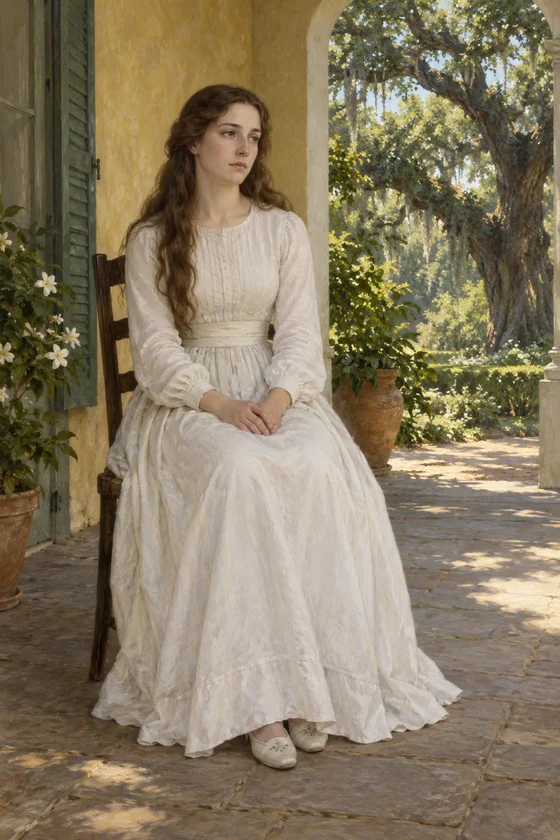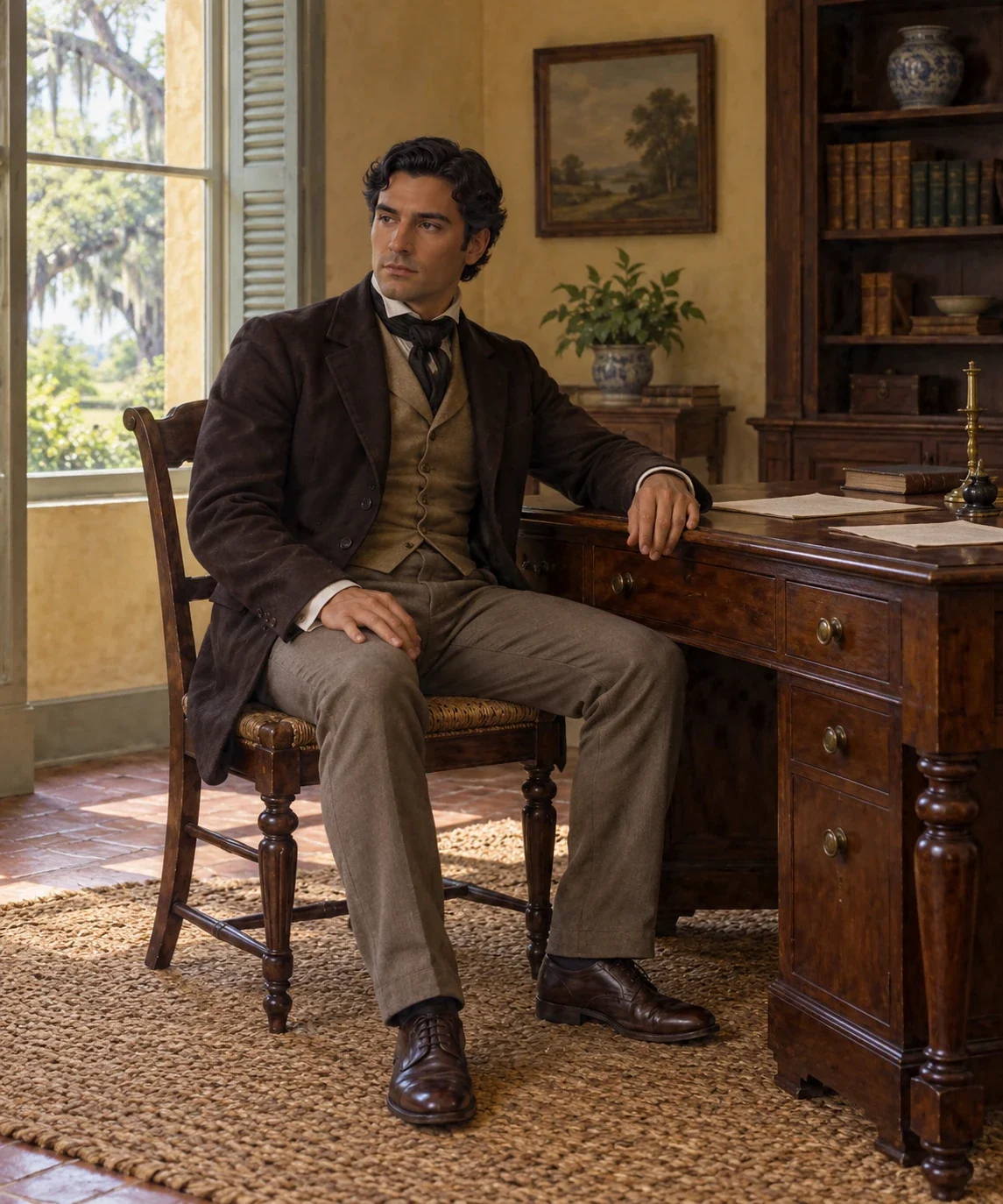
Original AI literary interpretation.
Overview
Armand Aubigny is the young master of L’Abri, a yellow-stuccoed Louisiana plantation house shadowed by large oaks. His father brought him from Paris at eight after his mother died there. Proud of his family name, he rules the enslaved population harshly. His sudden love for Désirée seems to sweep aside practical objections about her unknown parentage, and he orders her wedding gifts from Paris. Marriage and the birth of their son temporarily soften his imperious nature. The narrative describes his face as dark and handsome; neither that description nor his wife's later comparison of their hands supplies a biological test of ancestry.
When the baby is about three months old, Armand avoids his wife and child and renews his cruelty toward enslaved people. Asked to explain the child's appearance, he tells Désirée that the child is not white and therefore she is not white. He treats his own social standing as secure and her unknown origin as sufficient blame. When Madame Valmondé offers Désirée and the baby a home, Armand insists that they go. The narration exposes his self-justification: he feels wronged by God and imagines his rejection of his wife as a retaliation against that injustice. This account of his reasoning does not make his accusation true or his conduct justified.
Some weeks after Désirée's departure, he directs enslaved workers to burn the cradle, clothing and wedding finery associated with mother and child. While gathering her old letters, he finds a fragment written by his own mother to his father. She thanks God that their son will never know that she belongs to the race branded by slavery. The revelation locates the ancestry he has feared within his own family. The tale ends with the letter, without narrating his reaction, a change in his treatment of enslaved people, or any attempt to find Désirée. The portrait therefore presents the fictional plantation owner in his study, without inventing redemption or turning racial ancestry into a visual code.
First appearances & development
Individual in Kate Chopin’s authored English tale Désirée’s Baby. Historical racial categories and slavery form the fictional social conflict, not a reliable system for reading ancestry from appearance.
Canon & continuity
Complete 48-paragraph original English narrative and retained title, author, publisher, imprint, date and complete contents read. No whole-collection or independently inspected physical-copy claim.
Selected bibliography
Documented works and useful reading. This is not a list of every appearance.
- 01
Bayou Folk - Désirée’s Baby
Year is the retained Houghton, Mifflin and Company collection title; no first-appearance or independently verified physical-copy claim.
Family & connections
A source-supported family tree or inspiration record has not yet been compiled for this profile. Related reading below indicates a connection in subject matter, not a proven lineage or creative influence.
References
Sources supporting this profile. Linked pages have their own scope and editorial standards.
- Primary authored literary narrativeDésirée’s Baby - complete original English tale and retained collection framingResearch access: 2026-10-21
Image credits
AI-generated illustrationOriginal AI literary interpretation.