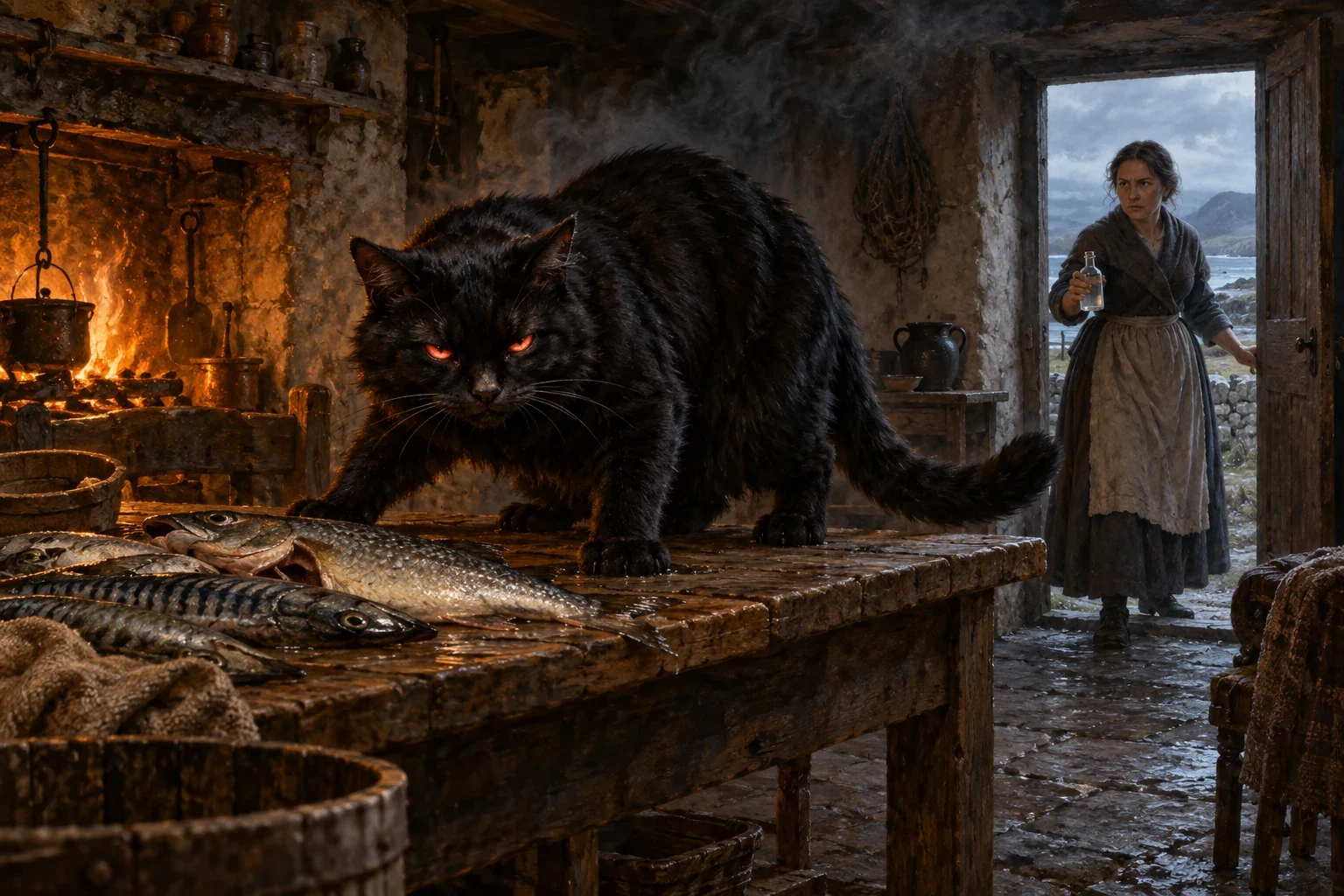
AI-generated interpretation of Lady Wilde’s Demon Cat of Connemara. The black cat, fish, red eyes and woman’s holy-water response are source-based; the composed confrontation, cottage, bottle, clothing and coastal view are artistic reconstruction. Smoke combines elements of the tale rather than documenting one witnessed instant.
AI-generated interpretation of Lady Wilde’s Demon Cat of Connemara. The black cat, fish, red eyes and woman’s holy-water response are source-based; the composed confrontation, cottage, bottle, clothing and coastal view are artistic reconstruction. Smoke combines elements of the tale rather than documenting one witnessed instant.
Overview
A fisherman’s wife in Connemara has plentiful fish ready for market, but a large cat repeatedly comes at night and eats the finest pieces. In Lady Wilde’s telling, the nuisance becomes an openly supernatural confrontation. While women are working in the house, daylight abruptly darkens and the door bursts open. A huge black cat walks to the hearth. When a young girl calls it the devil, it answers her and scratches her arm, then shuts the door to prevent anyone leaving.
A passing man hears the cries and tries to enter. The cat blocks the doorway, withstands his stick and tears his face and hands until he flees. It then announces its dinner and begins eating the fish. The mistress strikes it with the tongs, and both women attack it with sticks, but the blows do not stop it. It spits fire and wounds them, driving them from the house. Its speech, control of the threshold and resistance to ordinary blows distinguish the encounter from the earlier loss of food.
The mistress returns with holy water and quietly throws it on the cat. A dense black cloud fills the house; only its red eyes remain visible through the smoke. As the cloud clears, the creature’s body burns, shrivels into a cinderlike remnant and disappears. The fish are safe thereafter, and the narrator declares that the evil power has been broken. This is the complete resolution of a particular Christian-framed tale, not a claim that ordinary cats are demonic or that holy water has a generally verified physical effect.
Yeats prints the story under The Devil, credits Lady Wilde and names Ancient Legends of Ireland in note56. The locality supplied is Connemara; no village, household identity or historical date is given. The speaking aggressor is not identified here as a Gaelic cat sìth, a witch in disguise or the King of the Cats. Those would add identities not established by this witness.
Origins & earliest records
Source-specific narrative in Fairy and Folk Tales of the Irish Peasantry, edited and selected by W. B. Yeats. The retained title names Walter Scott Publishing Co., Ltd., London and Felling-on-Tyne, with a New York address; its physical print year is not stated.
Records & interpretation
Complete selected account, byline, ending and attached note where present read from retained Project Gutenberg33887 witness. Claims remain attributed to the narrator.
Selected bibliography
Documented works and useful reading. This is not a list of every appearance.
- 01
Fairy and Folk Tales of the Irish Peasantry, edited and selected by W. B. Yeats
Printed pp.229–230. Note56.
Family & connections
A source-supported family tree or inspiration record has not yet been compiled for this profile. Related reading below indicates a connection in subject matter, not a proven lineage or creative influence.
References
Sources supporting this profile. Linked pages have their own scope and editorial standards.
- Historical primary literary/folklore collectionFairy and Folk Tales of the Irish Peasantry, edited and selected by W. B. Yeats — complete selected account and apparatusResearch access: 2026-10-27
Image credits
Modern AI interpretation of a historical accountAI-generated interpretation of Lady Wilde’s Demon Cat of Connemara. The black cat, fish, red eyes and woman’s holy-water response are source-based; the composed confrontation, cottage, bottle, clothing and coastal view are artistic reconstruction. Smoke combines elements of the tale rather than documenting one witnessed instant.
AI-generated interpretation of Lady Wilde’s Demon Cat of Connemara. The black cat, fish, red eyes and woman’s holy-water response are source-based; the composed confrontation, cottage, bottle, clothing and coastal view are artistic reconstruction. Smoke combines elements of the tale rather than documenting one witnessed instant.