A sourced illustration has not yet been added. This gap is included in the coverage record.
Overview
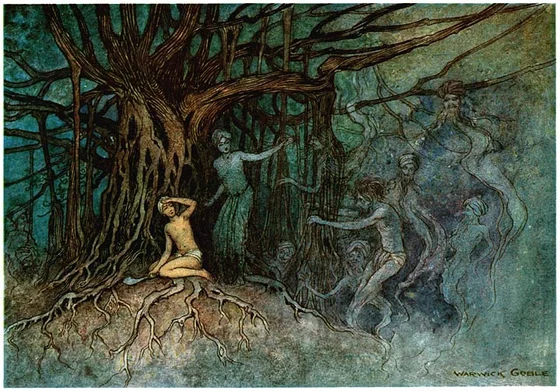
Six skulls stand in niches of Kali’s temple after a mendicant has killed their former owners in his attempt to attain supernatural perfection. They laugh when a prince enters, explaining that he is intended to become their seventh companion. One speaks for the group and tells him how to turn the intended execution against the mendicant.
The prince asks his captor to demonstrate the required bow, then kills him while he is prostrate. The skulls laugh again, rejoin their respective bodies and become living men, while Kali favors the prince. This is the folktale’s account of a particular murderous practitioner and his defeated scheme; it does not establish human sacrifice as the conduct of all worshippers of Kali or supply a practical ritual.
Origins & earliest records
Bengali oral storytelling translated by Lal Behari Day
Records & interpretation
Complete relevant tale, attached notes,1883 preface and1912 edition credits directly read.
Selected bibliography
Documented works and useful reading. This is not a list of every appearance.
- 01
Folk-Tales of Bengal
XIII, The Man who wished to be Perfect, pp.185–187, within complete tale178–187; first edition1883, illustrationsWarwickGoble
Family & connections
A source-supported family tree or inspiration record has not yet been compiled for this profile. Related reading below indicates a connection in subject matter, not a proven lineage or creative influence.
Primary records and illustrations
Lal Behari Day, Folk-Tales of Bengal (Macmillan,1912; first edition1883)
XIII. XIII, The Man who wished to be Perfect, pp.185–187, within complete tale178–187
Complete tale and footnotes read, pluspreface andeditionhistory. Bengali oral informants described collectively, individual teller of this tale not identified. Original paraphrase; no source-image verification claimed.
References
Sources supporting this profile. Linked pages have their own scope and editorial standards.
- Historical translated oral narrative and collector notesLal Behari Day, Folk-Tales of Bengal (1912), XIII, The Man who wished to be Perfect, pp.185–187, within complete tale178–187Research access: 2026-10-05
Image credits
A sourced illustration has not yet been added. This gap is included in the coverage record.