A sourced illustration has not yet been added. This gap is included in the coverage record.
Overview
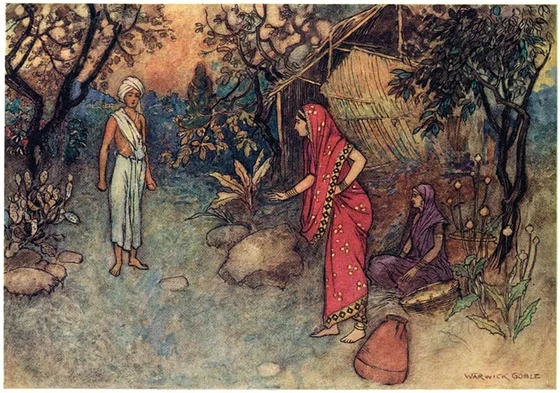
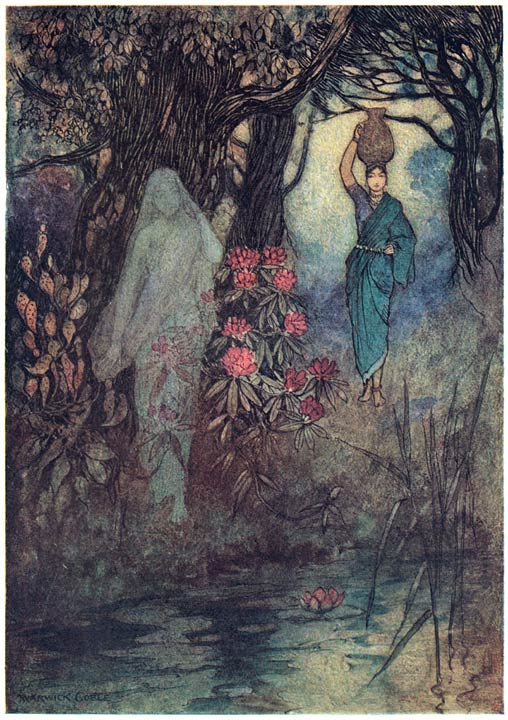
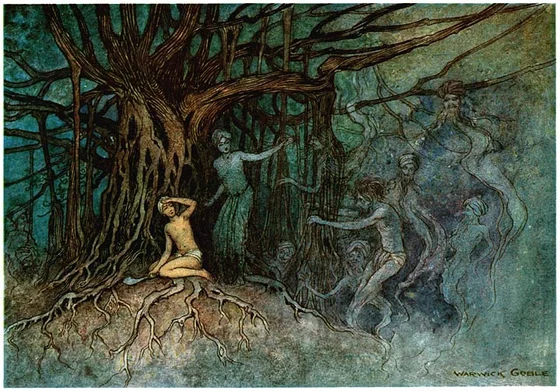
Seven hundred Rakshasas occupy a country after consuming its king, inhabitants and cattle. They forage beyond the ocean by day and return at dusk. An old Rakshasi protects the sole remaining princess, Keshavati, from her companions, killing her with a silver stick each morning and reviving her with a golden one each evening. Champa Dal conceals himself beneath sacred trefoil in the palace’s Shiva temple.
Persuaded that the girl fears losing her protector, the old Rakshasi reveals their collective life-secret: two bees rest atop a submerged crystal pillar. A person must retrieve them in one breath and destroy them without letting their blood touch the ground. She says each fallen drop would produce a thousand Rakshasas; this multiplication remains a threatened consequence, not an event the story enacts.
Champa retrieves the bees and kills them over ashes, catching the blood there. The approaching Rakshasas all die, some nearly reaching the palace gate. The old guardian’s claimed practical immortality is thus disproved within the tale. This particular group’s shared vulnerability is not presented here as a universal rule for all Rakshasas.
Origins & earliest records
Bengali oral storytelling translated by Lal Behari Day
Records & interpretation
Complete relevant tale, attached notes,1883 preface and1912 edition credits directly read.
Selected bibliography
Documented works and useful reading. This is not a list of every appearance.
- 01
Folk-Tales of Bengal
IV, The Story of the Rakshasas, pp.77–82; complete tale61–88 and notes; first edition1883, illustrationsWarwickGoble
Family & connections
A source-supported family tree or inspiration record has not yet been compiled for this profile. Related reading below indicates a connection in subject matter, not a proven lineage or creative influence.
Primary records and illustrations
Lal Behari Day, Folk-Tales of Bengal (Macmillan,1912; first edition1883)
IV. IV, The Story of the Rakshasas, pp.77–82; complete tale61–88 and notes
Complete tale and footnotes read, pluspreface andeditionhistory. Bengali oral informants described collectively, individual teller of this tale not identified. Original paraphrase; no source-image verification claimed.
References
Sources supporting this profile. Linked pages have their own scope and editorial standards.
- Historical translated oral narrative and collector notesLal Behari Day, Folk-Tales of Bengal (1912), IV, The Story of the Rakshasas, pp.77–82; complete tale61–88 and notesResearch access: 2026-10-05
Image credits
A sourced illustration has not yet been added. This gap is included in the coverage record.