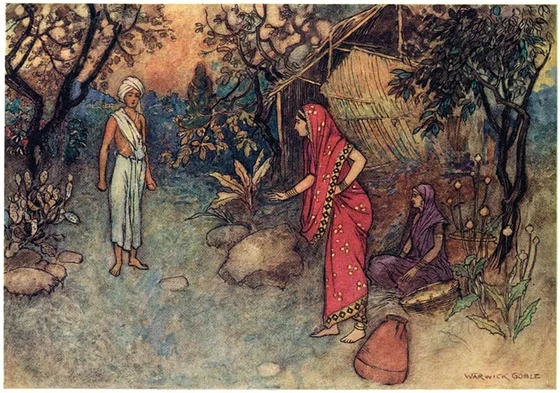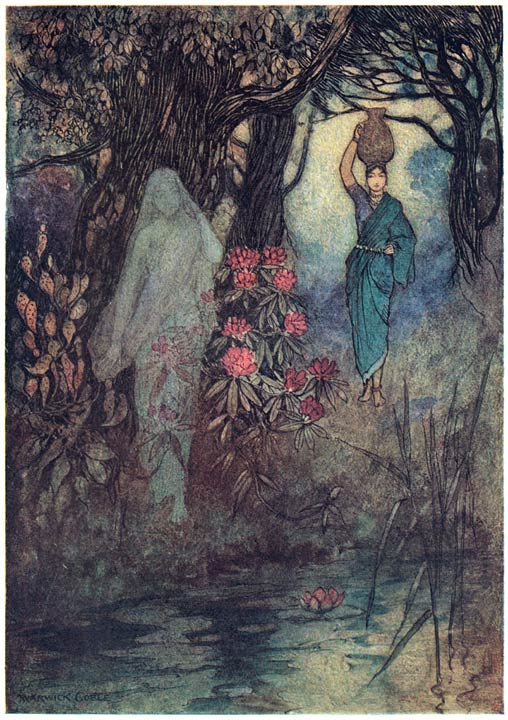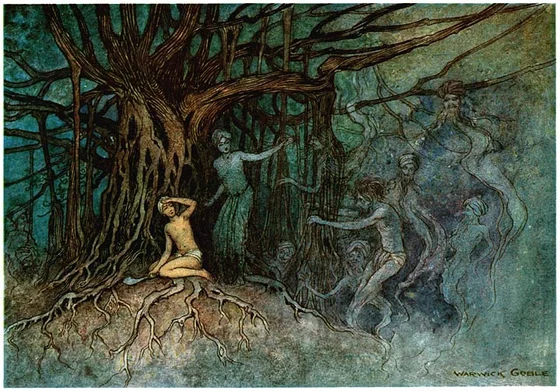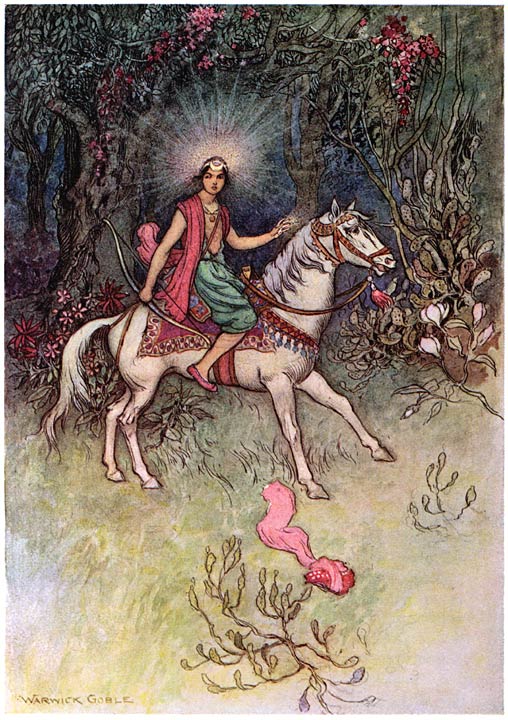
Boy with the moon on his forehead riding after his turban falls, Warwick Goble illustration published 1912
The youth’s turban falls while he hunts, revealing the luminous moon on his forehead to the king. The radiating halo, crescent design, costume and horse belong to Goble’s interpretation; the stars on his palms are not visible in this scene.
Overview
A poor woman’s daughter predicts that she will bear twins: a beautiful girl and a boy with the moon on his forehead and stars on his palms. After she marries the king, jealous co-wives arrange the infants’ removal and substitute puppies. A potter and his wife find the twins among pots that have inexplicably baked without their fire. The siblings grow up in that household, then settle in the royal bazaar. The boy conceals his luminous forehead with a turban; when it falls during hunting, the king recognizes the marks promised by his seventh wife.
Sent to obtain kataki flowers for his sister, he rides a pakshiraj and wins assistance from a Rakshasi and Rakshasa by calling them aunt and uncle and presenting hunted game. These forms of address establish protection, not stated blood kinship. Following their advice, he addresses a thorn forest and the ocean as mothers, and both open a path. He rescues Pushpavati by destroying the two bees on which seven hundred Rakshasas depend, catching their blood on his body. Pushpavati later explains his family’s history to the king, securing the twins’ and their mother’s recognition.
Origins & earliest records
Bengali oral storytelling translated by Lal Behari Day
Records & interpretation
Complete relevant tale, attached notes,1883 preface and1912 edition credits directly read.
Selected bibliography
Documented works and useful reading. This is not a list of every appearance.
- 01
Folk-Tales of Bengal
XIX, The Boy with the Moon on his Forehead, pp. 227–247 and three notes
Family & connections
A source-supported family tree or inspiration record has not yet been compiled for this profile. Related reading below indicates a connection in subject matter, not a proven lineage or creative influence.
Primary records and illustrations
Lal Behari Day, Folk-Tales of Bengal (Macmillan,1912; first edition1883)
XIX. XIX, The Boy with the Moon on his Forehead, pp. 227–247 and three notes
Complete XIX through closing formula and all three notes directly read. Gold-stick head/feet distinction retained; XIX wooden-box and blood conditions not merged with IV. Original paraphrase; no source-image inspection claimed.
References
Sources supporting this profile. Linked pages have their own scope and editorial standards.
- Historical translated oral narrative and collector notesDay, Folk-Tales of Bengal (1912), XIX, The Boy with the Moon on his Forehead, pp. 227–247 and three notesResearch access: 2026-10-05
Image credits
Historical illustrationBoy with the moon on his forehead riding after his turban falls, Warwick Goble illustration published 1912
The youth’s turban falls while he hunts, revealing the luminous moon on his forehead to the king. The radiating halo, crescent design, costume and horse belong to Goble’s interpretation; the stars on his palms are not visible in this scene.