A sourced illustration has not yet been added. This gap is included in the coverage record.
Overview
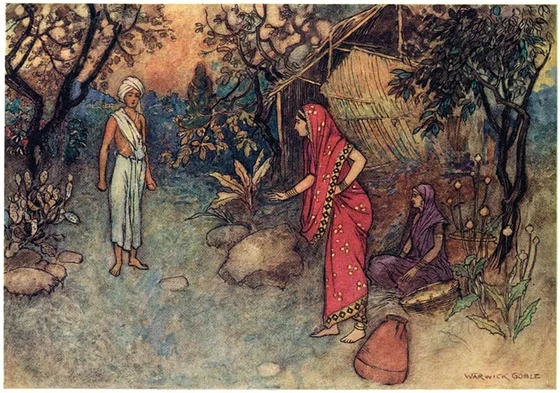
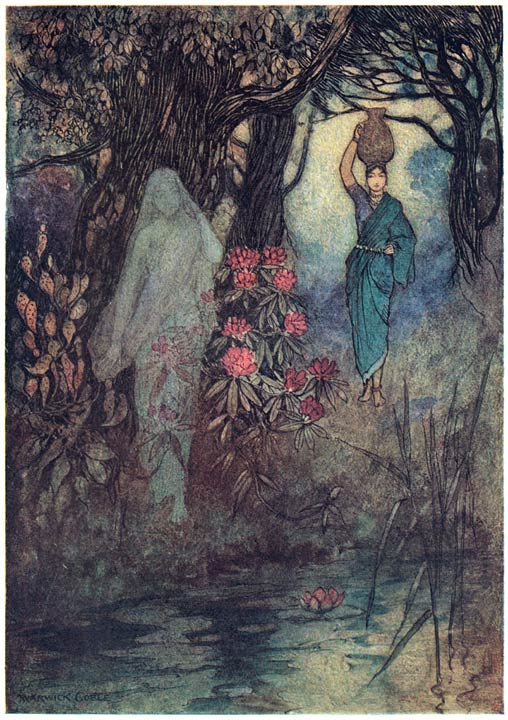
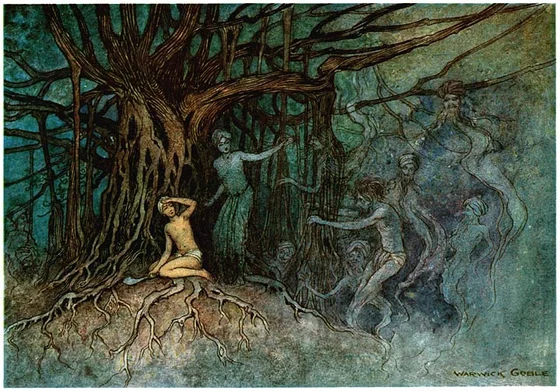
The seven hundred Rakshasas guard kataki gardens beyond an ocean and a thorn forest. They leave to hunt and return with a noise compared to a mighty tempest. One Rakshasi holds Pushpavati captive and repeatedly kills and revives her with magical sticks. While being attended by the girl, she explains that a wooden box at the bottom of a tank contains a male and female bee. A human with the moon on his forehead and stars on his palms can kill the company by crushing both bees without spilling their blood on the ground.
The Rakshasi regards these conditions as practically impossible. She threatens that spilled blood would allow the company to tear the intruder into seven hundred pieces. The destined youth instead retrieves the box, crushes the bees and smears every drop of blood on his body; the returning Rakshasas fall dead outside the gardens. Unlike the fourth tale’s Keshavati episode, this account specifies a wooden box rather than a crystal pillar and does not threaten multiplication from fallen blood. The two groups are kept as distinct narrative witnesses.
Origins & earliest records
Bengali oral storytelling translated by Lal Behari Day
Records & interpretation
Complete relevant tale, attached notes,1883 preface and1912 edition credits directly read.
Selected bibliography
Documented works and useful reading. This is not a list of every appearance.
- 01
Folk-Tales of Bengal
XIX, The Boy with the Moon on his Forehead, pp. 227–247 and three notes
Family & connections
A source-supported family tree or inspiration record has not yet been compiled for this profile. Related reading below indicates a connection in subject matter, not a proven lineage or creative influence.
Primary records and illustrations
Lal Behari Day, Folk-Tales of Bengal (Macmillan,1912; first edition1883)
XIX. XIX, The Boy with the Moon on his Forehead, pp. 227–247 and three notes
Complete XIX through closing formula and all three notes directly read. Gold-stick head/feet distinction retained; XIX wooden-box and blood conditions not merged with IV. Original paraphrase; no source-image inspection claimed.
References
Sources supporting this profile. Linked pages have their own scope and editorial standards.
- Historical translated oral narrative and collector notesDay, Folk-Tales of Bengal (1912), XIX, The Boy with the Moon on his Forehead, pp. 227–247 and three notesResearch access: 2026-10-05
Image credits
A sourced illustration has not yet been added. This gap is included in the coverage record.