A sourced illustration has not yet been added. This gap is included in the coverage record.
Overview
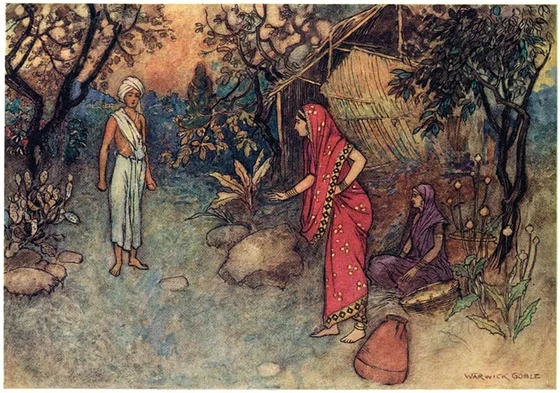
The elder wife reaches an ascetic meditating near a leafy hut after her co-wife has torn out her remaining hair. He directs her to immerse herself once in a nearby tank; she emerges with long hair and renewed youth. He then lets her choose a modest basket that contains inexhaustible treasure. The narration also changes her complexion; its preference for fair skin is a period beauty convention, not a measure of human worth.
The younger wife later seeks the same reward but takes a second immersion against his instruction, losing the first transformation. He refuses her a further boon. The ascetic is called muni or Father Muni, a descriptive religious title, and is not given a personal name or identified with a particular historical teacher. The tale’s transformation is not an instruction for cosmetic or medical treatment.
Origins & earliest records
Bengali oral storytelling translated by Lal Behari Day
Records & interpretation
Complete relevant tale, attached notes,1883 preface and1912 edition credits directly read.
Selected bibliography
Documented works and useful reading. This is not a list of every appearance.
- 01
Folk-Tales of Bengal
XXII, The Bald Wife, pp.269–274; first edition1883, illustrationsWarwickGoble
Family & connections
A source-supported family tree or inspiration record has not yet been compiled for this profile. Related reading below indicates a connection in subject matter, not a proven lineage or creative influence.
Primary records and illustrations
Lal Behari Day, Folk-Tales of Bengal (Macmillan,1912; first edition1883)
XXII. XXII, The Bald Wife, pp.269–274
Complete tale and footnotes read, pluspreface andeditionhistory. Bengali oral informants described collectively, individual teller of this tale not identified. Original paraphrase; no source-image verification claimed.
References
Sources supporting this profile. Linked pages have their own scope and editorial standards.
- Historical translated oral narrative and collector notesLal Behari Day, Folk-Tales of Bengal (1912), XXII, The Bald Wife, pp.269–274Research access: 2026-10-05
Image credits
A sourced illustration has not yet been added. This gap is included in the coverage record.