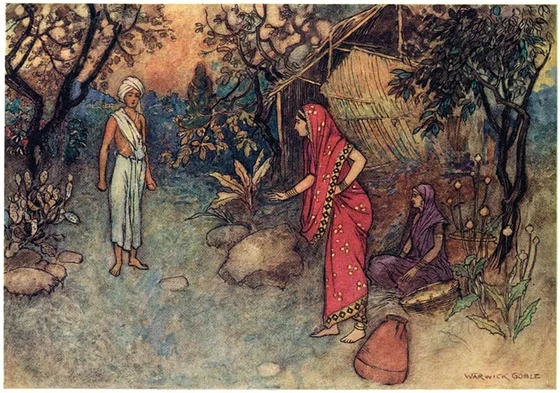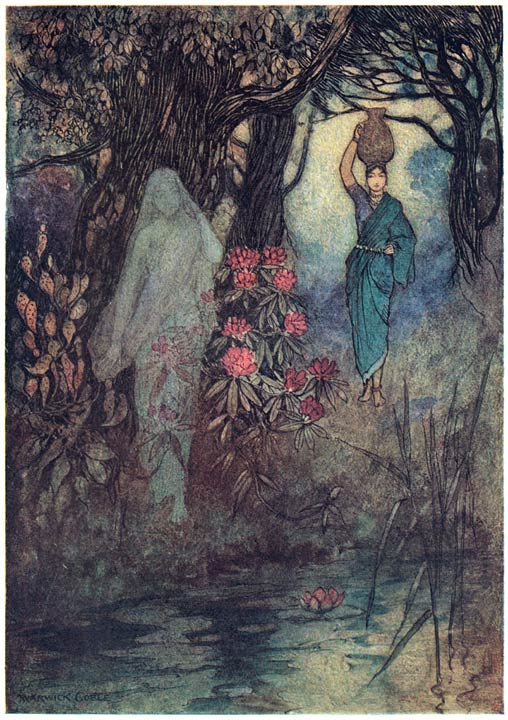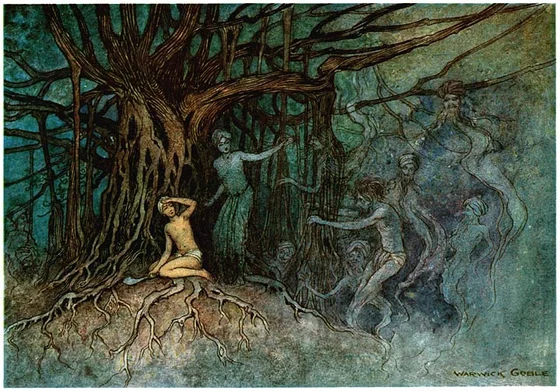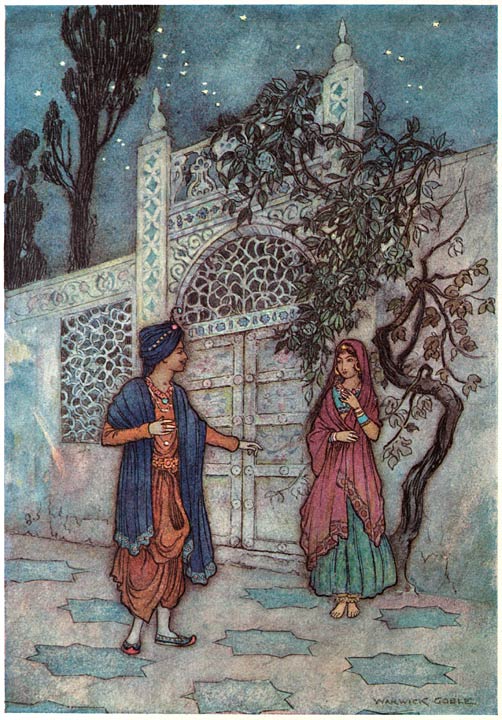
The revived Dalim Kumar meets the woman at his palace gate, Warwick Goble, 1912
The prince stands by the palace gate after his temporary revival. Goble illustrates the encounter described in Life’s Secret; the picture shows his living appearance and does not depict the hidden golden necklace that holds his life.
Overview
A mendicant gives the childless Suo queen a drug to take with pomegranate-flower juice and foretells a handsome son named Dalim Kumar. He also locates the child’s life in a golden necklace inside a wooden box in the heart of a large boal fish in the palace tank. The hostile Duo queen learns the secret, arranges for the fish to be killed and wears the necklace; Dalim dies at that moment.
His grieving father preserves him in a supplied garden-house. Whenever the queen removes the necklace at night, Dalim revives; when she puts it on in the morning, he dies again. His friend discovers that the nighttime figure is living flesh and blood. The cycle is therefore conditional life and death within the story, rather than an ordinary ghost’s nocturnal haunting.
He marries the niece of Bidhata-Purusha, whose foretold husband was to be dead, and fathers two sons during the years of nightly life. His wife disguises herself as a barber and uses their elder son’s insistence on borrowing the necklace to recover it. Dalim then remains alive and returns to his parents. The concluding punishment of the Duo queen is his father’s violent judgment, not a magical action of the necklace.
Origins & earliest records
Bengali oral storytelling translated by Lal Behari Day
Records & interpretation
Complete relevant tale, attached notes,1883 preface and1912 edition credits directly read.
Selected bibliography
Documented works and useful reading. This is not a list of every appearance.
- 01
Folk-Tales of Bengal
I, Life’s Secret, pp.1–15, notes1–6; first edition1883, illustrationsWarwickGoble
Family & connections
A source-supported family tree or inspiration record has not yet been compiled for this profile. Related reading below indicates a connection in subject matter, not a proven lineage or creative influence.
Primary records and illustrations
Lal Behari Day, Folk-Tales of Bengal (Macmillan,1912; first edition1883)
I. I, Life’s Secret, pp.1–15, notes1–6
Complete tale and footnotes read, pluspreface andeditionhistory. Bengali oral informants described collectively, individual teller of this tale not identified. Original paraphrase; no source-image verification claimed.
References
Sources supporting this profile. Linked pages have their own scope and editorial standards.
- Historical translated oral narrative and collector notesLal Behari Day, Folk-Tales of Bengal (1912), I, Life’s Secret, pp.1–15, notes1–6Research access: 2026-10-05
Image credits
Historical illustrationThe revived Dalim Kumar meets the woman at his palace gate, Warwick Goble, 1912
The prince stands by the palace gate after his temporary revival. Goble illustrates the encounter described in Life’s Secret; the picture shows his living appearance and does not depict the hidden golden necklace that holds his life.