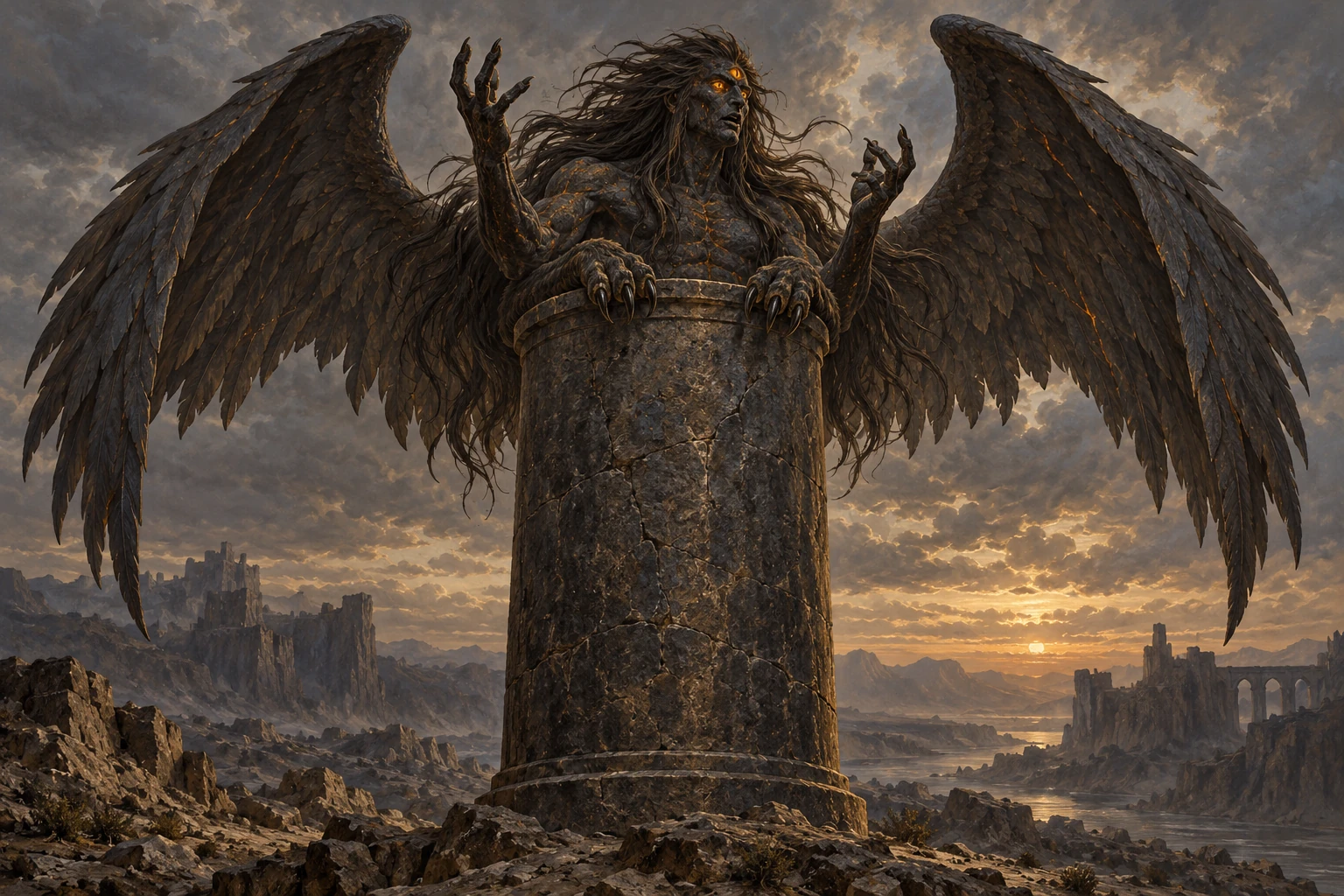
AI-generated interpretation of Dahish in Burton’s City of Brass. The stone confinement, four differentiated arms, wings, long hair and forehead eye follow the account. Feathered wings, stone-like skin, architecture and scenery are artistic choices, not a general depiction of jinn.
A specific literary Ifrit; no Final Fantasy character design or claim of historical observation.
Overview
In Burton’s “The City of Brass,” Emir Musa and his guide Abd al-Samad encounter a black stone pillar containing a frightening being sunk to his armpits. The account gives him two wings and four arms: two humanlike, two ending in lionlike paws with iron claws. His hair resembles horses’ tails, and a third eye in his forehead emits sparks. He identifies himself as Dáhish, son of Al-A’amash, an Ifrit of the Jinn under divine punishment. These are the features of this particular translated tale, rather than a universal anatomy for jinn.
Dáhish explains that he guarded a red-carnelian idol worshipped by a powerful sea-king and commanded the rebellious Jann supporting him. Speaking from inside the idol, he falsely assured the king that he could withstand Solomon. The dispute followed Solomon’s demand for the king’s daughter in marriage, destruction of the idol and submission to his religious authority. The king’s name is not supplied in this selected Burton passage. Dáhish’s own admission of ignorance and boastfulness frames the decision that brings the armies into conflict.
Solomon arrives with human and supernatural forces, birds, beasts and serpents. Dáhish challenges Al-Dimiryat, Solomon’s commander of the Jann, and they exchange fiery missiles before the wider battle closes around them. Birds attack from above while beasts and serpents join the fighting below. After the rebels are defeated, Dáhish flees. Al-Dimiryat pursues him for three months’ journey until exhaustion allows his capture. Dáhish begs to be brought before Solomon, who orders the pillar hollowed out, chains him inside it and seals him with his signet-ring. Al-Dimiryat carries the prison to its present location, and an angel is appointed to guard it.
The account returns to the travellers after this embedded history. Dáhish tells Abd al-Samad that other imprisoned spirits can be found in brass vessels in the sea of Al-Karkar and gives directions toward the City of Brass. The company leaves him behind; it does not free him or defeat him in another battle. His confinement is said to last until Judgment Day, while his opening answer also reserves release to divine will. This literary episode is kept distinct from Qur’anic teaching, present-day belief and the unrelated abilities or appearance of Final Fantasy’s Ifrit.
Origins & earliest records
The Book of the Thousand Nights and a Night, Volume VI, Richard F. Burton translation, retained Burton Club Shammar Edition, printed in the United States. The consulted title gives no historical imprint year; it is not represented as an independently verified original 1885 printing.
Records & interpretation
Complete selected encounter in nights 570–572, printed pages 96–101, including both verse blocks, embedded battle and imprisonment history, resumed conversation, departure and first City of Brass identification. Complete attached notes 122–128 and chapter-head note 104 read. The remainder of The City of Brass and the full volume were not read for this profile.
Selected bibliography
Documented works and useful reading. This is not a list of every appearance.
- 01
The Book of the Thousand Nights and a Night, VI: The City of Brass, Dáhish encounter
Complete selected encounter, nights 570–572, pp. 96–101; notes 122–128 and framing note 104. Title identifies Burton Club and Shammar Edition; no physical printing collated.
Family, evolution & connections
Jinn
In Burton’s City of Brass, Dahish explicitly calls himself an Ifrit of the Jinn. His particular body, rebellion, defeat and sealed imprisonment supply one literary account beside the broader scriptural and narrative category. The relation does not assign his appearance, hostility or fate to all jinn or identify him with Final Fantasy’s Ifrit.
References
Sources supporting this profile. Linked pages have their own scope and editorial standards.
- Historical English literary translationBurton Volume VI, The City of Brass — complete Dáhish encounter and notesResearch access: 2026-10-26
Image credits
Modern interpretation of a historical literary accountAI-generated interpretation of Dahish in Burton’s City of Brass. The stone confinement, four differentiated arms, wings, long hair and forehead eye follow the account. Feathered wings, stone-like skin, architecture and scenery are artistic choices, not a general depiction of jinn.
A specific literary Ifrit; no Final Fantasy character design or claim of historical observation.