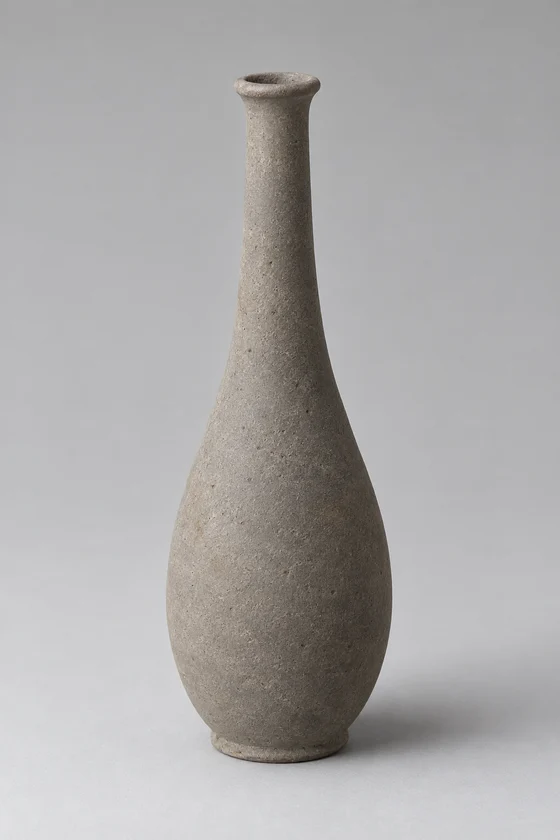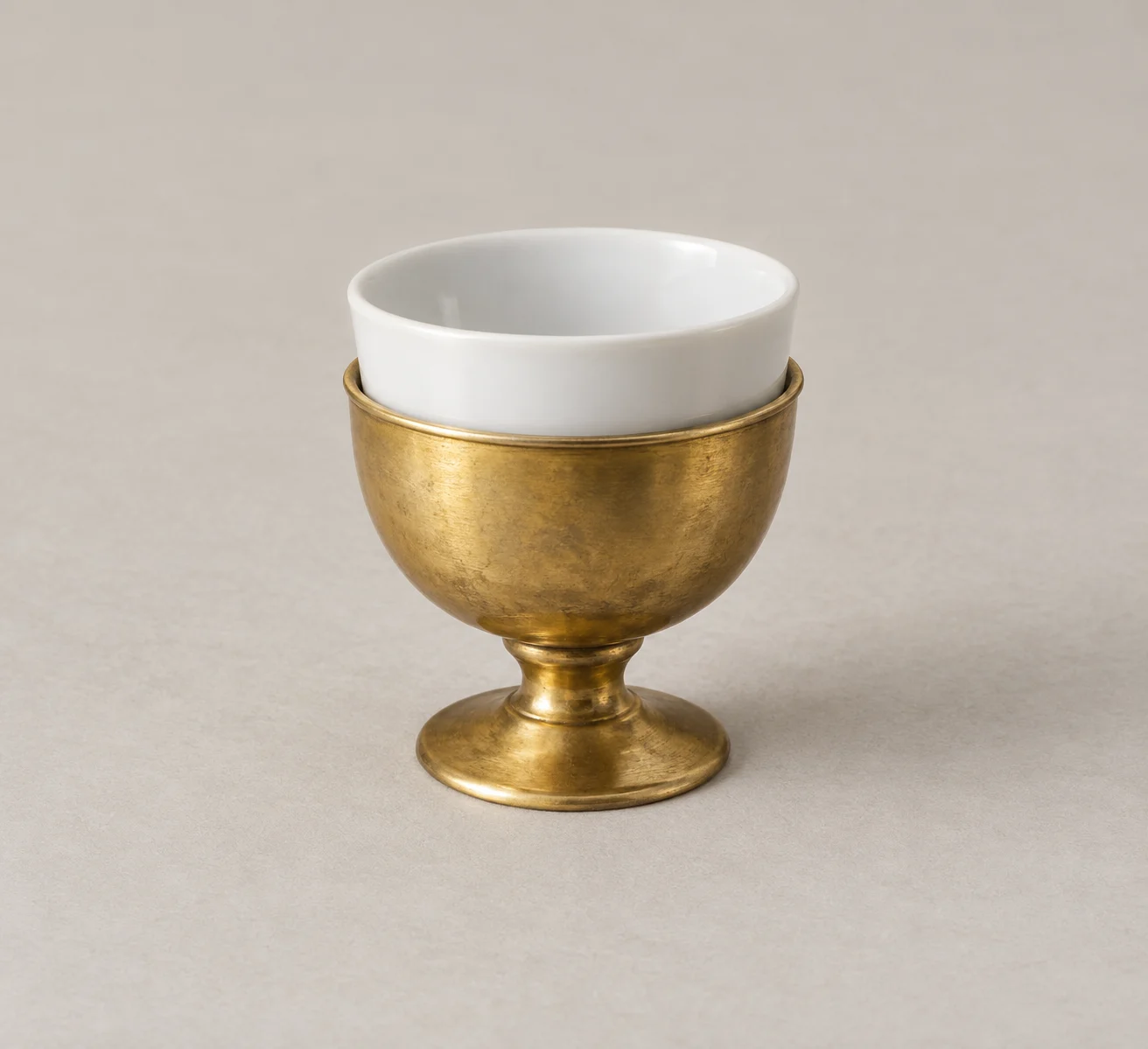
Generated contextual interpretation of vessels in Lane’s dated Cairo account; not an authenticated specimen or exact replica. Colour and surface appearance are interpretive. Porcelain and brass are selected from the stated alternatives; ornament is omitted.
Generated contextual interpretation of vessels in Lane’s dated Cairo account; not an authenticated specimen or exact replica. Colour and surface appearance are interpretive. Porcelain and brass are selected from the stated alternatives; ornament is omitted.
Overview
Lane describes coffee being served in a small handleless cup called a fingán, placed inside a second vessel called a zarf. The inner cup could be porcelain or Dutch ware; the outer holder could be silver or brass, according to the owner’s circumstances. His engraving separates a cup and holder for comparison and also shows a cup seated within a brass zarf. The holder has a foot beneath its rounded bowl, providing a place to grip it without adding a handle to the drinking cup. The accompanying note distinguishes the illustrated silver service from the separate brass example and says that a full service contained matching cups and holders, sometimes with a superior pair for a distinguished recipient.
The objects belong to a practice of receiving and serving people, rather than merely to a decorative arrangement. Lane describes a servant presenting coffee while holding the foot of the zarf, and receiving the returned vessels with both hands. Coffee also appears in his accounts of morning routines, visits and evening conversation. His chapter initially concentrates on households of higher and middle rank and explicitly includes free and enslaved domestic workers. These distinctions matter when reading his broad language about Egyptian habits. The contextual illustration selects porcelain and brass from the stated alternatives and simplifies ornament; it does not identify a particular maker, reproduce the whole service or establish that every household followed the same practice.
History & identity
Edward William Lane’s account was written in Egypt in 1833–1835, using earlier notes. The retained Ward, Lock and Co. reprint says it follows the third edition of 1842. Its transcribed title names London, New York and Melbourne but supplies no printed year; Project Gutenberg catalogues this edition as 1890. These publishing locations do not establish where the illustrated objects were made.
Sources & representation
The published engravings accompany the author’s explanatory text. They support visible forms within a mediated account, not a surviving object’s provenance or an authenticated modern reconstruction.
Selected bibliography
Documented works and useful reading. This is not a list of every appearance.
- 01
An Account of the Manners and Customs of the Modern Egyptians
Ward, Lock and Co. reprint of the 1842 text; catalogue date 1890 distinguished from undated transcribed title. Chapter V, Domestic Life, with its complete notes; author’s preface and third-edition advertisement.
Language & cultural connections
Source-supported language and cultural connections have not yet been compiled for this profile.
References
Sources supporting this profile. Linked pages have their own scope and editorial standards.
- Historical outsider observation with explanatory engravings; later reprintLane, Modern Egyptians: Chapter V and notes, retained historical reprintResearch access: 2026-10-18
Image credits
AI-generatedGenerated contextual interpretation of vessels in Lane’s dated Cairo account; not an authenticated specimen or exact replica. Colour and surface appearance are interpretive. Porcelain and brass are selected from the stated alternatives; ornament is omitted.
Generated contextual interpretation of vessels in Lane’s dated Cairo account; not an authenticated specimen or exact replica. Colour and surface appearance are interpretive. Porcelain and brass are selected from the stated alternatives; ornament is omitted.