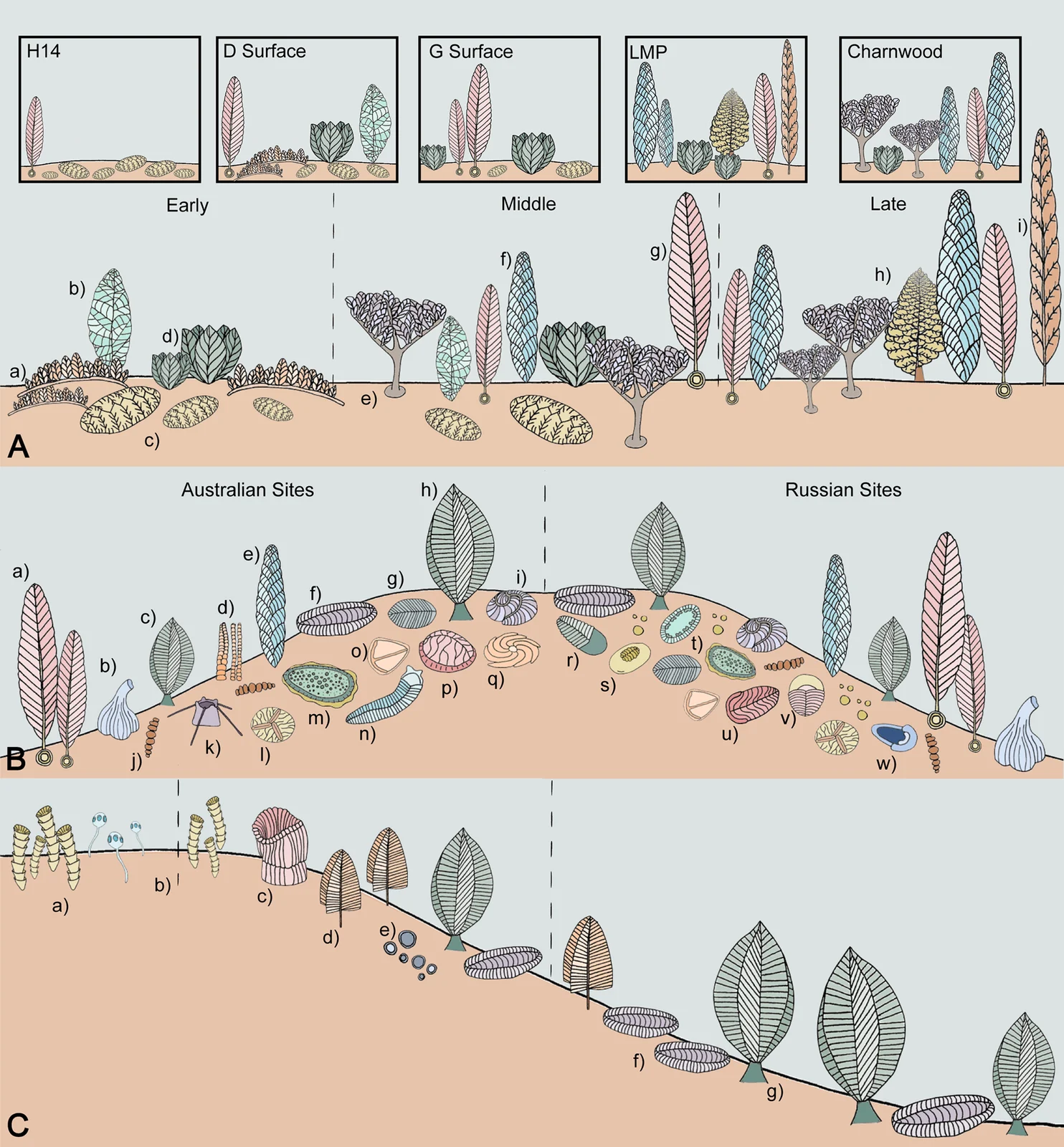
Cloudina reconstructed as yellow nested tubes labelled a in panel C of Eden and colleagues’ 2022 Ediacaran community diagram; all three published panels retained
Cloudina appears as the yellow nested tubes labelled a at the left of panel C, which reconstructs a Nama assemblage. This is an illustrated ecological interpretation, not a fossil photograph or evidence of original colour. The authors explicitly state that the taxa and environmental separations are not to scale. Panels A and B reconstruct different Ediacaran communities; their other organisms should not be mistaken for Cloudina.
Overview
Cloudina built tubes from successive funnel-like units containing thin laminae. Fossils occur in several marine settings, including microbial-mat associations and reef frameworks. Their exact animal affinity remains debated: superficial similarity to other tube-dwellers does not settle a relationship to annelids or cnidarians. The broader informal cloudinomorph grouping may include different organisms with convergent external shapes, so claims about one member cannot automatically be assigned to the genus.
Shore and Wood examined four contemporaneous Upper Omkyk Member localities in Namibia in 2021. Their transect extended from the energetic mid-ramp reef of Driedoornvlakte through Zebra River and Omkyk to the shallow, low-energy Zwartmodder setting. Assemblages included specimens attributed to C. hartmannae and C. riemkeae, while some Omkyk tubes were identified more cautiously as probable Cloudina. This distinction preserves the uncertainty of specimens altered by burial rather than treating every similar tube as a securely identified species.
Tube curvature and relative wall thickness differed among sites. The highest-energy reef assemblage had especially thick walls, while Zebra River showed greater tube sinuosity. The investigators interpret these differences as environmental influences on construction, potentially involving currents, substrate, food availability or carbonate precipitation. Their curvature measurements used two-dimensional bedding surfaces, which cannot capture every bend through the third dimension. The study does not identify a single experimentally demonstrated cause of the differences.
The preserved minerals also have histories. Original laminae may be replaced by dolomite or represented by moulds subsequently filled with calcite. Early cement between laminae and funnels formed before tube breakage and later sediment infilling, adding mechanical strength. However, the authors could not determine whether all such cement formed during life, after death while the tubes remained in place, or in older parts abandoned by growing soft tissue. Elemental comparisons did not provide a distinctive signature proving biological control of every cement generation.
This evidence favors a weakly calcified, organic-rich framework with early reinforcement, rather than equating the entire modern fossil wall with material secreted by the living animal. The quoted Nama interval describes a geological succession; an ash-bed date of 547.32 plus or minus 0.65 million years from an overlying member is stratigraphic context, not a direct date for each studied tube. These assemblages therefore inform early skeletal construction while leaving soft anatomy, exact ancestry and individual lifespan unresolved.
Origins & earliest records
Selected account follows Shore and Wood's 2021 primary fossil and petrographic study.
Evidence & interpretation
Bedding-plane measurements, polished thin sections, cathodoluminescence, electron microscopy and elemental microprobe comparisons distinguish construction from mineral alteration.
Selected bibliography
Documented works and useful reading. This is not a list of every appearance.
- 01
Environmental and diagenetic controls on the morphology and calcification of the Ediacaran metazoan Cloudina
Scientific Reports 11, 12341. Complete main geological setting, Results, Discussion, conclusions and Methods read. CC BY4.0 factual adaptation credited; supplementary data and analytical pipelines not reproduced.
Family, evolution & connections
Selected cloudinids in Park and colleagues’ morphological hypothesis (2021)
Eleven named cloudinid tips pruned from the strict-consensus topology in Figure 2: four Cloudina species and the seven CLT taxa. Feiyanella, the outgroup and other cloudinomorphs are omitted; the separately depicted hydroconozoans are not inserted as an inferred terminal.
Scroll sideways to see all branches. With a keyboard, focus the tree and use the arrow keys.
- Selected cloudinids
- Cloudina riethae
- Remaining selected cloudinids
- Cloudina hartmannae
- Remaining selected cloudinids
- Cloudina lucianoi
- Cloudina carinata and CLT clade
- Cloudina carinata
- Selected CLT clade
- Lipopora daseia
- Remaining selected CLT taxa
- Lipopora lissa
- Tretocylichne and Cambroctoconus
- Tretocylichne perplexa
- Cambroctoconus — retained four-way polytomy
- Cambroctoconus koori
- Cambroctoconus kyrgyzstanicus
- Cambroctoconus coreaensis
- Cambroctoconus orientalis
Park et al. scored sixteen ingroup taxa and twenty-three morphological characters, with Sinotubulites as outgroup. Characters were equally weighted and unordered. TNT traditional searches used random addition and TBR swapping; four most-parsimonious trees of length 42 produced the strict consensus, with CI 0.595 and RI 0.770. The diagram preserves selected branching and the unresolved Cambroctoconus node. No node-support values are displayed or invented. This is a conditional morphological hypothesis, not established direct descent. The authors’ Bayesian analysis did not distinguish lower cloudinids from other cloudinid-like tubular organisms; soft-body evidence remains important to affinity. Their proposed cnidarian interpretation competes with bilaterian interpretations of some cloudinomorph fossils, which are not automatically the same organisms. Stratigraphic bars, proposed character transitions and ancestral timing are omitted. Pruned and redrawn from Park et al. (2021), CC BY 4.0, with attribution retained.
Taxonomic classification
A hierarchy of classified groups, not a chain of direct ancestors.
- GenusCloudina
References
Sources supporting this profile. Linked pages have their own scope and editorial standards.
- ResearchShore and Wood 2021 primary fossil study (CC BY4.0)Research access: 2026-10-05
Image credits
Scientific fossil community reconstruction diagramCloudina reconstructed as yellow nested tubes labelled a in panel C of Eden and colleagues’ 2022 Ediacaran community diagram; all three published panels retained
Cloudina appears as the yellow nested tubes labelled a at the left of panel C, which reconstructs a Nama assemblage. This is an illustrated ecological interpretation, not a fossil photograph or evidence of original colour. The authors explicitly state that the taxa and environmental separations are not to scale. Panels A and B reconstruct different Ediacaran communities; their other organisms should not be mistaken for Cloudina.