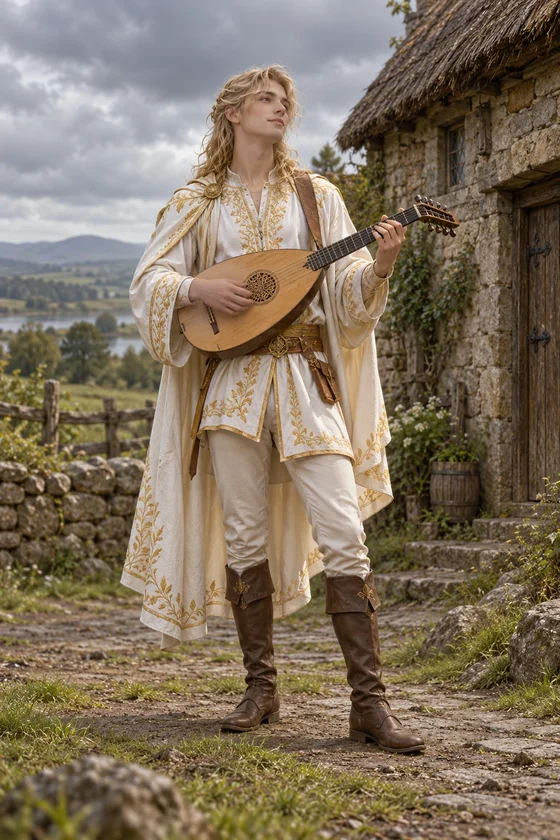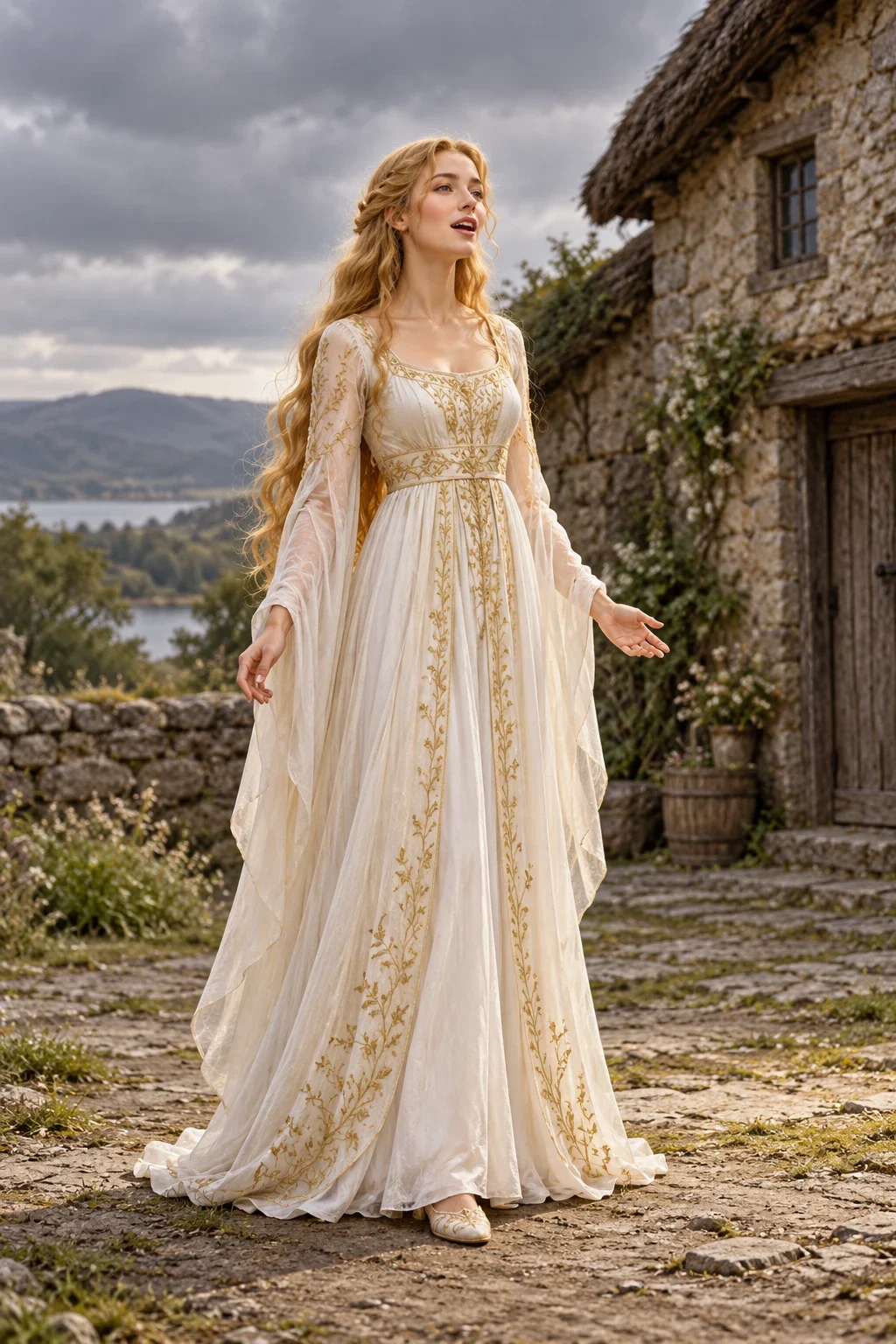
AI-generated interpretation; human form, with unspecified details imagined.
Overview
Chrysea sings while her husband Arasmon plays the lute. Both are young and beautiful when they reach a village whose inhabitants suffer under a wizard’s spell. Learning that an outsider can break it by repeating the elves’ nightly song, she decides to help despite a warning of retaliation. She slips out in a cloak, frees a captive blackbird and carries it onto the moor. Hidden there, she hears the song and sings it back, destroying the miniature village that embodies the enchantment.
The elves punish her by turning her into a small harp of pure gold, with clasped golden hands and arms at its top. She must remain so until someone plays their tune on its strings. Arasmon finds the harp and carries it through his travels, but neither he nor the listeners understand its attempts to say who she is. He alone can draw its beautiful music; other players produce a melancholy wail. The instrument helps him guide fishermen and hearten soldiers while its own appeal for recognition remains unheard.
Arasmon remembers her long golden hair and white-and-gold gown. When he finally returns to the moor, the blackbird supplies the tune that he plays to release her. Chrysea stands beside him dressed as before and sings until he opens his eyes and recognizes her. He dies against her, and the narration says her heart breaks and she dies beside him. Her liberation of the village is not erased by the tragic ending, nor should the villagers’ later idea that the musicians were angels replace their stated human identities.
First appearances & development
An individual heroine in Mary de Morgan’s authored The Wanderings of Arasmon, published in the retained 1880 Macmillan collection. Her human identity and enchanted instrument-form belong to the same character.
Canon & continuity
Complete tale, paragraphs 1–122, including her decision, transformation, unheard speech and restoration. Appearance at paragraphs 2, 41, 47, 106 and 114.
Selected bibliography
Documented works and useful reading. This is not a list of every appearance.
- 01
The Wanderings of Arasmon, in The Necklace of Princess Fiorimonde, and Other Stories
Family & connections
A source-supported family tree or inspiration record has not yet been compiled for this profile. Related reading below indicates a connection in subject matter, not a proven lineage or creative influence.
References
Sources supporting this profile. Linked pages have their own scope and editorial standards.
- Complete public-domain original literary tale in historical-edition transcriptionThe Wanderings of Arasmon — Mary de Morgan, Macmillan 1880Research access: 2026-10-21
- Native historical title-page image1880 title page — Mary de Morgan; illustrations by Walter CraneResearch access: 2026-10-21
Image credits
AI-generated illustrationAI-generated interpretation; human form, with unspecified details imagined.