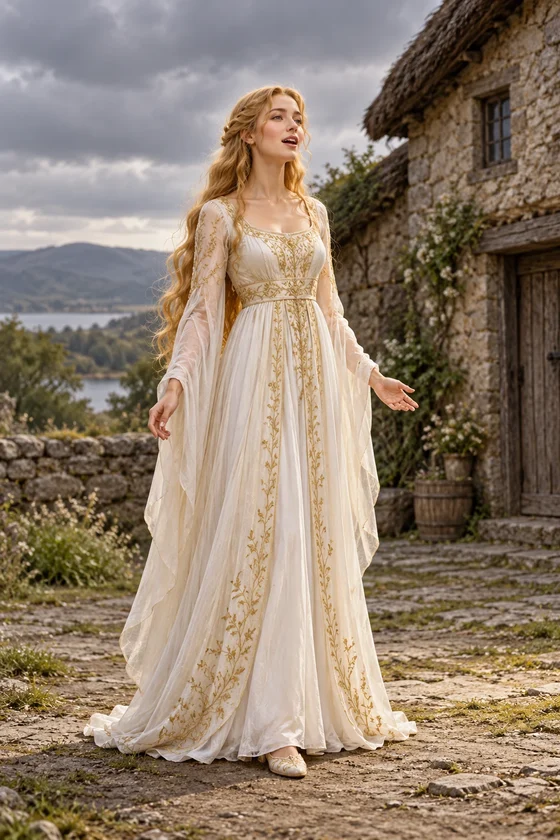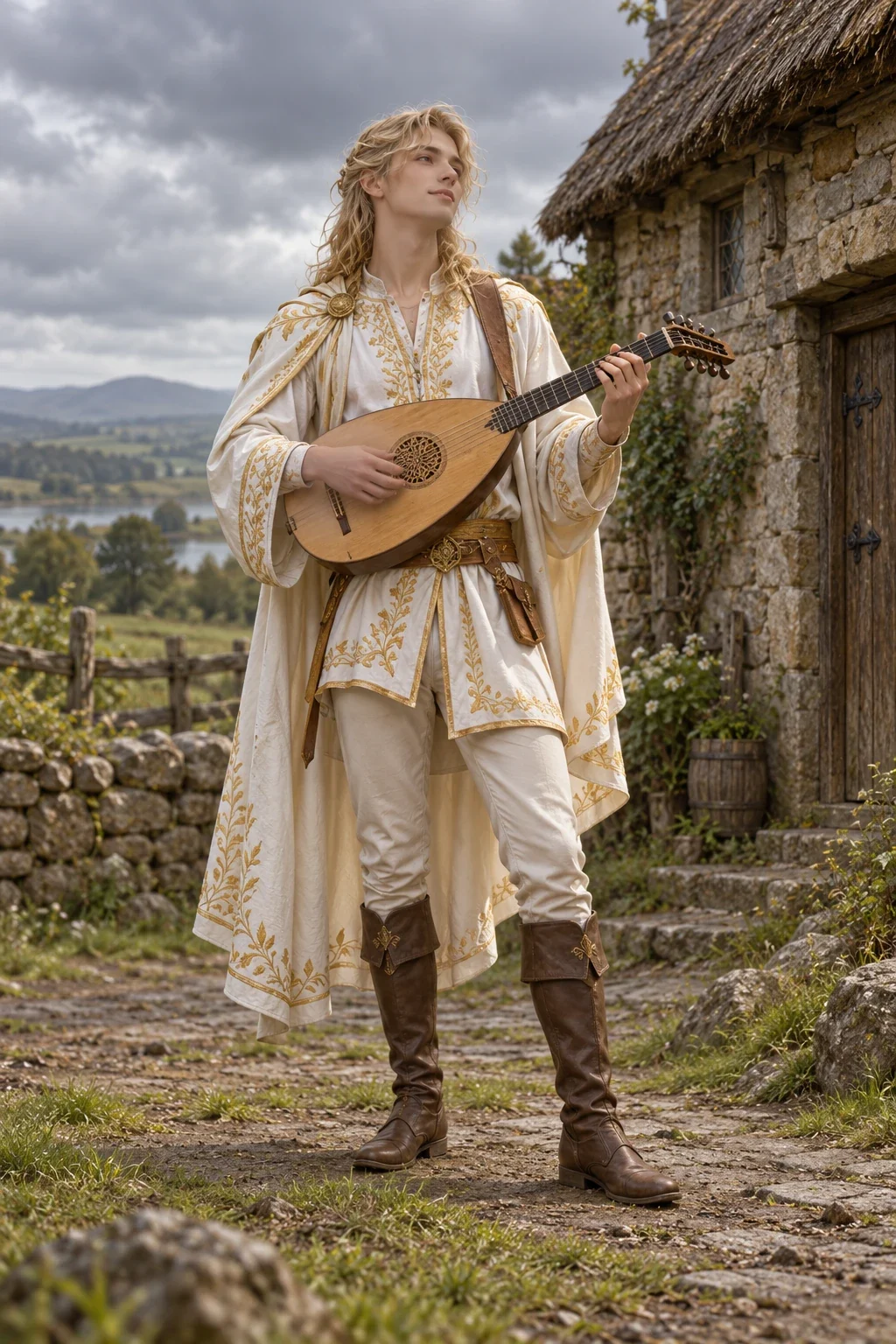
AI-generated interpretation; early human appearance and unspecified details imagined.
Overview
Arasmon travels with his wife Chrysea, playing a lute while she sings. Their music earns generous rewards, but at a miserable village he refuses the inhabitants’ money and accepts only lodging and food. While he sleeps, Chrysea frees the village from enchantment and is herself changed into a golden harp. Arasmon knows nothing of this exchange. He searches for her, finds the harp on the moor, and carries it away without understanding the words it tries to communicate.
The search lasts for years. His playing guides fishing boats through a fog and restores courage to the defenders of a besieged city. Those public benefits do not resolve his private loss: the harp’s voice remains unintelligible to him, even when it names Chrysea. At a music-loving king’s court he wins admiration and costly clothes, but jealous musicians plan to steal the instrument. Overhearing them, he leaves rather than surrender the only thing he believes he still has to love.
A woman awaiting her soldier husband persuades him to return to the place where he last saw Chrysea. By then he is gray, ragged, weak and scarcely recognizable to the villagers whose home has prospered. Beneath an oak he hears a blackbird sing the enchantment’s tune and plays it on the harp, restoring Chrysea. He recognizes her, rests his head against her and dies; she dies beside him. The reunion is real within the tale, but it does not save their lives.
First appearances & development
Mary de Morgan’s authored 1880 tale makes the husband’s unknowing search run alongside the wife’s concealed presence. This is a literary fairy tale, not an attributed community belief or a historical musician’s biography.
Canon & continuity
Complete tale, paragraphs 1–122; the narrator follows Chrysea’s transformation before returning to the husband who cannot understand her harp-voice.
Selected bibliography
Documented works and useful reading. This is not a list of every appearance.
- 01
The Wanderings of Arasmon, in The Necklace of Princess Fiorimonde, and Other Stories
Family & connections
A source-supported family tree or inspiration record has not yet been compiled for this profile. Related reading below indicates a connection in subject matter, not a proven lineage or creative influence.
References
Sources supporting this profile. Linked pages have their own scope and editorial standards.
- Complete public-domain original literary tale in historical-edition transcriptionThe Wanderings of Arasmon — Mary de Morgan, Macmillan 1880Research access: 2026-10-21
- Native historical title-page image1880 title page — Mary de Morgan; illustrations by Walter CraneResearch access: 2026-10-21
Image credits
AI-generated illustrationAI-generated interpretation; early human appearance and unspecified details imagined.