
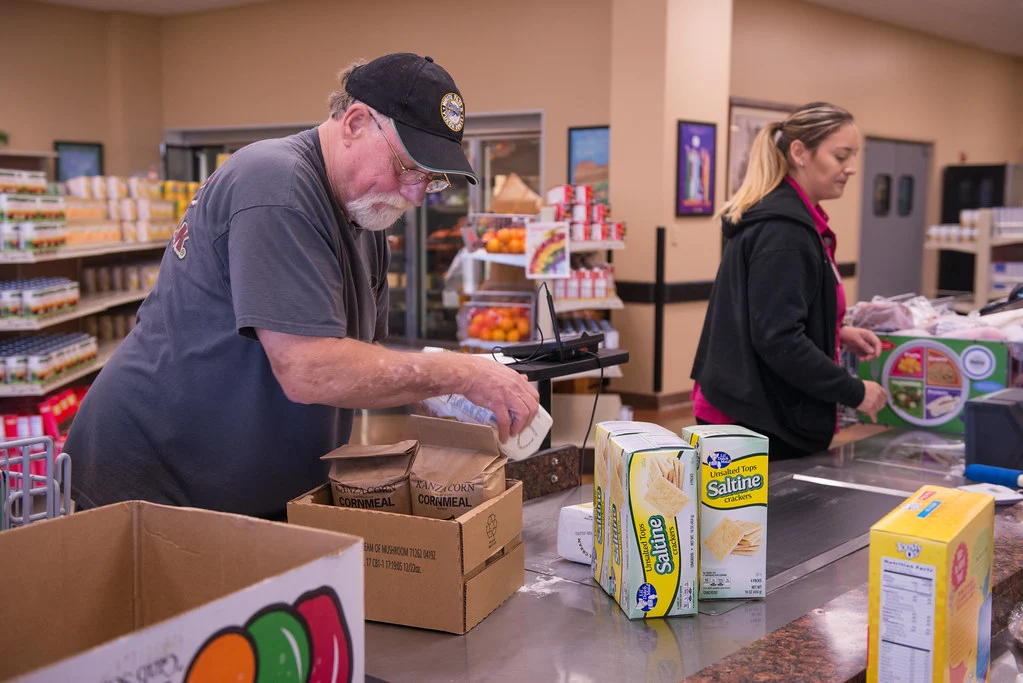
Joe Harris gathers groceries while Kyanna Wishon manages checkout at Chickasaw Nation Purcell Nutrition Services, USDA photograph
USDA identifies Joe Harris as a client and Kyanna Wishon as staff in the Chickasaw Nation’s food-distribution programme at Purcell Nutrition Services, Oklahoma. The scene shows its grocery-store model of choosing and checking out food. It documents a contemporary community service, rather than a representative appearance of all Chickasaw people.
Overview
The Chickasaw Nation’s history connects earlier homelands in the southeastern United States with its later homeland in south-central Oklahoma. Its public account describes towns, agriculture, trade and organized law before removal. The 1837 Treaty of Doaksville placed resettled Chickasaws among the Choctaw in Indian Territory; in 1856 the Chickasaws established a separate government. These political arrangements did not make the two peoples a single cultural identity. Tishomingo became the capital, with an elected constitutional government. After restrictions associated with Oklahoma statehood, federal legislation in 1970 again allowed election of principal officers; a new Chickasaw constitution followed in 1983.
Historical persistence also operates through stories, places and teaching. The Nation’s heritage account emphasizes oral tradition as a way young people learn relationships to the world and obligations of integrity and endurance. This is a living educational practice, not simply a source of colourful tales for outsiders. Its insistence on telling Chickasaw experiences from a Chickasaw perspective gives community-authored histories a different position from colonial descriptions. Neither type of document should automatically stand for the knowledge of every family or every historical period. Public heritage interpretation can introduce those relationships while leaving room for family knowledge, personal experience and changing forms of cultural expression.
The culture and humanities program brings historical and cultural presentations to schools, elders’ settings, youth camps and public gatherings. It also addresses cemetery preservation and repatriation. Its educational displays can include ball sticks, regalia and shakers, relating objects to continuing activities and inherited practices. The program explains that many presentations focus on the eastern homelands before removal. That focus is a selected teaching scope, not evidence that Chickasaw cultural life stopped at migration or is confined to the past.
Chikashshanompa’, the Chickasaw language, is placed with Choctaw in the western branch of the Muskogean language family by the Nation’s guide. Linguistic relationship does not determine citizenship or biological ancestry. The guide connects language loss with schooling that discouraged Indigenous speech and pressures to use English. Renewal includes fluent-speaker apprenticeships, community learning, youth activities and digital lessons. It recognizes different spelling systems rather than declaring one community’s writing invalid. The dictionaries listed below provide named bibliographic routes; their full texts have not been collated here. Undated speaker estimates and activity schedules require fresh verification before being treated as current.
The Chikasha Academy Adult Immersion Program gives a more specific example of language renewal. Its service page describes novice adult learners working with fluent speakers and proficient second-language speakers in a compensated, full-time programme in Ada. The inspected version specifies a two-year commitment, community participation, regular contact with fluent speakers and meetings with the language committee. Its expected outcome is conversational ability, identified in the questions-and-answers section as Intermediate Mid, rather than automatic fluency comparable to lifelong speakers. Admission includes an application and interview, and places depend on availability. This is a description of a particular teaching model and its goals; it does not establish that every participant reaches the same proficiency or obtains a teaching position.
History & identity
Chickasaw historical self-description distinguishes southeastern homelands, forced removal and later governmental developments in Oklahoma. No archaeological label is equated automatically with the present nation.
Sources & representation
Complete public History, Culture, Language and Heritage page bodies from the Chickasaw Nation. These institutional resources describe selected programs and historical themes rather than all citizens’ individual lives. Complete academy service description and all ten written FAQs read.
Selected bibliography
Documented works and useful reading. This is not a list of every appearance.
- 01
A Chickasaw Dictionary
Bibliographic reference in the Nation’s language guide; full dictionary not inspected.
- 02
Chickasaw: An Analytical Dictionary
Bibliographic reference in the Nation’s language guide; full dictionary not inspected.
- 03
Language Committee Working on Expanding Chickasaw Vocabulary
Chickasaw Times,July2022 article; current site masthead is not the article date
- 04
A Concise Chickasaw Dictionary
Chickasaw Press,1October2015; ISBN9781935684367,408pages, publisher catalogue checked
- 05
Web Exclusive: A Conversation with Linda Hogan
Image, web-exclusive interview associated with issue79; publication year unresolved.
Language & cultural connections
These connections link languages or specific cultural works and institutions; they do not establish biological ancestry or ethnic identity.
Choctaw Nation of Oklahoma
The Sam Noble Museum places Choctaw in Western Muskogean and identifies Chickasaw as its closest linguistic relative. A Choctaw Dictionary Committee article likewise explains Muskogean language relationships through recurring sound correspondences. This connects the languages, not biological descent or interchangeable national identities.
Located primary passages
Specific passages supporting details in this entry, grouped by their published witness.
Language Committee Working on Expanding Chickasaw Vocabulary
Chickasaw Times,July2022 article; current site masthead is not the article date
- The community newspaper connects language revitalization with earlier dictionaries and named teachers, then describes the committee’s ongoing work on vocabulary for contemporary life. It treats first-language speakers as decision-makers, using discussion and consensus to evaluate new terms and older usages. This records a particular institutional language project in2022, rather than portraying Chickasaw as a fixed vocabulary or claiming its history began with printed dictionaries.
Contemporary committee membership/statistics not carried into current totals. Article’s broad generalizations about all Native American languages not adopted.
Web Exclusive: A Conversation with Linda Hogan
Image, web-exclusive interview associated with issue79; publication year unresolved.
- Hogan connects bird observation with her process of drafting poems and essays. She describes artistic attention as a contribution to environmental understanding, contrasting that approach with management alone. These are a Chickasaw writer’s stated literary commitments, not a universal account of Indigenous thought or an independently verified ecological experiment.
Final displayed sentence lacks closing punctuation. Related crane essay and books unread; issue year not inferred from surrounding reviews.
References
Sources supporting this profile. Linked pages have their own scope and editorial standards.
- Community-authoredChickasaw Nation HistoryResearch access: 2026-10-05
- Community-authoredChickasaw Nation CultureResearch access: 2026-10-05
- Community-authoredChickasaw LanguageResearch access: 2026-10-05
- Community-authoredChickasaw HeritageResearch access: 2026-10-05
- Tribal programmeChikasha Academy Adult Immersion ProgramResearch access: 2026-10-05
Image credits
Contextual community photographJoe Harris gathers groceries while Kyanna Wishon manages checkout at Chickasaw Nation Purcell Nutrition Services, USDA photograph
USDA identifies Joe Harris as a client and Kyanna Wishon as staff in the Chickasaw Nation’s food-distribution programme at Purcell Nutrition Services, Oklahoma. The scene shows its grocery-store model of choosing and checking out food. It documents a contemporary community service, rather than a representative appearance of all Chickasaw people.