
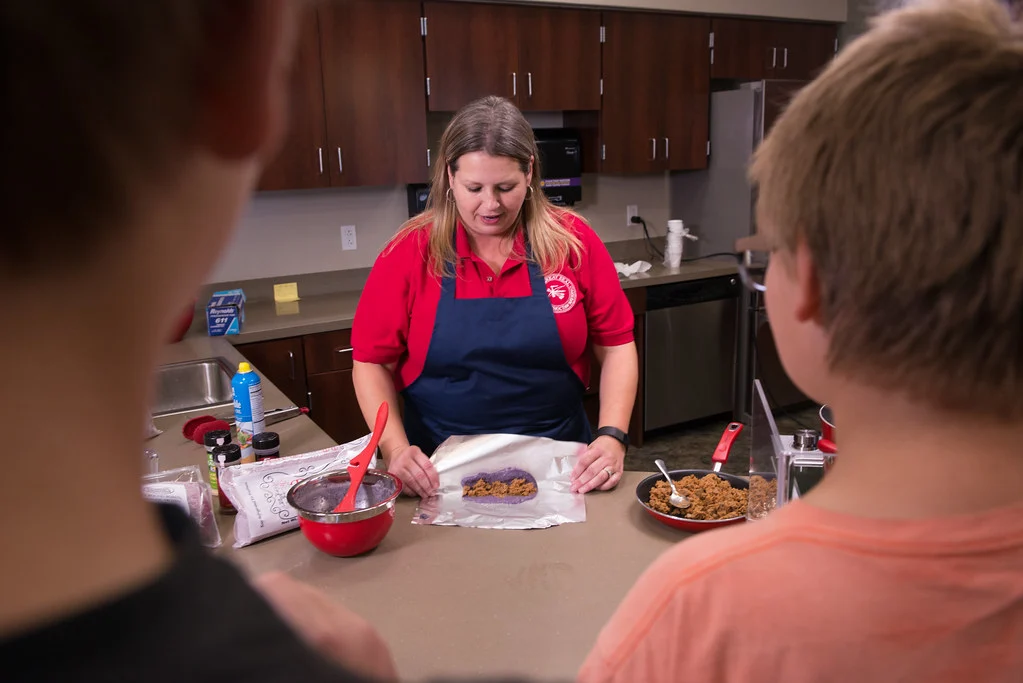
Nutritionist Carmen Robertson demonstrates blue cornmeal tamales at the Choctaw Nation of Oklahoma programme in McAlester, USDA photograph
USDA identifies nutritionist Carmen Robertson giving a blue-cornmeal tamale demonstration at the Choctaw Nation of Oklahoma’s food-distribution programme in McAlester. This is a particular nutrition-education activity. The photograph does not establish the citizenship of the unnamed audience or present one dish as the diet of every Choctaw person.
Overview
The Choctaw Nation of Oklahoma is a living Indigenous nation with a reservation in southeastern Oklahoma. Its elected Tribal Council represents twelve districts, alongside executive and judicial institutions. The Nation’s public account emphasizes family, culture and opportunities for its people. This is a particular political community, not a substitute name for every Choctaw community or for anyone learning the language. Its public institutional symbols also carry historical meanings: the Great Seal, formalized in 1857, includes a pipe associated with alliances, an unstrung bow and arrows honouring three chiefs.
The community-authored Iti Fabvssa introduction to A New Chahta Homeland places removal after the 1830 Treaty of Dancing Rabbit Creek within an account of rebuilding. It acknowledges that Oklahoma also contains the overlapping homelands of Caddo and other Indigenous nations. Choctaws created new institutions, laws, schools and relationships rather than merely arriving as passive recipients of outside aid. The essay stresses that Choctaw-written sources can correct histories assembled mainly from United States government records. Its proposed decade-by-decade series is expressly selective; the introduction cannot stand in for all later articles or every Choctaw experience.
Cultural institutions connect historical sites with present teaching. Cultural Services works with elders, educational materials and activities, while historic preservation includes repatriation, reburial and protection of sites. The former Capitol building, completed in 1884, now serves as the Tvshkahomma Capitol Museum. The Choctaw Cultural Center combines exhibitions with teaching spaces and a Living Village. Wheelock Academy’s preserved school site interprets student lives through photographs and personal objects. These places allow different kinds of evidence to be examined together: architecture, institutional records, objects and memories. They should not be mistaken for a single timeless picture of Choctaw life.
Chahta Anumpa Aiikhvna, the School of Choctaw Language, offers several routes into learning. The Nation’s public guide links classes, a dictionary with pronunciation and contextual examples, a topical phrasebook, and immersive digital lessons featuring elders and community speakers. Its apprenticeship program is described as sustained daily learning, joining grammar and conversation with cultural understanding. These resources support transmission through practice; their existence does not imply that every citizen has the same fluency or learning history. The guide also directs readers to stories and hymns. Those are identified as resources here without reproducing their words or claiming a complete reading of every linked text. Community-created language and historical materials are central witnesses to contemporary Choctaw life, alongside older archival evidence.
History & identity
The profile distinguishes the Nation’s Oklahoma political homeland from older homelands and from other Indigenous peoples’ relationships to the same lands.
Sources & representation
Complete public About, Culture and Language page bodies and the complete three-page Iti Fabvssa series introduction read. Linked stories, hymns and subsequent series instalments are not claimed as inspected.
Selected bibliography
Documented works and useful reading. This is not a list of every appearance.
- 01
A New Chahta Homeland: A History by the Decade
January2021 series introduction,3pages; complete text read, not the entire later series.
- 02
School of Choctaw Language resources
Public resource guide; linked dictionary and phrasebook identified without claiming complete inspection.
- 03
A New Chahta Homeland: A History by the Decade, 1830–1840
Iti Fabvssa, February2021, official three-page article; month verified by community archive
Language & cultural connections
Source-supported language and cultural connections have not yet been compiled for this profile.
Located primary passages
Specific passages supporting details in this entry, grouped by their published witness.
A New Chahta Homeland: A History by the Decade, 1830–1840
Iti Fabvssa, February2021, official three-page article; month verified by community archive
- The community-authored history examines removal and rebuilding in Indian Territory. It connects collective landholding, the1834 constitution and district organization with efforts to protect sovereignty after devastating losses. Its1837 Chickasaw district account describes a historical arrangement, not the present identities or governments of the two nations.
Complete article1–3; post-removal constitution and districts2
Reading scope is limited to the identified sections. No uninspected primary sources, supplementary analysis or complete corpus claimed. No quotation added.
References
Sources supporting this profile. Linked pages have their own scope and editorial standards.
- Community-authoredAbout the Choctaw NationResearch access: 2026-10-05
- Community-authoredChoctaw Nation CultureResearch access: 2026-10-05
- Community-authoredSchool of Choctaw LanguageResearch access: 2026-10-05
- Community-authoredIti Fabvssa, A New Chahta HomelandResearch access: 2026-10-05
Image credits
Contextual community photographNutritionist Carmen Robertson demonstrates blue cornmeal tamales at the Choctaw Nation of Oklahoma programme in McAlester, USDA photograph
USDA identifies nutritionist Carmen Robertson giving a blue-cornmeal tamale demonstration at the Choctaw Nation of Oklahoma’s food-distribution programme in McAlester. This is a particular nutrition-education activity. The photograph does not establish the citizenship of the unnamed audience or present one dish as the diet of every Choctaw person.