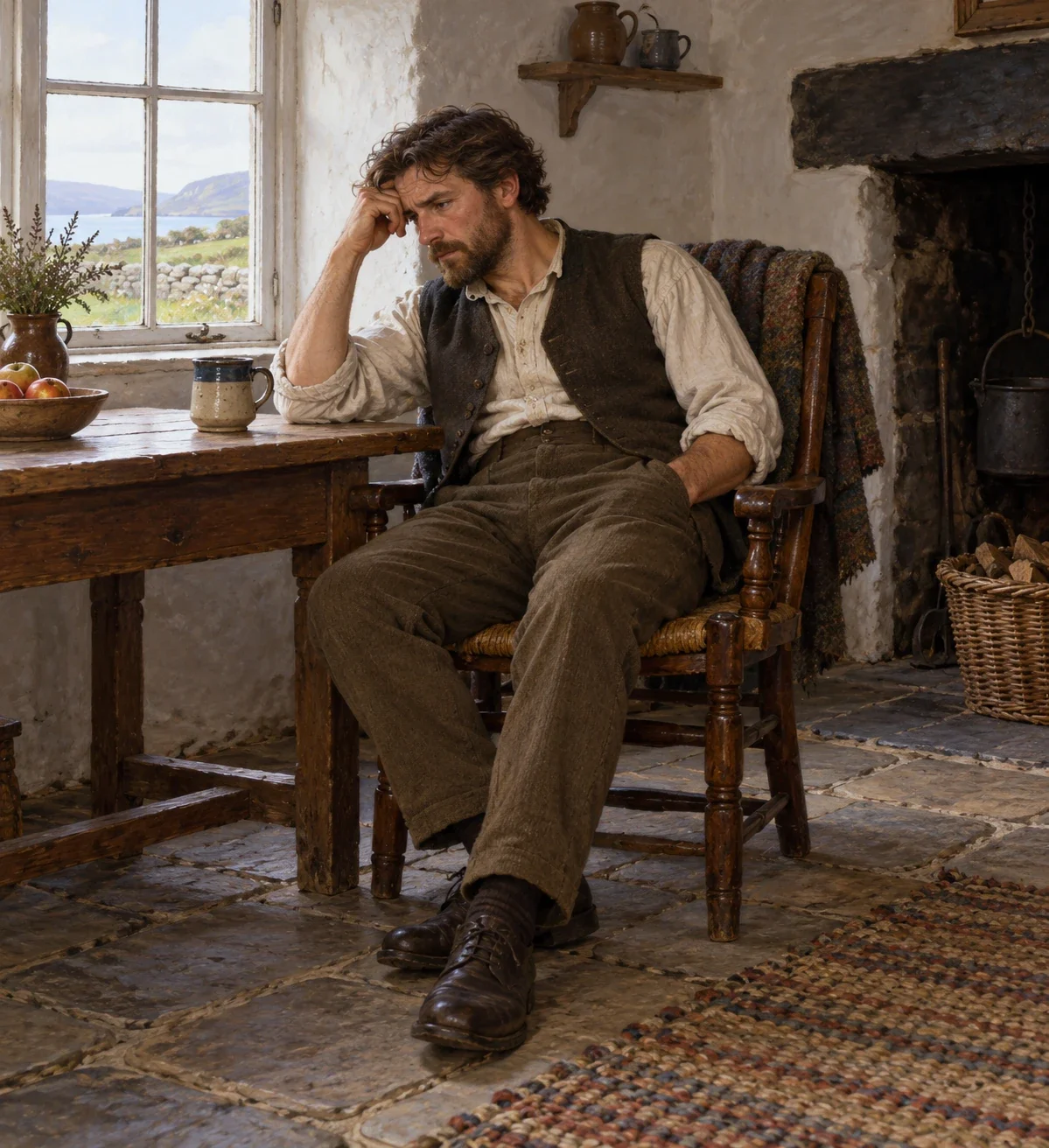
Portrayal of Chalse Ballawhane, the Fairy Doctor.
Portrayal selects Chalse seated at home before the journey, with the source’s hand positions. Face, age, clothes, furniture construction and room details are interpreted; the title does not establish a medical diagnosis or modern profession.
Overview
Morrison’s Fairy Doctor identifies its central figure as Chalse Ballawhane; the visiting tailor addresses him as Mr. Teare. He is a human inhabitant of the story, rather than one of the Little Ones. The narrator credits him with power over sea fishes, birds and land animals, while making an explicit exception for the Little Ones. Chalse gets on well with them and often keeps their company, but cannot command them. People in the account suggest that he has never properly learned their language. These are the tale’s explanations of his unusual standing, not evidence for a medical practice or an independently verified supernatural ability.
A tailor arriving to work at the house finds Chalse seated in a large chair, one elbow on the table and one hand holding his forehead, with his other hand deep in his trouser pocket. Chalse appears distracted, looks through the window and towards the clock, and says that he is going out to a large supper. He invites the tailor, who is eager to see the Little People, but imposes a condition: whatever he sees or hears, and whoever speaks to him, he must give no answer. The silence requirement belongs to this journey within the narrative; it is not an instruction restricting dissemination of the published story.
Chalse takes his hat and leaves briefly. Horses can then be heard approaching. He explains that they could not obtain another horse for the tailor, fetches something from the parlour and tells his guest to mount while he holds its head. They race over hedges and ditches towards a steep riverbank. During the leap the frightened tailor exclaims in astonishment. At once he finds himself alone in a bog, his lapboard between his legs. The text reveals what his apparent mount has become without describing a separate animal’s anatomy. Later questions about the outing elicit only his emphatic refusal to go again. Chalse is neither exposed as a fraud nor given a further punishment or explanatory ending.
Origins & earliest records
“The Fairy Doctor,” pp. 38-41, in Morrison’s Manx collection; no individual teller is assigned to this particular tale in the preface.
Records & interpretation
Complete original narrative and full original preface read in the retained HTTP200 HTML transcription; title/imprint transcribed. No native printed-page inspection or whole-book reading claim.
Selected bibliography
Documented works and useful reading. This is not a list of every appearance.
- 01
Manx Fairy Tales
Complete selected account, pp. 38-41; original preface. London: David Nutt. Retained English transcription; original printed pages not visually inspected.
Family & connections
A source-supported family tree or inspiration record has not yet been compiled for this profile. Related reading below indicates a connection in subject matter, not a proven lineage or creative influence.
References
Sources supporting this profile. Linked pages have their own scope and editorial standards.
- Historical folklore collection in EnglishMorrison’s original Manx Fairy Tales, selected complete accountResearch access: 2026-10-07
Image credits
AI-generatedPortrayal of Chalse Ballawhane, the Fairy Doctor.
Portrayal selects Chalse seated at home before the journey, with the source’s hand positions. Face, age, clothes, furniture construction and room details are interpreted; the title does not establish a medical diagnosis or modern profession.