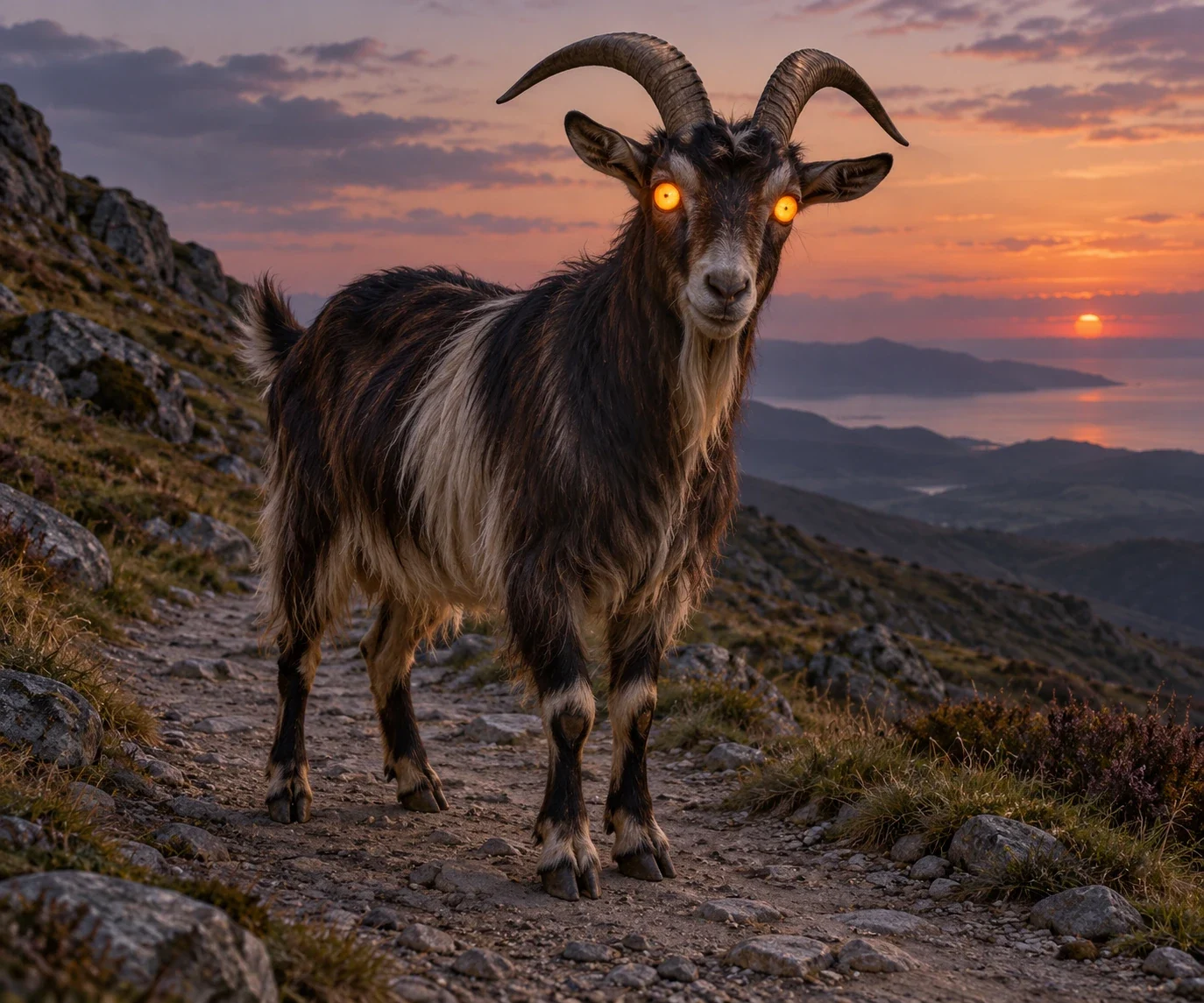
Portrayal of Caillagh-ny-Faashagh, the Prophet Wizard.
Portrayal selects the goat appearance on the mountain road. Goat anatomy, coat colour, horns and landscape details are interpreted; large fiery eyes are textual. No human-goat hybrid, general Cailleach identity or current community-belief claim.
Overview
Morrison calls Caillagh-ny-Faashagh the greatest wizard of the old Isle of Mann and also the Prophet Wizard of the Wilderness. Her account consistently refers to this figure as male. He lives beneath a rock in a quarry on a lonely mountainside and roams the mountains after dark. The narrative gives him the power to take any shape, but describes two particular forms: a goat with large fiery eyes, and an exceptionally tall man. These remain appearances of the named wizard, rather than evidence for a separate goat species or a general identification with every Manx supernatural being.
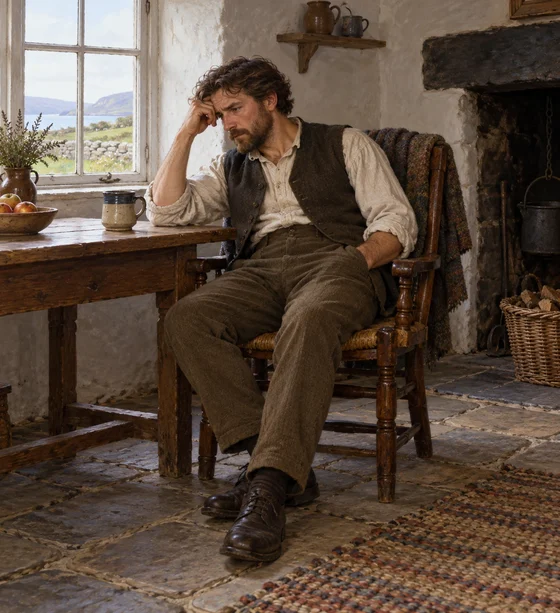
In the goat episode he follows a traveller along a mountain road. His eyes are compared to two dishes. As the man moves his lantern from one hand to the other, the goat follows it from side to side. The traveller runs, and on leaving the mountain road hears the wizard’s terrible goat-like cry behind him. A second encounter places the wizard in a human shape, as tall as two men, following a woman across the mountain at Garey mooar. Again his eyes are enormous and burning, and again the pursuit stops when the frightened traveller leaves the mountain. The account supplies no costume, weapon or detailed facial description for that human form.
He foretells events only when someone asks. The collection links his answers to the Battle of Santwat, Foxdale’s mineral wealth, fighting near Peel, and the future roads, railway and inn around Snaefell. Some passages declare predictions fulfilled, while others remain future possibilities within the story’s telling. Its battle narrative also explains a difference in widows’ inheritance between north and south. Those historical, legal and prophetic assertions are reported as Morrison’s narrative, not independently established chronology, current law or successful prediction. The final sayings concern Mann and Scotland drawing close enough for two women to wring a blanket between them, and the island’s rulers being forced to flee. The tale closes with these expectations before the world’s end, without resolving them or killing the wizard.
Origins & earliest records
“Caillagh-ny-Faashagh, or the Prophet Wizard,” pp. 176-181, in Morrison’s 1911 Manx collection; no particular teller is assigned to it in the preface.
Records & interpretation
Complete original account through all prophecies and ending, plus full original preface and title/imprint transcription. No independent historical, legal, linguistic or prophecy validation claimed.
Selected bibliography
Documented works and useful reading. This is not a list of every appearance.
- 01
Manx Fairy Tales
Complete selected account, pp. 176-181; original preface. London: David Nutt. Retained English transcription; original printed pages not visually inspected.
Family & connections
A source-supported family tree or inspiration record has not yet been compiled for this profile. Related reading below indicates a connection in subject matter, not a proven lineage or creative influence.
References
Sources supporting this profile. Linked pages have their own scope and editorial standards.
- Historical folklore collection in EnglishMorrison’s original Manx Fairy Tales, selected complete accountResearch access: 2026-10-07
Image credits
AI-generatedPortrayal of Caillagh-ny-Faashagh, the Prophet Wizard.
Portrayal selects the goat appearance on the mountain road. Goat anatomy, coat colour, horns and landscape details are interpreted; large fiery eyes are textual. No human-goat hybrid, general Cailleach identity or current community-belief claim.