
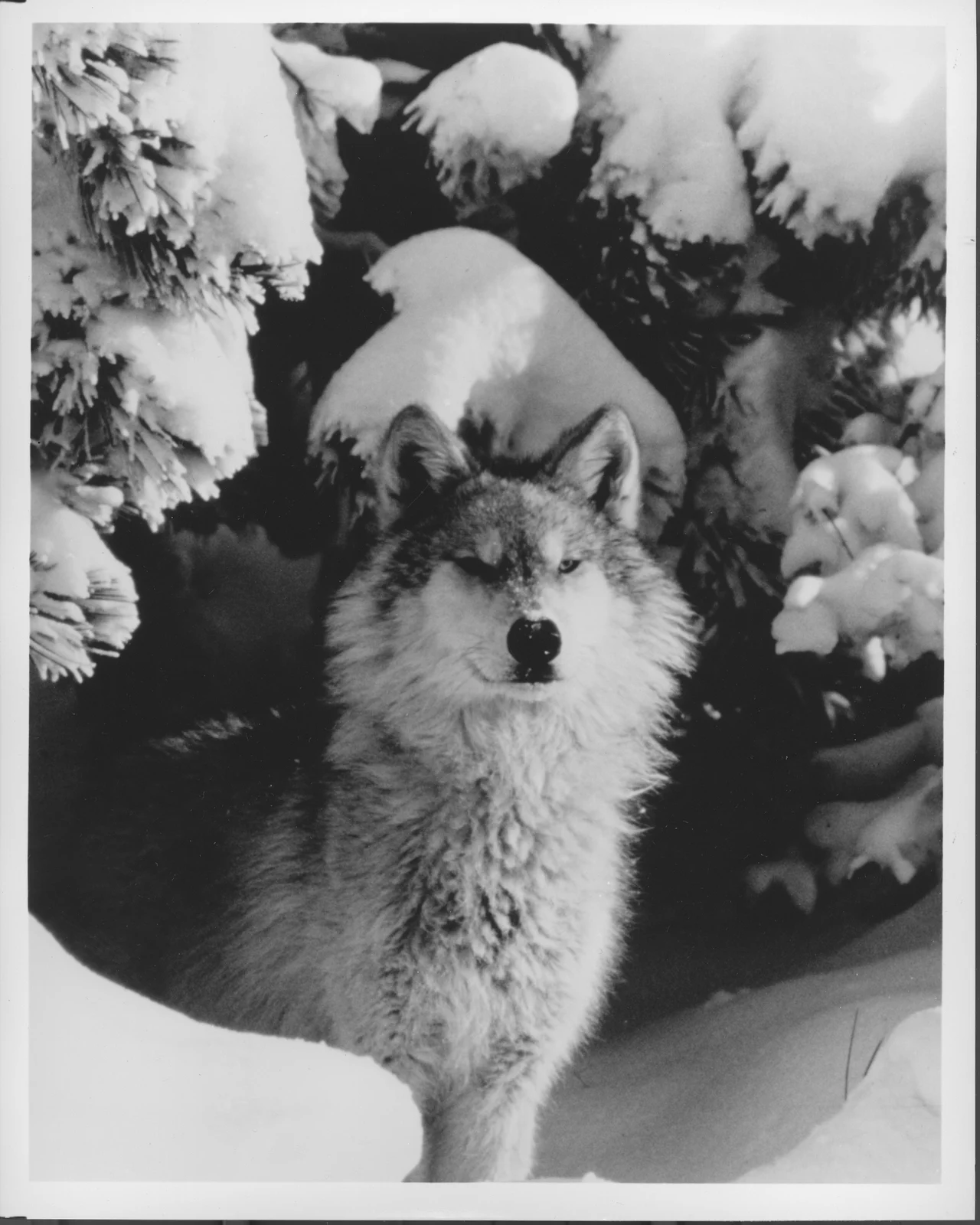
Gray wolf, Canis lupus, sitting beneath snow-covered branches, circa1995
A gray wolf photographed beneath snow-covered branches. The source identifies the species as Canis lupus and dates the photograph to approximately1995; it does not identify the individual animal or establish that the scene is in the wild.
Overview
The gray wolf is a large wild member of the dog family, Canidae. Its scientific name is Canis lupus Linnaeus, 1758; ITIS records it as a valid species under taxonomic serial number 180596. Long legs support travel and running, while a substantial skull and jaws enable it to capture and feed on large mammals. Despite the common name, pelage can be white, grizzled gray, brown or black. The U.S. Fish and Wildlife Service gives an adult mass range of 18–80 kilograms across sexes and geographic populations; this range is not a typical weight for every locality.
The species occurs across North America, Europe and Asia and occupies habitats including tundra, taiga, temperate forest, grassland, mountains and desert. In North America its prey include large hoofed mammals such as deer, elk, moose and caribou. Its adaptable range and prey use require local descriptions rather than treating one monitored population as representative of all wolves.
Yellowstone monitoring documents packs as social family groups that cooperate in hunting, care of young and defence of territory and carcasses. Howling and scent marking help maintain relations within and between neighbouring packs. The park describes a February mating season, April births and approximately 63 days of gestation for its wolves. These are regional observations. Carcasses left by wolves also feed ravens, magpies, coyotes, bears and other scavengers. Changing prey selection reflects interactions with other predators, weather, prey condition and human management; a single wolf-only explanation would omit those factors.
In Chavez and colleagues’ 2019 comparative genomic study, the gray wolf and domestic dog belong to the sampled Canis group with the coyote. Other sampled canids include the African wolf, golden jackal, Ethiopian wolf, dhole and African wild dog. The species-tree reconstruction used thousands of genomic windows, while a separate demographic analysis modelled gene flow. These analyses describe relationships among lineages and sampled genomes. A branching diagram does not identify any sampled modern wolf as the individual ancestor of a dog, and genomic divergence is not interchangeable with a species-splitting date.
Dog domestication is a related but separate historical question. Bergström and colleagues’ 2022 analysis of 72 ancient wolf genomes found stronger overall dog affinities to ancient eastern Eurasian wolves, together with another wolf-related ancestry component in Near Eastern and African dogs. The authors considered both additional domestication and later admixture as explanations for that component. None of their ancient wolf genomes directly matched the inferred dog progenitor populations. The evidence therefore supports wolf ancestry without fixing one sampled population, locality or simple domestication event. The published label Canis familiaris for dog tips is preserved as that study’s usage rather than made a universal taxonomic verdict.
Origins & earliest records
Canis lupus is an extant species formally named by Linnaeus in 1758. That nomenclatural date is not its evolutionary origin. Ancient-genome studies investigate population histories through the Late Pleistocene; they do not establish a single precise first-species date. Dog domestication concerns selected wolf-related ancestral populations and subsequent human-associated lineages.
Evidence & interpretation
ITIS TSN 180596 supplies valid-species standing and hierarchy. FWS supports broad morphology, range and habitat; Yellowstone NPS supplies explicitly regional monitored ecology. Chavez et al. 2019 supports a sampled genomic relationship framework, with species-tree and migration models distinguished. Bergström et al. 2022 supports ancient-wolf ancestry comparisons and unresolved exact dog progenitors. No current legal listing or global census is inferred from older agency timelines.
Selected bibliography
Documented works and useful reading. This is not a list of every appearance.
- 01
Comparative genomics provides new insights into the remarkable adaptations of the African wild dog (Lycaon pictus)
Evolutionary history results, species-tree methods and Supplementary Figure S1. Canis lupus is one sampled comparative tip; study also models gene flow.
- 02
Grey wolf genomic history reveals a dual ancestry of dogs
Abstract, ancient-genome sampling and dog-ancestry results; exact progenitor wolf populations are not identified by sampled genomes.
- 03
Genome Sequencing Highlights the Dynamic Early History of Dogs
PLOS Genetics10(1):e1004016,16January2014;12August2014 author/acknowledgement correction checked.
Family, evolution & connections
Gray wolf and sampled canids in a 2019 coalescent species tree
The eleven terminals of Supplementary Figure S1 represent ten species, including two African wild dog samples. Labels follow the study; the domestic dog label does not settle its taxonomic rank.
Scroll sideways to see all branches. With a keyboard, focus the tree and use the arrow keys.
- Sampled canids
- Gray fox (Urocyon cinereoargenteus)
- Remaining sampled canids
- Andean fox (Lycalopex culpaeus)
- Selected wolf-like canids
- African wild dog samples (Lycaon pictus)
- Eastern Africa CN3669
- Southern Africa RKW481
- Remaining sampled wolf-like canids
- Dhole (Cuon alpinus)
- Sampled Canis
- Ethiopian wolf (Canis simensis)
- Remaining sampled Canis
- Golden jackal (Canis aureus)
- Remaining sampled Canis
- African wolf (Canis lupaster)
- Coyote, domestic dog and gray wolf
- Coyote (Canis latrans)
- Sampled domestic dog / gray wolf pair
- Domestic dog (Canis familiaris; published label)
RAxML gene trees from 25 kb nuclear windows, followed by ASTRAL-III 5.5 coalescent species-tree inference with 100 bootstrap replicates and gray fox as outgroup. Figure S1 and Results report 8,117 windows; main Methods reports 8,177. Only branching is represented here. The species-tree procedure does not model gene flow. The supplementary discussion questions the golden jackal position and tests a separate demographic topology exchanging it with the Ethiopian wolf. Figure S1 ages are average genomic divergence estimates, not branch support, species-split dates or domestication dates; none are transcribed. The main figure overlays a different demographic model and migration bands. Living samples are not direct ancestors, and this tree does not identify the exact progenitors of domestic dogs.
Taxonomic classification
A hierarchy of classified groups, not a chain of direct ancestors.
Domestic dog sample in Chavez et al. (2019)
The sampled gray wolf and domestic dog form a pair in Supplementary Figure S1. This branching does not make the living wolf a direct ancestor or establish exact domestication progenitors; gene flow and different divergence measures complicate that history.
Elk in northern Yellowstone
Monitored northern-range wolves primarily killed elk, selecting different vulnerable age groups across seasons. The researchers distinguish kill frequency from food biomass; other predators, harvest and climate also affect elk survival.
Bison in northern Yellowstone
Bison contributed both wolf kills and scavenged carcasses. Their share of acquired winter biomass increased between the study’s 1995–2004 and 2005–2014 periods; this is a local historical finding, not a universal wolf diet.
Located primary passages
Specific passages supporting details in this entry, grouped by their published witness.
Genome Sequencing Highlights the Dynamic Early History of Dogs
PLOS Genetics10(1):e1004016,16January2014;12August2014 author/acknowledgement correction checked.
- The study sequenced three modern Eurasian wolves, two divergent dog lineages and a golden jackal, with a Boxer reference for comparison. Models inferred ancestral population declines and gene flow that complicate attempts to identify dog origins from present-day wolves. The authors found no sampled wolf population uniquely closest to dogs. An extinct progenitor population remained a hypothesis, not an identified ancestor. Date estimates depended strongly on mutation-rate and generation-time assumptions; the2014 demographic model is not treated as the final resolution of domestication.
Remaining Results, full Methods, supplementary analyses and raw sequences not independently read/reanalysed. Correction DOI10.1371/journal.pgen.1004631 concerns Alan Wilton sample-collection credit and dingo-provider acknowledgement; no new modern taxonomy inferred.
References
Sources supporting this profile. Linked pages have their own scope and editorial standards.
- Authoritative taxonomic registryITIS — Canis lupus, TSN 180596Research access: 2026-10-05
- Government species accountU.S. Fish and Wildlife Service — Gray WolfResearch access: 2026-10-05
- Government monitoring and ecological synthesisYellowstone National Park — Wolf EcologyResearch access: 2026-10-05
- Primary genomic researchChavez et al. 2019 — comparative canid genomicsResearch access: 2026-10-05
- Primary ancient-genome researchBergström et al. 2022 — ancient wolf genomesResearch access: 2026-10-05
Image credits
Exact subjectGray wolf, Canis lupus, sitting beneath snow-covered branches, circa1995
A gray wolf photographed beneath snow-covered branches. The source identifies the species as Canis lupus and dates the photograph to approximately1995; it does not identify the individual animal or establish that the scene is in the wild.