Altun, son of Buruldai Bogdo
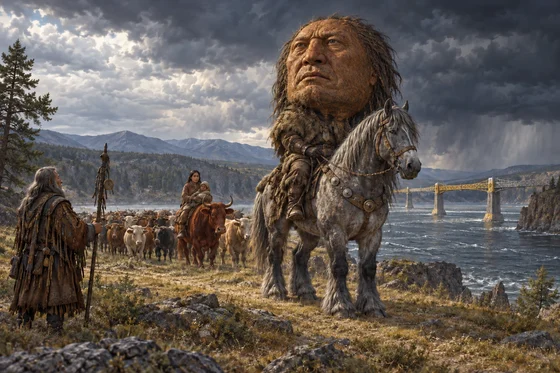
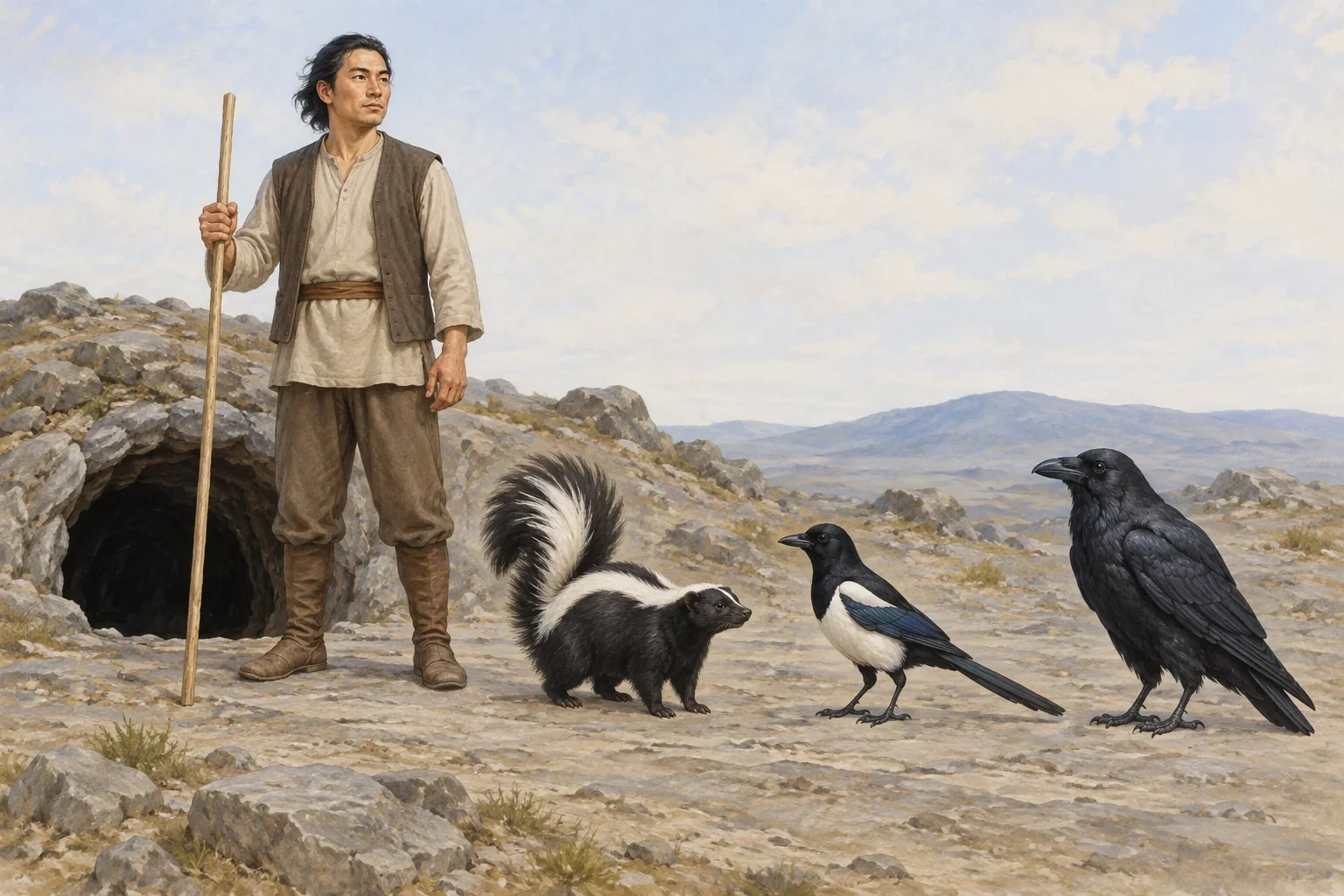
AI illustration of Altun’s escape, with sequential animal forms arranged symbolically. Clothing, cane design and setting are imagined; this is not historical or ethnographic evidence.
Overview
In the first of Curtin’s two Buruldai Bogdo tales, an elderly childless khan mourns a wonderful colt because he has no heir to ride it. At a gathering of seven lamas, the youngest announces that a child has already been born at home. The boy grows with extraordinary speed. When his infant sister is stolen through the smoke hole, he obtains a wise horse and arms from Red Mountain, after a petition to Esege Malan. The steed tests him before agreeing to serve him.
The youth meets three other riders, each seeking an abducted infant sister. Their trails converge at a rock covering a deep opening. A chain made by nine heavenly blacksmiths is too short to reach its bottom; the others turn back before completing the descent. The khan’s son, now named Altun, drops the remaining distance, breaks his ribs and remains helpless for nine years. A mouse’s recovery after eating an herb reveals how he can heal himself. He also restores an ailing eagle with living water.
Below ground he finds the four sisters with a hundred-headed Mangathai. His sister initially warns him against fighting and says she is happy there; the story does not present her as immediately demanding rescue. Altun reverses the effects of living and poisonous water and eventually kills the captor. He sends the women and possessions upward first, but the other riders cut his chain. The grateful eagle heals him, yet an attempted flight fails when Altun feeds it his own flesh. Reciprocity helps him without providing an effortless escape.
An old couple reward Altun for dividing their silver fairly. By biting a cane called dudkí in stages, he reaches the opening and takes the forms of a skunk, magpie and raven before regaining his human body above ground. He heals his wounded horse and later uses the cane to turn the three betrayers into a fox, skunk and magpie. The ending reunites him with his family and marries him to the other sisters. This entry follows No.I only; No.II is a separate version under the same Buruldai identity and is not blended into its sequence.
Origins & earliest records
Historical English collection of Buryat narratives
Records & interpretation
Complete retained historical English primary collection; XII, Buruldai Bogdo No.I, pp.186–195; No.II pp.196–200 excluded from selected sequence
Selected bibliography
Documented works and useful reading. This is not a list of every appearance.
- 01
A Journey in Southern Siberia: The Mongols, Their Religion and Their Myths
XII, Buruldai Bogdo No.I, pp.186–195; No.II pp.196–200 excluded from selected sequence
Family & connections
A source-supported family tree or inspiration record has not yet been compiled for this profile. Related reading below indicates a connection in subject matter, not a proven lineage or creative influence.
References
Sources supporting this profile. Linked pages have their own scope and editorial standards.
- Complete retained historical English primary collectionCurtin1909 — XII, Buruldai Bogdo No.I, pp.186–195; No.II pp.196–200 excluded from selected sequence
Image credits
AI narrative interpretationAltun, son of Buruldai Bogdo
AI illustration of Altun’s escape, with sequential animal forms arranged symbolically. Clothing, cane design and setting are imagined; this is not historical or ethnographic evidence.