A sourced illustration has not yet been added. This gap is included in the coverage record.
Overview
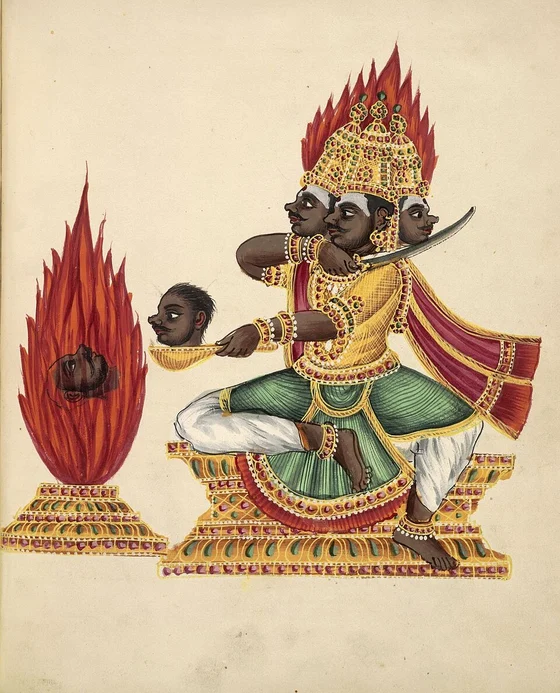
In this particular story, a miserly landlord’s refusal to treat his tenants generously leaves his fields uncultivated and his irrigation works dry. A visiting ascetic teaches him an invocation through which he obtains a Brahmarâkshas, the spelling used in the chapter heading. The being appears as a huge, terrifying figure with a formidable voice, but politely agrees to serve the man who has summoned him. His condition is that one task must immediately follow another: if his employer has no more work, he will kill him. The tale later makes the threatened fate more explicit as being eaten.
The landlord first orders him to deepen and repair an enormous tank, expecting months or years of work. The demon completes it within the day. He then ploughs the fields of twenty villages in two ghaṭikās and prepares all the garden land almost instantly. Desperate for another task, the landlord accepts his wife’s intervention. She plucks a long hair from her own head and orders the servant to straighten it. Sitting in a pīpal tree, he repeatedly rolls it against his thigh, but it keeps bending. Remembering that goldsmiths heat metal wire, he puts the hair over a fire and destroys it. Afraid to face the woman without her hair, he runs away.
The collector connects this ending with the practice of nailing hair to a tree believed to house devils. That is an attributed explanation in the 1890 collection, not a verified account of present practice or advice for a ritual. The demon is neither slain nor formally released, and the narrative supplies no earlier human life, genealogy or caste history for him. The broader Rakshasa name is a related category; this source does not establish a parent–child relationship or make the servant’s behaviour universal.
Origins & earliest records
Southern Indian narratives in Kingscote and Natesa Sastri’s English collection
Records & interpretation
Complete English chapter, attached notes, edition title and collection preface read.
Selected bibliography
Documented works and useful reading. This is not a list of every appearance.
- 01
Tales of the Sun; or, Folklore of Southern India
XXVI, The Brahmarâkshas and the Hair, pp.285–289. London: W. H. Allen & Co.; English transcription page markers, not independent print-scan collation.
Family & connections
A source-supported family tree or inspiration record has not yet been compiled for this profile. Related reading below indicates a connection in subject matter, not a proven lineage or creative influence.
Primary records and illustrations
Tales of the Sun; or, Folklore of Southern India
Kingscote and Natesa Sastri; London: W. H. Allen & Co.,1890. XXVI, The Brahmarâkshas and the Hair, pp.285–289
Cache kingscote-sastri-26.txt; title/preface/introduction checked. Brahmarâkshas exact source spelling. No former-human origin in this witness. Transcription has anomalous phrase “When enemies were approaching”; no clock time inferred from it. Master himself says tank work done within one day. Related Rakshasa is not genealogy.
References
Sources supporting this profile. Linked pages have their own scope and editorial standards.
- Historical collected narrative and editorial comparisonTales of the Sun; or, Folklore of Southern India — XXVI, The Brahmarâkshas and the Hair, pp.285–289Research access: 2026-10-05
Image credits
A sourced illustration has not yet been added. This gap is included in the coverage record.