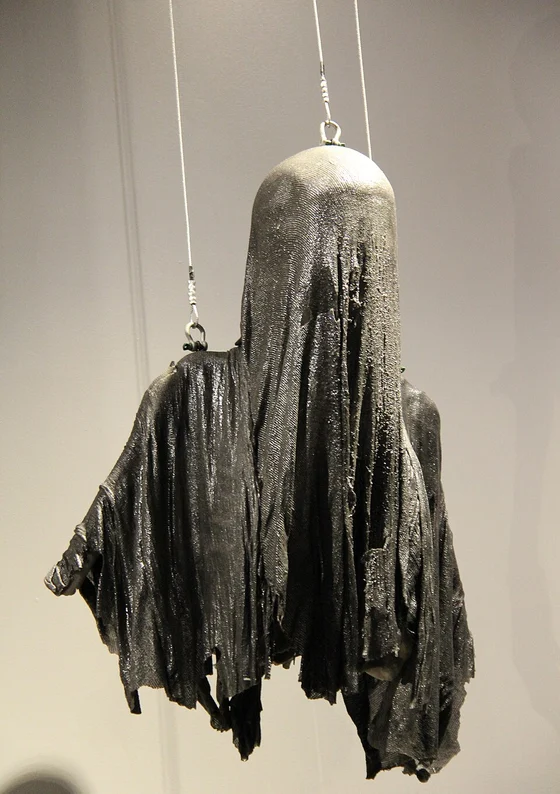
A sourced illustration has not yet been added. This gap is included in the coverage record.
Overview
Boggarts take the form of what most frightens a nearby observer, making identification depend on an encounter rather than a stable visible anatomy. No unobserved natural body is established in Rowling's account. A cupboard or other hiding place can rattle or scratch before the creature is seen, and confined spaces are favoured without being its only possible habitat. The author's supplementary description places Boggarts among non-beings: they have never been alive in the ordinary sense, and seem associated with human emotion. The phrasing leaves the proposed emotional generation as an account within the setting, rather than supplying a detailed reproductive mechanism. Their resemblance to an animal, person or apparition is therefore an adopted fear-form, not evidence that all those things belong to one biological species.
Prisoner of Azkaban makes the Boggart a classroom problem under Lupin, where pupils learn to turn a personal fear into something laughable. Neville's intimidating Snape becomes ridiculous in his grandmother's clothes; the response reveals Neville's experience as much as the creature's own nature. The spell Riddikulus and the caster's comic intention work together, with laughter completing the defeat. Later encounters can expose fears much more private than a classroom example, as with Mrs Weasley's imagined dead relatives in Order of the Phoenix. A comparison of those scenes shows why the monster is useful for characterization: it externalizes an observer's anxiety without establishing the feared event as true. Rowling's essay broadens this beyond students and records Muggle encounters, while allowing further Boggarts to arise after one disappears. This is distinct from the domestic nuisance or shape-changing spirit found in other uses of the traditional name.
First appearances & development
The selected publication context is 1999 novel and supplementary author. Harry Potter and the Prisoner of Azkaban supplies the first named treatment in this entry's comparison, while Harry Potter and the Order of the Phoenix supplies a distinct narrative or reference context. This is a selective bibliography, not a claim that the first work listed is always the creature's earliest appearance anywhere in the franchise.
Canon & continuity
The official material linked here supports the creature's identification and the particular traits described. The named works distinguish a general bestiary account from individual encounters and later implementations. No full audit of every illustrated edition, adaptation or licensed game is claimed; statements about a particular character remain attached to that character's story rather than generalized to all members.
Selected bibliography
Documented works and useful reading. This is not a list of every appearance.
- 01
Harry Potter and the Prisoner of Azkaban
Lupin's lesson introduces fear-forms, comic transformations and the counterspell.
- 02
Harry Potter and the Order of the Phoenix
Mrs Weasley's encounter presents feared deaths, rather than actual events.
- 03
Boggart
Author's supplementary account of non-beings, hiding behaviour and renewed appearances.
Family & connections
A source-supported family tree or inspiration record has not yet been compiled for this profile. Related reading below indicates a connection in subject matter, not a proven lineage or creative influence.
References
Sources supporting this profile. Linked pages have their own scope and editorial standards.
- OfficialBoggart (Harry Potter) — official franchise guideResearch access: 2026-10-05
- Primary workBoggart — J. K. Rowling original writingResearch access: 2026-10-05
Image credits
A sourced illustration has not yet been added. This gap is included in the coverage record.